Brian Martin

A small world: Shibboleth, by Thomas Peermohamed Lambert, reviewed

From our UK edition

Two shibboleths are treated in Thomas Peermohamed Lambert’s audacious debut novel. The first is the University of Oxford; the second is the Israeli-Palestinian controversy. ‘It is the great issue, isn’t it? The great shibboleth.’ Edward, the protagonist, is a state-educated undergraduate whose connection to Islam is a Muslim grandfather from Zanzibar. He finds himself in

Learning difficulties: The University of Bliss, by Julian Stannard, reviewed

From our UK edition

You have been warned. First, David Butterfield has excoriated Cambridge University in these pages, leaving its standing devalued. Now Julian Stannard, a poet and novelist, delivers in fiction a devastating evisceration of other current universities. The University of Bliss belies its title. This is a work of high satire and Stannard vents his frustration with

A death foretold: The Voyage Home, by Pat Barker, reviewed

From our UK edition

Emily Wilson, the distinguished translator of Homer, has remarked that Pat Barker’s The Silence of the Girls about the Trojan War is a distinctly feminist book. Renowned for her first world war Regeneration trilogy, Barker has now written a powerful novel about the first part of Aeschylus’s Oresteia. She takes the infrastructure of legend and

Fools rush in: Mania, by Lionel Shriver, reviewed

From our UK edition

Pearson Converse teaches literature at Verlaine University, Pennsylvania. She exists in an alternative universe to our own in which the Mental Parity Movement holds sway.  There is intellectual levelling, and no ‘cognitive discrimination’. This is high satire, exaggerated, crude, inviting ridicule of the social system portrayed, close to the great satirists of the 18th century

Frederic Raphael settles old scores with a vengeance

From our UK edition

Last Post is a collection of reminiscences, anecdotes and a settling of old scores by Frederic Raphael in the form of imaginary letters to many of the people who have been part of his long life. You might expect a nonagenarian’s critical faculties to have ‘mellowed by the stealing hours of time’, but far from

A.N. Wilson has many regrets

From our UK edition

‘Spare thou them, O God, which confess their faults.’ A.N. Wilson seems, on the surface, to have taken to heart the wise words of the Anglican general confession. Aged 71, he looks back on his life and career and records his regrets and failures both private and professional. His major concern is the failure of

Connecticut connections: A Little Hope, by Ethan Joella, reviewed

From our UK edition

A Little Hope, Ethan Joella’s debut novel, is about the lives of a dozen or so ordinary people who live in smalltown East Coast America. By helicopter over Connecticut ‘you wouldn’t notice Wharton right away’. Yet the problems its inhabitants face are universal. There is the seemingly American Dream family – Greg, Freddie, Addie the

A visit from Neanderthals: The Red Children, by Maggie Gee, reviewed

From our UK edition

This is the kind of novel that will be discussed jubilantly in the book clubs of places like Lib Dem north Oxford. It is a social polemic disguised as fiction. Maggie Gee’s concerns are topical: migration, global warming, ‘the virus’, colour prejudice and first nations. The Red Children will be selective in its appeal. Strange

In search of Great-Aunt Pearl’s will: a black comedy of familial strife

From our UK edition

Lendal Press has found a brilliant novelist in Matt Cook: funny, shrewd, satirical, disturbingly and entertainingly analytical in his psychology of character. This debut novel is narrated by a precocious 14-year-old, Benjamin Carter, whose family on his father’s side is having a collective nervous breakdown. Great-Aunt Pearl has died; her derelict house, ‘a riot of

On the cowboy’s trail: Powder Smoke, by Andrew Martin, reviewed

From our UK edition

Detective Inspector Jim Stringer is back. This is a York novel, or rather a Yorkshire crime novel. The LNER railway policeman investigates a supposed double murder, tracing a young fairground sharpshooter, Kid Durrant, through the Yorkshire countryside. The action takes place over five days in early December 1925, but is interspersed with flashbacks to the

Appearances are deceptive: Trio, by William Boyd, reviewed

From our UK edition

Talbot Kydd, film producer; Anny Viklund, American actress; Elfrida Wing, novelist; these make the trio of the title. Private lives are the issue. Wing’s long-suffering agent tells her if you want to know what’s going on in people’s heads, ‘behind those masks we all wear — then read a novel’. The main setting of Trio

A Wiltshire mystery: A Saint in Swindon, by Alice Jolly, reviewed

From our UK edition

This novella is suited to our fevered times. Scheduled to coincide with the Swindon spring festival of literature, now cancelled, it reflects the way we are now living. Inspired by the collective imagination of a Swindon book group, Alice Jolly has written a prophetic story. The narrator is Janey, married to the older Phil and

Cuckoo in the nest?

From our UK edition

You might think The Carer rather an unpromising title, but Deborah Moggach’s book delivers a wickedly witty entertainment. Towards the end, she describes the setting where a crucial event takes place — ‘somewhere as humdrum as a caravan park, toilet block, clock golf, Tupperware’. So very good at describing the ordinary, she transforms it into

Cat and the King

From our UK edition

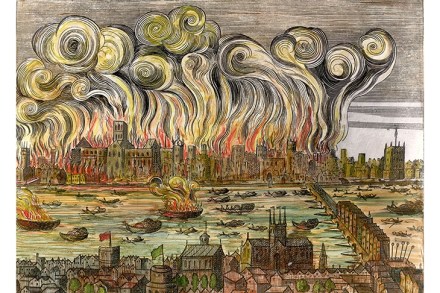
The scene is London in 1667, the city recovering from the Great Fire the year before, with 80,000 people homeless and refugee camps established on the outskirts. Andrew Taylor introduces his readers to life as it survived there and involves them in the politics of Charles II’s court. Cobblestones are ‘slick with rain’, rushlights smell

Eros and Agape

From our UK edition

‘I still think he was a bastard.’ This is the opinion that Julia, daughter of the novelist Arthur, has about Peter Abelard. In Melvyn Bragg’s narrative, Arthur is finishing his novel about Abelard and Heloise, living in Paris, separated from his wife, and visited by Julia. She gives a modern woman’s view of the behaviour