Andrew McQuillan

Andrew McQuillan writes about politics and unionism across the UK. He is Scottish and has lived and studied in Belfast for several years.

Can Jeffrey Donaldson halt the DUP’s civil war?

From our UK edition

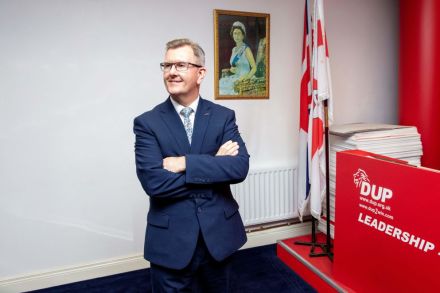
Sir Jeffrey Donaldson, the Lagan Valley MP, has triumphed in the one-horse race to replace Edwin Poots as leader of the DUP, getting the top job at the second time of asking. Nobody else came forward to instigate a leadership election, meaning that his appointment will be rubber stamped when the party's electoral college meets this Saturday. Respected at Westminster, Donaldson seems a more plausible fit for high office than the gauche Poots, though both men are remarkably similar; Donaldson, like Poots, is a committed Christian and is a prominent Orangeman. History is never far away from the politics of Northern Ireland. Donaldson’s win coincides with the centenary of the opening of the Northern Ireland parliament.

Edwin Poots’s resignation could cause a crisis in Northern Ireland

From our UK edition

The end of Edwin Poots’s 21-day spell as leader of the DUP sums up the ordeal of being a unionist leader. Elected as a hard-line replacement for Arlene Foster, he has departed now after being seen to have given too much away to Sinn Fein over the Irish language. Who will replace him? The early candidate appears to be Sir Jeffrey Donaldson, the party’s Westminster leader who was defeated by Poots in last month’s contest. His supporters are championing him as a stabilising influence in a party which has ripped itself apart, with others suggesting that he should be elected without a contest. Poots’s election was a last roll of the dice for his wing of the party, the fundamentalists who didn’t really get over the departure of Ian Paisley in 2008.

The DUP is tearing itself apart

From our UK edition

Late last night, the UK government and Sinn Fein went over the heads of the DUP and agreed on a solution to the thorny issue of Irish language legislation. The Northern Ireland Secretary Brandon Lewis promised to step in and pass the legislation if Stormont fails to do so. An ultimatum has now been given to make good on the January 2020 New Decade, New Approach deal — the agreement that promised the language laws in the first place and which was central to the return of power-sharing. In theory, this rouse would have allowed the DUP to formally nominate Paul Givan as Arlene Foster’s replacement as First Minister with republican approval, avoiding the collapse of the institutions and a snap election. In reality, however, this has caused a profound crisis.

How long will Edwin Poots’s DUP reign last?

From our UK edition

New DUP leader Edwin Poots has wasted little time consigning the Arlene Foster era to history. Poots' shake-up of his Stormont ministerial team has resulted in Foster’s loyalists being shown the door, in favour of what the Traditional Unionist Voice leader Jim Allister drily termed 'Poots’ posts'. Poots' appointment of Paul Givan, his fellow Lagan Valley MLA, as first minister of Northern Ireland, is perhaps his most controversial, though not unexpected, move. Givan, who like Poots is a creationist, is one of the more verbose figures in the DUP hinterland.

The DUP has been broken by Brexit

From our UK edition

Are we witnessing the end of the DUP as the dominant unionist party in Northern Ireland? Tumultuous events in Belfast in recent days suggest as much. The DUP gathered on Thursday night to ratify the appointment of Edwin Poots and Paula Bradley as the party’s new leader and deputy leader. A dull rubber-stamping it was not; the meeting turned into the most public display of discord and factionalism in the party’s 50-year history. Rather than listen to Poots make his acceptance speech, Jeffrey Donaldson, the MP Gavin Robinson and both Nigel and Diane Dodds stood up and left. Dissatisfaction with how Arlene Foster was treated was given as the reason for the walk-out, with some party activists also resigning from their positions.

Could Sinn Fein become the largest party in Northern Ireland?

From our UK edition

In 2022, a year after its centenary, there is the chance that Northern Ireland could end up with a nationalist, republican, Sinn Fein First Minister. The latest survey of popular opinion in the province, polled by LucidTalk, currently has Sinn Fein as the largest party on 25 per cent, nine points clear of the DUP who have slumped to 16 per cent – from around 30 per cent at the 2019 Westminster election. Meanwhile, there has been a slight upswing in the performance of the Ulster Unionists and Traditional Unionist Voice. The middle ground Alliance party are on the same level as the DUP, while the moderate SDLP appear to be a minority taste among nationalists, and are stuck on 12 per cent.

Will the DUP’s Edwin Poots win his war on the Northern Ireland protocol?

From our UK edition

What to make of the triumph of Edwin Poots, the new leader of the Democratic Unionist party, who defeated the party’s Westminster leader Jeffrey Donaldson by 19 votes to 17 in its first ever leadership election? Poots’ victory marks for some the definitive end of the party’s moderate turn instituted by Peter Robinson in 2008. Those not au fait with the intricacies of the DUP may find the suggestion of moderation risible. But Robinson – and indeed his own successor, Arlene Foster – recognised that for unionism to succeed, a more open approach was needed. While the execution of that strategy was often lacking, the intent was there.

Can the DUP survive?

From our UK edition

A 36-person strong electorate will meet in Belfast this Friday to elect Arlene Foster’s replacement as leader of the Democratic Unionist party.  The choice facing the assembled ranks of the party’s MPs and members of the legislative assembly (MLAs) is, amusingly, between two men who share the same office in Lisburn: the Lagan Valley MP Sir Jeffrey Donaldson and Edwin Poots, the Stormont agriculture minister. Such is the DUP way, the two candidates are under orders not to speak to the media or undertake any form of public-facing promotional activity for the duration of the contest. However, a document sent by Poots to his colleagues setting out his vision for the future was leaked to the Northern Irish media.

Who would want to replace Arlene Foster?

From our UK edition

Arlene Foster has announced that she will be standing down as DUP leader on the 28 May and First Minister of Northern Ireland at the end of June, bowing to the inevitable after the arithmetic suggested that 80 per cent of her Stormont and Westminster colleagues were set against her leadership continuing.  This will be welcomed by those who in recent days orchestrated manoeuvres against her; Foster staging a defiant last stand had the potential to turn the leadership election poisonous very quickly, which was the last thing the embattled party needs. Who would honestly want to replace Foster now, such is the troubling in-tray she is handing over to her successor? The challenge is two-fold in advance of 2022’s Assembly election.

It’s remarkable that Arlene Foster lasted this long

From our UK edition

Arlene Foster’s spell as leader of the Democratic Unionist party is over. Today, Foster announced that she is stepping down as party leader on 28 May, and resigning her position as First Minister by the end of June. Her resignation came after a letter, signed by three quarters of the party’s MLAs alongside some MPs, was submitted to its chair Lord Morrow calling for her departure. In what is the most dramatic case of unionist infighting since Foster herself helped destabilise David Trimble's leadership of the Ulster Unionists in the early 2000s, moves are also afoot to remove her erstwhile deputy Nigel Dodds. Several of her most senior advisers, including the party's chief executive and director of communications, are also facing the chop.

Why is nobody talking about Northern Ireland?

From our UK edition

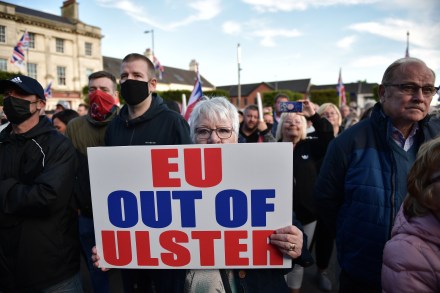
It is depressingly appropriate that a weekend which started on Good Friday was one which illustrated the shaky foundations of the agreement which brought a form of peace to Northern Ireland. Twenty three years on from that landmark deal, discontent among the Province's unionist and loyalist community is beginning to mount. Violence once again erupted on the streets of Derry last night. It was a repeat of the ugly scenes that played out over Easter weekend in Belfast’s loyalist Sandy Row area. Petrol bombs were flung and a total of 32 police officers were injured. The latest spark is mounting unhappiness among unionist pro-British groups at the Northern Ireland Protocol.