Andrew Lambirth

Curiosity unsatisfied

From our UK edition

Mari Lassnig Serpentine Gallery, until 8 June Alison Watt: Phantom National Gallery, until 29 June When I first saw the card for Maria Lassnig’s show I thought it was just another young or middle-aged artist trying it on. Then I discovered that Lassnig was born in 1919, and I wanted to know more. Had she always painted with this level of crude energy? Was her naive expressionist brushwork developed and refined over a lifetime? Unfortunately, it’s impossible to tell from her current solo show (the first of her work in Britain). Far from being anything like a retrospective survey — or indeed an introduction to an unknown artist — the work has been restricted to paintings produced in the past eight or nine years.

American beauty | 30 April 2008

From our UK edition

The American Scene The British Museum Coming of Age: American Art, 1850s to 1950s Dulwich Picture Gallery Although the potent influence of all things American has had a pernicious not to say deleterious influence on street culture and social attitudes in Britain, American art of the last century has offered a stimulus to many and certainly a yardstick to measure up against. Our art has not simply been made in the shadow of the American achievement (whatever Clement Greenberg might have wanted to think), but the extent and richness of the experimental territory covered by American painters (and to a lesser degree sculptors) between 1850 and 1950 remain a lasting inspiration.

Self styled

From our UK edition

Whitechapel at War: Isaac Rosenberg and his circle Ben Uri Gallery, 108a Boundary Road. London NW8, until 8 June It seems that Isaac Rosenberg thought of himself as a poet rather than as a painter, but that is to undervalue his distinct dual contribution as an artist. Although he exhibited little in his short lifetime, he trained at the Slade and was actually an artist–poet in the English Romantic tradition of William Blake. Remarkably, this is the first exhibition to examine his achievement solely as a painter in the context of his peers. Although there is not a great deal to see, the quality of the work assures Rosenberg’s place in the pantheon.

Sculptor of vision

From our UK edition

Nigel Hall: Sculpture + Drawing 1965–2008 Yorkshire Sculpture Park, until 8 June As you drive into the 500 acres of 18th-century parkland which provide the magnificent setting for this retrospective of Nigel Hall’s work, you are met by a tall sentinel-like sculpture, which stands near the entrance. Called ‘Crossing Vertical’ (2006), it’s a dynamic column of arcs and perforations, an excellent introduction to the prevailing interests of this artist, whose chief aim is to animate and reveal to us anew the space we inhabit and so often take for granted. This sculpture has a companion piece, ‘Crossing Horizontal’, which currently reclines in front of the main galleries further into the park.

Take your pick | 9 April 2008

From our UK edition

Robert Dukes (born 1965) is one of our finest younger artists. Now enjoying his second solo show with Browse & Darby (19 Cork Street, W1, until 2 May), this painter in the great tradition of European realist art proves that he can deliver the goods while continuing to break new ground. The chief joy of his exhibition is the lucid and succinct colour. Just look at the run of still-life paintings down the right-hand wall of the gallery as you enter. In front of you is the delicious ‘Pink Rose’, sensual and particular, and then comes a whole cornucopia of individually painted fruit.

Crowded out

From our UK edition

Cranach Royal Academy, until 8 June Friend of Martin Luther, and court painter to the Elector of Saxony (who was Luther’s protector), Lucas Cranach the Elder (c.1472–1553) has been called the leading artist of the Reformation. He produced many devotional images and religious scenes yet to us Cranach is known for other subjects — palely loitering nudes and strongly naturalistic portraits on fresh green backgrounds. Braving the queues at the Academy, I was pleasantly surprised to discover an exhibition filled with colour, mostly in the richly decorative religious works. We haven’t seen much Cranach in this country, though our public collections have a few choice examples of his work.

Natural beauty

From our UK edition

Amazing Rare Things The Queen’s Gallery, Buckingham Palace, until 28 September Do not be put off by the title of this show: in its barrow-boy eagerness to pull in the punters, such a naff title undermines the essential dignity of the exhibits (Leonardo is here, after all), and discounts the high quality of art on display. The Queen’s Gallery does not need to be so determinedly populist in approach, though I can understand that marketing people would not consider the exhibition’s theme — ‘The Art of Natural History in the Age of Discovery’ — to be sufficiently sexy. So we are lumbered with this teen-dream title. Ignore it, for your own good. There really are marvels to be seen.

Canter through Dada

From our UK edition

Duchamp, Man Ray, Picarbia Tate Modern, until 26 May Juan Muñoz Tate Modern, until 27 April  The recent Tate habit of serving up in threes major figures from art history is not to be encouraged. It almost worked in 2005 with Turner Whistler Monet, but as the old saying goes, ‘two’s company but three’s a crowd’, and one of the artists usually suffers. In the Degas, Sickert and Toulouse-Lautrec show (2005–6), it was Lautrec who suffered. In the current offering, it is Picabia, the least familiar of the three and the one needing most introduction to the public, thus warranting a better showing than he gets here, having to compete with his heavyweight mates.

Face value

From our UK edition

Pompeo Batoni 1708–1787 National Gallery, until 18 May The first impression offered by the Batoni exhibition in the Sainsbury Wing is one of dullness. I tend to do a quick reconnaissance of any show before starting the serious work of looking in detail, in order to gauge its range and extent, and my initial response was not optimistic. Why Batoni? was an early and abiding thought. I had already mentioned to an acquaintance on the way in that I had never before seen a Batoni exhibition, and a passer-by overhearing this, who happened to be leaving the gallery, remarked direly, ‘You’ll see why you’ve never seen one when you get in there.’ It was not perhaps the most auspicious of introductions.

Velvet revolutionaries

From our UK edition

Modern Painters: the Camden Town Group Tate Britain, until 5 May The Millbank branch of the Tate empire is currently blessed with two major loan exhibitions of painting, and if you find the Peter Doig retrospective a bit too thin for your taste, the thick dry crusty surfaces of the Camden Town Group’s pictures may be just the thing. A distinctly short-lived school of painting, it was effective for just a couple of years, from its founding by Sickert in 1911 to its dissolution at the end of 1913. Its influence perhaps extended a little beyond those strict limits, and it has become popular as a descriptive term or category for a particular kind of painting.

Art for the masses

From our UK edition

Alexander Rodchenko: Revolution in Photography Hayward Gallery, until 27 April There’s a whole separate exhibition in the downstairs galleries of the Hayward. It’s called Laughing in a Foreign Language and is supposed to explore the role of laughter and humour in contemporary art through the work of 30 so-called international artists. As an exhibition, it’s a total failure. It’s not just that humour doesn’t easily translate, even in this ghastly era of globalisation, when we seem to want to reduce everyone to the same set of responses and desires. It’s also that so many of the exhibits are striving to be knowing and clever. Laughter is a sacred gift, the most wonderful release and celebration, and it’s always evident when it’s forced.

Is he worth it?

From our UK edition

Peter Doig has aroused much passion in recent months for the prices his paintings have started to fetch in the world’s salerooms. For many, he is not only the acceptable face of contemporary British painting, but also a buoyant export and bright international star. Even those who dislike painting and prefer less demanding forms of art such as installation and photography are prepared to make an exception for Doig, perhaps because he is easy on the eye. Ten years ago he enjoyed a fairly prestigious show at the Whitechapel, now he’s been given the main galleries at the Tate’s Millbank branch. The Whitechapel show left me unconvinced of his virtues though I remember liking one or two of the smaller pictures. Now we have the chance to see what all the fuss is about.

Back to nature

From our UK edition

By Leafy Ways: Early Work by Ivor Abrahams Against Nature: The hybrid forms of modern sculpture Henry Moore Institute, Leeds, until 4 May The Henry Moore Institute is one of our foremost sculptural venues, a focus for study and scholarship, equipped with an impressive library and archive specialising in British sculpture. Opened in 1993 on The Headrow in the centre of Leeds, it is devoted to telling the story of sculpture in Britain, while also taking into account the context of continental modernism. It regularly mounts small, intense and often provocative (in the sense of intellectually challenging) exhibitions.

Be selective

From our UK edition

From Russia: French and Russian Master Paintings 1870-1925 from Moscow and St Petersburg Royal Academy, until 18 April Sponsored by E.ON It is a salutary and instructive experience to forego the relatively civilised Press View of an exhibition, when only the denizens of the world’s press and assorted successful liggers are allowed in, and attempt to review a show amid the hurly-burly of an average open-to-the-public day. Especially when the exhibition has been talked up to the skies and punters are queuing to get in. Column inches had helped to create the unsatisfactory and uncomfortable viewing conditions in which I found myself last week, and here I am adding to them. While commending the contemporary appetite for culture, I do wish there were fewer people in the world.

Italian treats

From our UK edition

A Decade of Discovery Esoterick Collection, 39a Canonbury Square, London, N1, until 6 April This year, as the Estorick Collection of Modern Italian Art celebrates its tenth anniversary, garlanded with plaudits for the loan exhibitions it has mounted, it is time to focus once again on its greatest asset: its permanent collection. This new display, occupying all six galleries, shows the collection to fine advantage, enabling a group of works by Massimo Campigli to be viewed for the first time, along with a couple of new acquisitions, and further enhanced by works loaned from British and Italian collections, mostly private individuals whose generosity must be applauded. The exhibition starts on the ground floor with a room of the Estorick’s big names — the Futurists.

Generosity of spirit

From our UK edition

Rose Hilton: A Selected Retrospective Tate St Ives, until 11 May Rose Hilton was born Rosemary Phipps in the Kentish village of Leigh, near Tonbridge, in 1931. She grew up the dutiful daughter of parents who were strict Plymouth Brethren, but early on she showed distinct signs of artistic talent. Her parents considered that this might equip her as an art teacher, but Rose had higher ambitions: she determined to be a painter. Force of character combined with innate skills took her from Beckenham Art School to the Royal College of Art in London, where she won prizes and was praised by her tutor Carel Weight for her sense of colour.

Casting a spell

From our UK edition

The Age of Enchantment: Beardsley, Dulac and their Contemporaries 1890–1930 Dulwich Picture Gallery, until 17 February The Age of Enchantment: Beardsley, Dulac and their Contemporaries 1890–1930 Dulwich Picture Gallery, until 17 February Taste is strictly divided over the enchanted visions currently on view at Dulwich. It seems that people are rarely indifferent to this kind of imagery; it either delights or revolts. I must admit that I went more in the spirit of inquiry than enthusiasm. I found a densely hung exhibition — it’s the kind of show you really ought to have a lorgnette for — which makes a surprisingly wide appeal, for the work on view is more varied than I’d anticipated.

Beguiled by a master

From our UK edition

Hidden Burne-Jones Leighton House Museum, 12 Holland Park Road, London W14, until 27 January It’s always a pleasure to visit Lord Leighton’s house and imagine oneself in a more spacious era, venturing into the artists’ quarter of Kensington and paying a call on one of the most popular artists of the Victorian period. The remarkable architecture of the house with its famous Arab Hall always deserves another look, though the exhibitions mounted in the upstairs gallery are becoming an increasing draw for the art public. Last year it was Leighton’s drawings, now brilliantly followed up by a show of little-known Burne-Jones drawings from Birmingham Museum and Art Gallery.

Take another look at Millais

From our UK edition

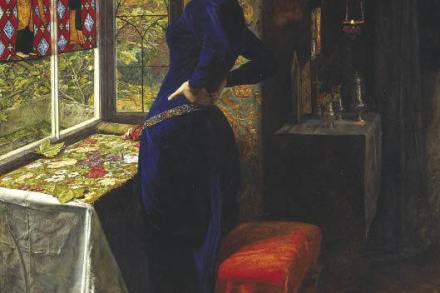
Andrew Lambirth urges those who think they don’t like this artist to go and see this show Last chance to see this large and lavish retrospective of the most famous of the Pre-Raphaelite Brotherhood, Millais (Tate Britain, until 13 January). The Tate confidently asserts that John Everett Millais (1829–96) was the ‘greatest’ of the association which initially consisted of Holman Hunt, Dante Gabriel Rossetti and himself, with a handful of fellow-travellers. Later Burne-Jones and William Morris formed a second-generation PRB, and there were other useful associates like Ford Madox Brown, William Dyce, Arthur Hughes and John Brett. To call Millais the ‘greatest’ is to oversimplify matters.

A look ahead to 2008

From our UK edition

At the National Gallery the year starts with a show of Pompeo Batoni’s stylish portraits of 18th-century Grand Tourists in Italy (20 February to 18 May). The painter Alison Watt (born Greenock, 1965) has now completed her two-year stint as the NG’s seventh Associate Artist and will be showing the fruits of her labours in the Sunley Room (13 March to 22 June). Watch out for the endless fascinations of drapery. The summer slot is filled by Radical Light: Italy’s Divisionist Painters 1891–1910 (18 June to 7 September), which traces the development of Italian pointillism into the excesses of Futurism.