Zoom

Dear Mary: How can I wind up a Zoom call with a chatty friend?

From our UK edition

Q. Is there a tactful way to wind up a Zoom call when one of you has more time on their hands than the other? A friend, living alone in London, Zooms me on a regular basis. He is immensely good value — and as a successful stage actor is clearly missing the audience he would have were it not for lockdown. Much as I would love to be entertained by him for lengthy periods, I need to get things done while the children are at school. How can I halt his flow without wounding his ego? — M.N., Tetbury, Glos A. With a small amount of preparation you can enjoy this actor’s company without fretting about your chores. Answer the Zoom call while already at an ironing board. Ask if he minds if you start wading through a pile of laundry while you are chatting.

Jeffrey Toobin’s Zoom horror show

It's been a bad couple of years for Jeffreys... Veteran New Yorker reporter Jeffrey Toobin has been suspended from the magazine after he 'exposed himself during a Zoom call last week', according to VICE. Toobin, who also serves as a CNN legal analyst, must have been reaching for the tissues as he described the incident as an 'embarrassingly stupid mistake' and offered an apology to his 'wife, family, friends and co-workers' in a statement. Cockburn is perhaps most surprised that Toobin is the first significant figure to be caught out during a video-conference, seven months into the COVID pandemic. What took us? Naturally, Twitter users have been having a field day with the story: https://twitter.com/rysimmons/status/1318266346610765829 https://twitter.

jeffrey toobin

The case for road rationing

From our UK edition

Here’s the quandary. How in future can we make the kind of rapid advances we have made during the Covid crisis without waiting for a lethal pandemic — or worse — to force our hand? We have, after all, made exceptional non-medical discoveries in the past few months. By being forced to adapt simultaneously, we have discovered better forms of collective behaviour which might never have emerged independently. I was an early convert to video-conferencing, yet even I was astounded at the extent to which the world can function remotely.

Bob Geldof is an unconventional Zoom host

From our UK edition

Gstaad I experienced my first Zoom conference last week, and didn’t think much of it. As the great Yogi Berra once remarked, ‘You can observe a lot by just watching,’ but in my case I observed very little and heard quite a lot. I suppose that one day every meeting will be conducted Zoom-style, but I bet my bottom dollar they’ll never be as preposterous as the annual Pugs Club get-together. As everyone knows, Pugs is the world’s most exclusive club, by a long shot. It once had 21 members, but we lost Christopher Lee, and then our president, Nick Scott, and our commodore, Tim Hoare. Pugs has neither a purpose nor a motto, and was dreamed up by Scott as he recuperated from a massive hangover on my boat off a Greek island 15 years ago.

Andrew Marr: Scotland is slipping away from the Union

From our UK edition

Staying in Britain for the summer has been, in many ways, entirely glorious. We have zigzagged from Shropshire through Derbyshire to the Northumberland coast, from Fife and Perthshire to Herefordshire and Devon. On the way, beautiful little towns and sweeping coastlines, not empty but not crammed either; excellent local food and plenty to keep us interested, from echoing cathedrals to buzzing bookshops. But it has also allowed me to see first hand just how desolate so many high streets are: not only the shops closed because of plague, but those shuttered, clearly from a long time back. Boarded up doors, bleached posters… If it wasn’t so wet, the tumbleweed would be blowing.

Zoom falling: has the video-call novelty worn off?

From our UK edition

A takeover battle for BT would bring much-needed excitement to the City — as well as a major political row. The privatised telecoms giant that rarely pleases its customers and regulators has seen its shares fall by four-fifths since late 2015. While many other tech-related stocks have rebounded, BT’s price is still down where it was when the market plunged in February — lockdown having interfered with BT Openreach’s broadband installation programme, slashed new orders from business customers and even knocked out the fixtures that might have been shown on BT Sport’s television channels. On top of all that, there’s a gaping hole in the pension fund.

Edinburgh Festival is in ruins – but there’s one gem amid the rubble

From our UK edition

The virus has broken Edinburgh. The shattered remnants of the festival are visible on the internet. Here’s what happened. The international festival has been reduced to one filmed theatre commission and a handful of videoed musical offerings. The Fringe has survived but in a horribly mutilated form. Two of its most prestigious brands, the Pleasance and the Assembly Rooms (which host hundreds of shows between them every year), have pulled out entirely. They’re so well established that they’ll have no difficulty restarting in 12 months’ time. Another big name, the Gilded Balloon, is offering a few online shows and some recorded highlights from previous years.

Will Hancock’s ‘Zoom medicine’ take off?

From our UK edition

It's not unusual that the left and right hands of government don't know what the other is doing: despite being based in the same postcode, different departments are notoriously bad at communicating. They even stop speaking to one another occasionally, with secretaries of state blocking new policies at what is known as the 'write-round' stage of policy development. This is where ministers consult colleagues across government on a policy, which others can then block. Sometimes departments have such a strong objection to a policy in another ministry that they refuse to sign off anything else through write-rounds until this plan is dropped.

From riveting Hitchockian melodrama to bigoted drivel: BBC’s Unprecedented reviewed

From our UK edition

Back to the West End at last. After a four- month lay-off, I grabbed the first available chance to catch a show in central London. I joined 20 enthusiasts at the ‘West End Musical — Silent Disco Walking Tour’, which convened outside a Fitzrovia pub. We were given a pink bracelet and a set of headphones that pumped musical hits into our ears. Our cheerleader, Sean, introduced us to his helpers, Tiny Tom and Sticky Vicky, who taught us a quick dance move. It transpired that we were the performers as well as the audience. We set off across the West End like a military convoy of unemployed choristers. At Old Compton Street we belted out ‘A Spoonful of Sugar’ from Mary Poppins.

Why our greatest inventors are supreme hucksters

From our UK edition

People often tell me I have a strange way of looking at the world. Obviously, it doesn’t seem strange to me. But I do tend to see the world backwards. For instance, most people think the principal obstacles to economic and technological growth are all about supply. To me, it’s all in the demand. I have met one Italian economist, Mario Fabbri, who agrees. But apart from him, me and maybe Matt Ridley, there’s nobody else. Now, how crazy is this idea? What if the biggest constraint to progress really is a question of psychology, not economics? Certainly, if it is true, it should not surprise us that economists and policy--makers are reluctant to believe it. The knowledge and influence they possess would be instantly devalued.

James Graham’s small new drama is exquisite: BBC Four’s Unprecedented reviewed

From our UK edition

Let’s face it. Theatre via the internet is barely theatre. It takes a huge amount of creativity and inventiveness to make anything remotely like a theatrical drama in the digital sphere. The BBC’s Culture in Quarantine team have invited some talented writers and actors to try and crack it. Unprecedented begins with ‘Viral’, by James Graham, in which three 18-year-old lads enjoy a Zoom chat from their bedrooms. The craftsmanship in this small script is exquisite. The characters are united by a common purpose — creating a globally popular video clip — while each has to grapple with a personal crisis. One has a dying granny, one is coming to terms with his bisexuality, the third has a crush on his mate’s sister.

In Los Angeles, school’s out…forever?

Americans have mixed feelings about opening schools this fall. Some — like the Trump administration’s Department of Education — want schools to reopen, withholding federal dollars from those that remain closed. However, the majority of Americans see opening schools as a health risk to their children.After two-thirds of teachers opposed the reopening of schools, the Los Angeles School District will not be returning to in-person classes this fall. However, United Teachers Los Angeles, the main teachers' union in the city, seemingly wants to suspend the return of quality instruction indefinitely. UTLA — composed of 35,000 teachers — released a list of policy demands that must be met before schools reopen.

school

Will Zooming replace real-life socialising?

From our UK edition

‘Are you seriously telling me you would rather meet up on Zoom than in reality?’ I asked a friend as we got stuck into an argument about the future of our existence. ‘Well, it’s all we’ve got,’ he argued. No, it really isn’t. But how to explain to people who refuse to stop being locked down that lockdown is, to all intents and purposes, over? I get the distinct impression that a lot of people have so thoroughly enjoyed sitting on their backsides doing nothing — sorry, I mean finding themselves and getting in touch with their inner child and being close to nature — that they don’t want it to end, ever.

The big debate: is lockdown wrong?

Is lockdown a gargantuan mistake? That's the view of a growing number of thinkers and critics, including The Spectator’s very own Toby Young, who sees the political class's shutting down of entire populations as the most catastrophic policy error in history. Not every free thinker agrees, however. We asked Matt Labash, a contributing editor and a skeptic of lockdown skepticism, to challenge Toby over email. Matt Labash: Toby, thanks for stepping into the squared circle and joining me for a Pandemania tussle as a gentleman pugilist, sage, and co-equal partner in the search for truth. And also, as a fellow amateur epidemiologist, which there is no longer any shame in saying, since the pros have bunged things up so spectacularly.

civilization costs debate

How to go clubbing without leaving your living room

From our UK edition

To my surprise, what I miss most about life before the lockdown are parties. As others pine for restaurants and theatres, I am longing for sticky floors and 4 a.m. Ubers. Give me plastic cups and music so loud you feel it in your kidneys. Sylvia Plath wrote disparagingly of the ‘shrill tinsel gaiety of parties with no purpose’. It’s precisely that shrillness and pointlessness that I’m yearning for: drunk young bodies cramming together for no reason other than to be close to one another. At the weekend, my longing finally spilled over and I decided to make do online. I put on a nice top and loaded my lashes with mascara.

How Tom Stoppard foretold what we’re living through

From our UK edition

A TV play by Tom Stoppard, A Separate Peace, was broadcast live on Zoom last Saturday. I watched as my screen divided itself into four cubes in which appeared the actors, performing from home. The play was written in 1964 and it’s well suited to the split-split screen format because no physical contact occurs between the characters. Director Sam Yates added some rudimentary music and a bit of wobbly background scenery. Mr Brown (David Morrissey) is a mysterious Englishman who asks to be admitted to a private hospital in the middle of the night. Though he has no symptoms he’s given a bed, and he pays his bills in cash. ‘There’s nothing wrong with you,’ complain the medics. ‘That’s why I’m here,’ he says.

Forget Zoom college: it’s time for America’s youth to embrace entrepreneurship

In the fall, thousands of college campuses across the country could be set to move online. Students will find themselves paying amounts in excess of $40,000 a year for glorified Zoom sessions. Even more young professionals will be considering grad school as a way to ride out the biggest recession we’ve seen in a generation. It will be grad school with all the cost and hardly any of the networking benefits. But there’s another option: we can build. We can use the crisis and the move online as a reason to take risks, risks that once seemed crazy or impractical are suddenly worthwhile. Whether it’s making leaps in genetic engineering or learning how to practically homestead, building is acceptable again.

zoom class

Heads in the cloud

‘Nothing will ever be the same again.’ You hear a lot of that glibly categorical punditry around the COVID-19 outbreak. Already, the progress of a mindless virus through the human population is being touted as the herald of the reorganization of the world’s economic system and the end of neoliberalism, the harbinger of a world in which nurses and shelf-stackers are valued more highly than investment bankers. Well, we’ll see. There are, as has been often said, two great things of which we can always be certain: death and taxes. The former is currently enjoying a bit of a moment. But the latter, sooner or later, is going to make the sort of roaring comeback not seen since First Blood Part II.

connected lockdown heads covid-19

I hate joggers more than ever

From our UK edition

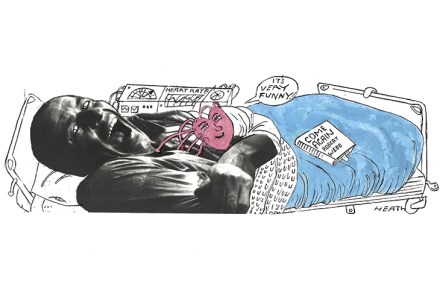
Empathy and kindness in these difficult times come more easily to some than others, but I’m trying. I had heart surgery in November to repair a faulty mitral valve. Recovery has been terribly scientific. On my daily walk, a heart monitor is synched with an app on my phone so through earphones I can hear my heart rate as well as encouraging messages in a voice I find indistinguishable from the American cultural critic Bonnie Greer. Mainly, my walk is spent suppressing the inner Nazi who can’t believe the human race still refuses to be more like me. Particularly at a time when good manners and common sense are now a public health issue.

Dear Mary: How do I get out of bossy chain emails?

From our UK edition

Q. Each day while working from home, I have at least one hour-long meeting via Zoom. One of my colleagues has a dodgy internet connection and has become a terrible menace as we all politely sit through minutes of unpleasant white noise while she tries to communicate her thoughts. The meeting chair never seems to take a hard line on this; do you have any advice? — M.C., Fosbury, Wilts A. You would do well to join the Zoom meeting via a computer rather than your phone. Zoom will highlight the person who is speaking at any one time, so when the offender’s name comes up on the screen, you can turn to some ironing or an unfinished watercolour you prepared earlier.