Ww1

The Spectator at war: Compulsory service

From The Spectator, 3 October 1914: We do not suggest that the voluntary principle should be abandoned during this war. The system is being worked for all it is worth ; it is answering well, thanks to the splendid spirit of the country ; and it would be absurd to change it mid-way for another system. But we cannot help reflecting that if we had had the scheme of National Service—of compulsory training for home defence, which is a different thing from conscription—recommended so earnestly and powerfully by Lord Roberts we should not now be in the throes of painfully improvising an Army....When the war is over there will be a steady demand fur the surest, cheapest, and most beneficial method of military defence—compulsory training for the youth of the country.
The Spectator at war: The ‘butcher’s bill’

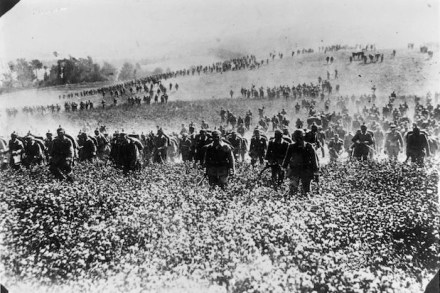
From The Spectator, 3 October 1914: There has been a good deal of speculation of late as to the total sum of German casualties. It is clear that they are very much greater than the official returns acknowledge. The best way to estimate them is by our own. These, since the beginning of the war, have been about thirty per cent of the men engaged. But the Germans have in the western theatre had at least one million two hundred thousand men in the field. It is difficult, then, to put their losses in killed, wounded, prisoners, and missing much below four hundred thousand, and they are probably heavier. To this stupendous figure must be added the losses on the Russian frontiers.

The Spectator at war: How it strikes the soldier

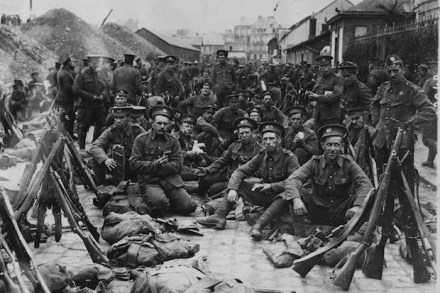
From The Spectator, 26 September 1914: One knew, of course, perfectly well that there was a very good feeling between men and officers in the British Army, and that there was a great deal of mutual respect and liking and good fellowship. What is very moving, however, is the belief that every soldier seems to have that his particular officer is the ablest, bravest, most careful, and most con- siderate man in the Army. Half the stories are prefaced by such remarks as: "You see, we had the luck to have a wonderful good officer. He knew exactly what ought to be done. We'd have followed him anywhere " —and so on.

My ghosts of Athens; a shooting and a royal wedding

Athens This grimy semi-Levantine ancient city has its beauty spots, with childhood memories indelibly attached. There is a turn-of-the-century apartment building across the street from my house where in 1942 or ’43 I watched a daughter and wife scream in horror from their balcony as three nondescript assassins executed a man as he bent over to get into his chauffeur-driven car. His name was Kalyvas and he was a minister in the Vichy-like Greek government of the time. He was bald and from my vantage point I saw the three red spots as the bullets entered his skull. His wife and daughter wore black from that day onwards. The daughter was a teenager — and a pretty blonde one at that. I was six and have never forgotten them or their screams of anguish.

The Spectator at war: Feet first

From The Spectator, 26 September 1914: There is nothing that a soldier needs more than good footwear; he can fight if need be on an empty stomach, but he cannot march on bare feet. Still, the means of supplying his needs are circumscribed. A commanding officer can make arrangements for accepting cartloads of goods at a depot; but a general in the field has to think of his transport with his supply, and though he might be grateful for the stock of a dozen drapers' shops, he has to move his troops besides clothing them, and he cannot pull unlimited quantities of flannel across a continent.

Charles III is made for numbskulls by numbskulls

Suppose Charles were to reign as a meddlesome, self-pitying, indecisive plonker. It’s a thought. It’s now a play, too, by Mike Bartlett. In his opening scene he bumps off Lilibet, bungs her in a box and assembles the family at Buck House to discuss ‘what next?’ Bartlett imagines them as stuck-up divs. William’s a self-righteous sourpuss. Kate’s a smug minx. Camilla’s a hectoring gadfly. Harry’s a weepy drunk. Charles is a colossally narcissistic nuisance. They’re too dim to understand the constitution so Camilla has to explain that a new reign commences with the death of the previous monarch and not at the coronation. (This is for the benefit of the audience, who are assumed to have the same poultry-level IQ as the Windsors.

The Spectator at war: A treat from a German private

From The Spectator, 26 September 1914: Excellent use is made of captured documents, and we are treated to excerpts from a letter by a German private which deals with the fighting capacity of the British soldier:— "With the English troops we have great difficulties. They have a queer way of causing losses to the enemy. They make good trenches, in which they wait patiently. They carefully measure the ranges for their rifle fire, and they then open a truly hellish fire on the unsuspecting cavalry. This was the reason that we had such heavy losses. . . . According to our officers, the English striking forces are exhausted. The English people never really wanted war.

The Spectator at war: Aerial warfare

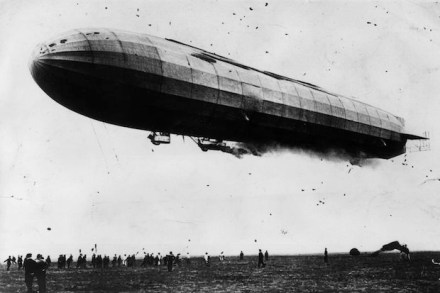
From The Spectator, 26 September 1914: The early afternoon papers of Friday publish a Reuter telegram to the effect that a Zeppelin flew over Ostend at eleven o'clock on Thursday evening, dropped three bombs, and flew away again. The damage was one office wrecked and one dog killed. If that is the bag of one Zeppelin in Ostend, what, after all, would be the bag of one hundred Zeppelins in London?

The Spectator at war: A costly experiment

From The Spectator, 26 September 1914: On Thursday the Press Bureau issued a very striking descriptive account of the situation at the front, written by "an eyewitness present with General Headquarters." It supplements the spirited narrative issued in the earlier part of the week, and shows that under pressure the War Office has discovered a very efficient military journalist among its combatant officers. "Todgers's can do it when it likes." It states that we are face to face with siege warfare, and that the Germans are in effect employing material which they had collected for the siege of Paris. The official war correspondent summarizes operations from September 18th to 20th by borrowing from the statement of a neighbouring French commander to his corps.

The Spectator at war: Letters from the front

From The Spectator, 19 September 1914: WE have no war correspondents present with the forces, to our great loss; and we are now in the quaintly topsy-turvy position of reading accounts of battles and of fighting in the letters sent home by individual officers and men—letters which might just as well have been written by the trained correspondents who have been forbidden to take the field.

The Spectator at war: Servants of the nation

From The Spectator, 19 September 1914: Friday's Times contains a letter from Lord Cromer on "Germany and Ourselves" which will give a double pleasure to thousands of readers. Its wise and vigorous terms are most useful and most timely in themselves, and they show how completely he is now restored to health :— "Let me add my firm conviction that the fear, which seems to prevail in some quarters, that, as a result of the war, the external and internal policy of this country may be guided by what is termed the military party,' is a pure delusion, and merely affords additional proof that as in the early days of the French Revolution, politicians of a certain type allow themselves to become the prey of words and formulas.

The Spectator at war: A heroic little nation

From ‘A review of the war’, The Spectator, 19 September 1914: It is the duty of all English publicists to make people here understand the splendid heroism with which the Servians have fought. They have contributed very greatly to the overthrow of Austria, and their brave Army and nation deserve all the help and encouragement that the Allies can give. We and the French very properly guaranteed a loan to Belgium. We, France, and the Russians ought to do the same by Servia, for the little nation’s finances must by this time be very nearly exhausted.

The Spectator at war: The cant of caution

From The Spectator, 19 September 1914: WHAT a nefarious little person is the captious critic! His watchword is caution, and he goes about damping down the fires of enthusiasm, only happy when be can hear some aspiring little flame fizzling out. At present he is enjoying himself hugely. All good people are registering rash vows to be of some use at a supreme crisis, and he is busy explaining to them in detail that it is of no sort of good for them to try. All their attempts, he would have them believe, are defeating themselves. They had better do nothing than what they are doing, he persuades them. Their efforts are involving a very great risk. A woman cannot so much as make a shirt for a sick soldier but he is down upon her.

The Spectator at war: A review of the war

From The Spectator, 19 September 1914: ON September 5th we wrote: "We and the French have got the wolf by one ear and the Russians have got him by the other, and though he may use his teeth with terrible effect, if we have the hardihood and patience to hold on we shall finish him in the end. And we shall have the hardihood and the patience." It was perhaps premature to write that a fortnight ago, but at the present moment it represents the situation pretty accurately. During the past week the wolf has been struggling specially hard to drag his head out of French and British jaws, but he has not yet succeeded. As we write his paws are planted firmly on the river Aisne, and he is making a desperate effort to wrench himself free.

The Spectator at war: A word to America

From The Spectator, 12 September 1914: WE desire to address a word to the American people, a word which must be spoken, though we are fully aware that it will be liable to misunderstanding and misconstruction, and is certain to be distorted by those whose business it is to exercise pressure upon American opinion in the German interest. First, in order that we may as far as possible minimize such misrepresentation, let us say quite clearly what we do not ask the American people to do. We do not ask them to come to our assistance, either directly or indirectly. The notion of trying to involve them in our wars and our difficulties is one which we have never entertained for a single moment.

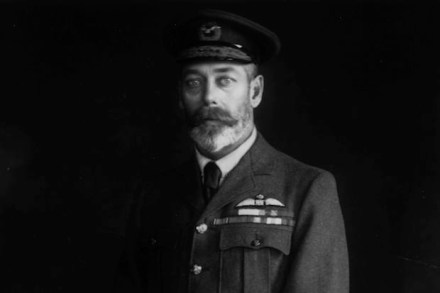
The Spectator at war: The King’s message

From The Spectator, 12 September 1914: The King's message addressed "To the Governments and Peoples of My Self-Governing Dominions," published to the world on Wednesday, is noble in its sincerity of word and thought. What could be said better or with a truer dignity than the following: ‘Had I stood aside when, in defiance of pledges to which my kingdom was a party, the soil of Belgium was violated and her cities laid desolate, when the very life of the French nation was threatened with extinction I should have sacrificed my honour and given to destruction the liberties of my Empire and of man- kind. I rejoice that every part of the Empire is with me in this decision.

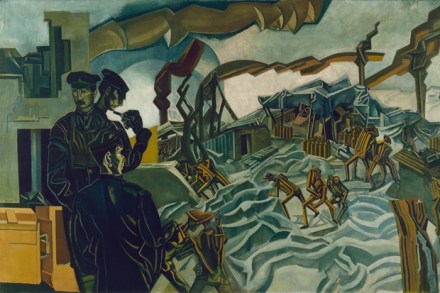
The Imperial War Museum finds a deadly place to display first world war masterpieces

The Imperial War Museum has reopened after a major refit and looks pretty dapper, even though it was overrun by hordes when I visited (it was still the school holidays). There’s a new and effective restaurant, inevitably, but also a new sense of spaciousness. I am not concerned here with weapons of mass destruction, merely with the record of the damage they inflict. They keep the art up on the third floor of the museum, and currently have a major display devoted to the first world war, which they claim is the largest of its type for nearly a century. It’s full of expected names, shown in some detail. But the ambience is wrong: there is something utterly deadly about those third-floor galleries (appropriate in a war museum, I suppose), which kills exhibitions stone-dead.

The Spectator at war: An apology to a chemist

‘An apology’, From The Spectator, 12 September 1914: WE are informed that a story told in a letter from a correspondent signing herself "A Country District Visitor," and published on August 22nd, 1914, has had an injurious effect upon Mr. C. H. Schuhmacher, Chemist, of Heswall, Cheshire. In contradiction of the statements quoted in that letter, we are now informed that Mr. Schuhmacher is a natural-born British subject of English parentage on his mother's side, and that his only son, Mr. Cyril Schuhmacher, is serving this country with the Liverpool Scottish.

It’s not easy for a middle-aged woman to get inside the head of a 12-year-old innkeeper’s son in 1914

Esther Freud wrote dazzlingly in the first person through the eyes of a five-year-old child in her first novel, Hideous Kinky (1992). What made that book so captivating was the young narrator’s sweet, naïve total acceptance of the chaotically nomadic existence her hippy mother brought her to in Morocco. The first-person voice was enchantingly concise, always noticing colours, as little girls do (‘the red and green town’), and unquestioningly stating the facts: ‘Bea and I waited at the Polio school while Mum looked for somewhere else to live.’ Freud’s latest novel, Mr Mac and Me, is also written in the first person through the eyes of a child: a 12-year-old boy in 1914 called Thomas Maggs, the only surviving son in a large and poor innkeeping family near Southwold.

The Spectator at war: Spiking the guns of German intrigue

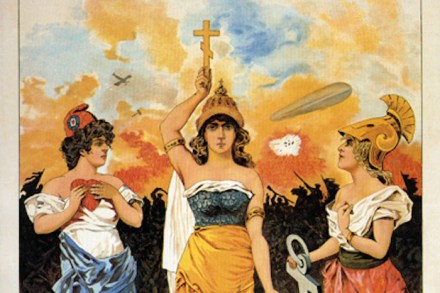
The papers of Monday published the welcome news that Britain, France, and Russia have agreed ‘not to conclude peace separately during the present war.’ Of course, it was quite unthinkable that Britain, France, or Russia should be so base as to make terms at the expense of her friends. Nevertheless, a signed pledge is an excellent thing to have, if only because it puts the matter beyond the possibility of doubt, and because it spikes the guns of German intrigue, which, if report speaks truly, had already began. It is, indeed, a pitiable situation when allies think of their own interests more than of the common cause, as William III.