Writing

The Proustian power of handwriting

From our UK edition

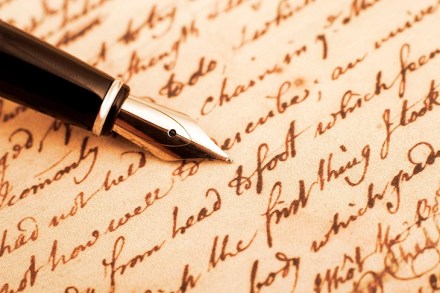
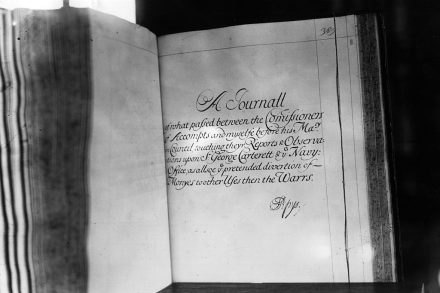
Towards the end of April, my mum sent me a letter. She doesn’t write as a rule — we speak on the phone — but this time she sent something. It’s hard to explain the effect her handwriting had on me after so many months of being apart. It was as if she was there, in envelope form, on the doormat. And because her handwriting’s been so familiar for so long, it wasn’t simply my mum as she is now, but Mum through three decades. I stood there in the gloom of the hall, vertiginous with memory, and I realised how unlikely it is that any future generation will have this same experience. I’m Generation X, the last of the analogue gang, brought up on handwriting. Our things weren’t encoded, they were imprinted: records and tapes.

The joy and suffering of writing a book

From our UK edition

Spring is coming. There was snow in the garden till last week, here in Canada, where I have been spending this strange winter. But today the sky is shining blue and the sunshine is soft and warm. I guess this is what Easter is really about. Rebirth. I have spent months without going farther than the corner food shop. Zoom winter. I have never been in the same few rooms for so long. And yet I have never been so much in touch with colleagues and friends from everywhere. I feel I have partially migrated into a semi-virtual reality. It is not too bad. It is relaxing. This week is crazy. My new book, Helgoland — about understanding quantum reality — has just been published and, because I have the best promotion person in the galaxy, I am submerged by journalists.

How I’d write Covid: The Thriller

From our UK edition

Like 98.3 per cent of humanity, I’ve spent the past 12 months reading dubiously precise statistics, staring listlessly into space for hours on end, and, most poignantly, wondering if I am an extra in a movie about a pandemic. This last intuition only worsened when I watched Contagion — the 2011 Kate Winslet/Gwyneth Paltrow pandemic movie — and it felt like I was simply watching the TV news (again), right down to the scenes of giant stadiums ominously filled with empty hospital beds. The sensation that I am living through a real-life thriller is particularly acute for me, because that’s what I do: write thrillers.

Science is not an instrument of patriarchal oppression

From our UK edition

Safe spaces, diversity quotas, gender-neutral pronouns, culturally relative facts, heteronormative hegemony. Are my right-on credentials right on enough? Am I sufficiently penitent for being white, cis and male? Will I be cancelled or de-platformed by the Pronoun Police? What is my woke-quotient? At least as far as science is concerned, it’s a satisfactory zero. Science is not a patriarchal instrument of colonial oppression. Nor is it a social construct. It’s simply true. Or at least truth is real and science is the best way we have of finding it. ‘Alternative ways of knowing’ may be consoling, they may be sincere, they may be quaint, they may have a poetic or mythic beauty, but the one thing they are not is true.

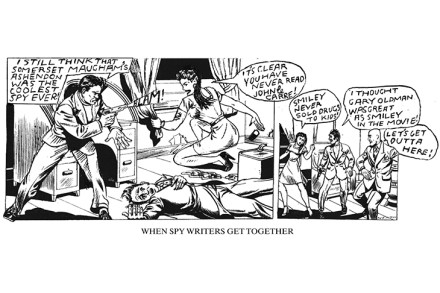
John le Carré’s wild MI6 Christmas parties

From our UK edition

In the middle of December, for reasons I’m coming to, I woke early in a posh hotel. I lay semi-dozing while my partner, Jo, was in the shower, and eventually worked out how to tune the bedside radio, an internet device, to Radio 4. The six o’clock pips sounded as a bathrobed Jo emerged, earbuds in place: on her digital radio she heard the headlines some seconds ahead of me, and as she sat on the bed, her smile faltered. What’s the matter, I asked. John le Carré’s died, she said. A heartbeat or two later, while the internet transmission caught up with the digital, the radio confirmed this. John le Carré had died. And then, after a similar timelag, the news landed somewhere inside me. John le Carré had died.

‘People confuse sadness with darkness’: the complicated world of Mary Gaitskill

From our UK edition

In the early 1990s, the American novelist Mary Gaitskill suffered an abrupt awakening. ‘I lived in New York, I didn’t have a television, I didn’t listen to the radio. I didn’t even read magazines or newspapers very often. I was really too preoccupied with my own existence, which was hand to mouth a lot of the time,’ she says. ‘But when I was a little better off, I began to pay attention. I did get a TV. I did listen to the news a lot. And I was just like, holy shit. What a weird fucking world.’ What particularly astonished her, she says, is how central the fashion industry had become: ‘Models had always been glamorous figures, but it was suddenly they were the most important thing any woman could possibly aspire to be.

City of gold: Peter Ackroyd on the undimmed spirit of London

From our UK edition

The silenced city has been, for some, uncanny. Deserted evening streets, darkened pubs, shut shops and the absence of fellow footsteps might suggest that some essential spirit has fled. Yet this is exactly the wrong way to look at it, says the novelist, historian and biographer Peter Ackroyd. For him, both lockdown and winter provide opportunities to see London in a different light. ‘The silence and the empty streets are very appealing,’ he says. ‘This is the time when Londoners get to hear distant church bells,’ he adds. ‘The identity of the city changes enormously in the winter and loses some of its majesty — but it retains its life and light.

We don’t want pandemic novels – we want gentle escapism

From our UK edition

I’m often asked when I’ll write a pandemic novel. I’m not sure I’d ever be tempted, though the backdrop of Edinburgh’s deserted streets at the height of the (first) lockdown certainly provided food for the imagination. I dare say novels will arrive — some may even be good. But I find that fiction concerning momentous events usually benefits from the dust having settled. Only then can we begin to comprehend the human costs, stresses and implications, by which time there may also be an audience ready to relive the experience. In the near future, however, I foresee a hunger for escape to a gentler and more reasonable world.

Violence has long flowed under Bangkok’s surface

From our UK edition

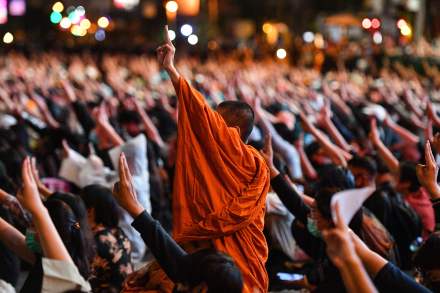
Three years ago I sat down to write a novel set in my adopted home city. Placing its claustrophobic action in the near future, I had no trouble imagining my mostly foreign characters haplessly trapped inside a decaying high-rise apartment complex and surrounded by political upheaval. Thailand has endured more military coups since 1945 than any nation on Earth, and I myself have lived through two, in 2006 and 2014, while the violent uprising of 2010 occurred while I was far away in New York. They are peculiar coups by world standards. Two Turkish friends who visited in 2014 were disgusted by the lack of tear gas and fatalities inflicted by air power. ‘You call this a coup?’ they asked.

Barbara Amiel: My memoir has cost me my best friends

From our UK edition

The only female writers of importance I have personally met are Margaret Atwood and Joan Didion, both of whom are rather short. That, I realise, is an advantage of sorts. You have less height to lose. Didion is 5ft 1in according to her Wiki entry, and Atwood, a tiny powerhouse, is listed optimistically as 5ft 4in, but that I think is like the Hollywood actors who I know are several inches shorter than listed heights, having stood breathlessly when Robert Redford walked passed me outside Bloomingdale’s in New York City. I mention this because after completing my third book, the first two written over 40 years ago when I was almost 5ft 8in, I am now 5ft 6in. I have lost an inch and a half since going into a three-year lockdown hunched at my desk.

I hate joggers more than ever

From our UK edition

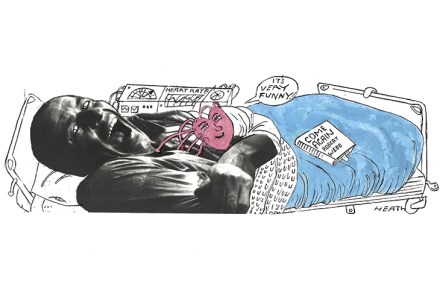
Empathy and kindness in these difficult times come more easily to some than others, but I’m trying. I had heart surgery in November to repair a faulty mitral valve. Recovery has been terribly scientific. On my daily walk, a heart monitor is synched with an app on my phone so through earphones I can hear my heart rate as well as encouraging messages in a voice I find indistinguishable from the American cultural critic Bonnie Greer. Mainly, my walk is spent suppressing the inner Nazi who can’t believe the human race still refuses to be more like me. Particularly at a time when good manners and common sense are now a public health issue.

Salman Rushdie: ‘The implausible has become everyday’

From our UK edition

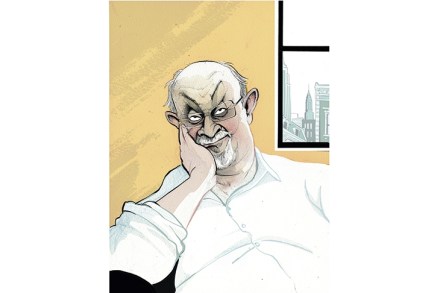
When I say goodbye to Sir Salman Rushdie in his offices at New York University in Lower Manhattan in early March, we bump elbows. Not that it’s much more than a gesture, by this stage: we shook hands unthinkingly on first meeting, and we’d just shaken hands again. It’s a novelty, still halfway to being a joke. As I descend in the lift to Cooper Square, it occurs to me that if I’ve given Rushdie coronavirus I will be halfway to achieving what the mullahs couldn’t. Halfway funny as a hypothetical; halfway not at this distance, writing the piece up three weeks later. As Alan Moore’s nihilistic Rorschach puts it: ‘Good joke. Everybody laugh. Roll on snare drum. Curtains.’ I don’t imagine Rushdie will take offence at this.

A writer’s coronavirus diary

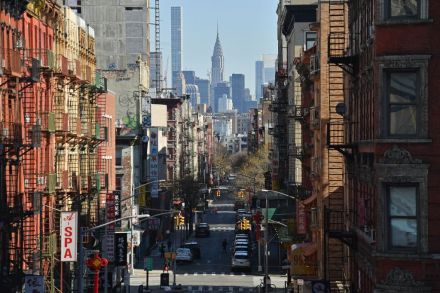
March 26, 2020‘New York is always hopeful,’ wrote Dorothy Parker, ‘Always it believes that something good is about to come off, and it must hurry to meet it.’ That is the New York I know and the New York I love. Now the city is ravaged by coronavirus, but that hope lives on. A little of it lives in me as well — even if I have left for my dad's place in the Hamptons.March 27, 2020‘What’s true of all the evils in the world is true of plague as well,’ wrote Camus in La Peste, ‘It helps men to rise above themselves.’ Why men, I wondered? Perhaps because women do not need to rise above themselves. They are transcendent already.March 28, 2020Am I suffering from coronavirus or aloneavirus?

coronavirus diary

Michael Morpurgo: Kale smoothies, writing, Pilates – my strict isolation schedule

From our UK edition

Writers like me are used to long hours alone. I’ve never enjoyed that side of it. I don’t like the bleakness of silence. As I try to settle and gather thoughts on my bed, pillows piled up behind me — Robert Louis Stevenson did the same, and it worked for him — I must have birdsong, music, the murmur of voices, and I must be able to see the living world from my window. I need the reassurance that I am not alone. I get up from the breakfast table always reluctantly, knowing the hours of solitary work that lie ahead, often dreading to have to go to it. I make myself do it, because I do have a story in my head I want to tell, because I need to prove to myself every day that I can still do it, and because it’s how I earn my living.

How to write the Great Coronavirus Screenplay

Across the most bourgeois quarters of the known world, youngish men with expensive educations and an unhealthy interest in the works of Italo Svevo have been driven by plague from their favorite coffee shops. For the first time in their lives they cannot go to Friday night loft parties and snicker about more successful contemporaries. What is to be done with all these days that stretch out languidly into infinity? Should they volunteer to dig graves? Help 3D-print a new ventilator design? Call their housebound mothers? No. Don’t be naive. When the going gets tough, the tough dust off their copies of The 101 Habits of Successful Screenwriters and get down to work. I mean, didn’t Shakespeare write King Lear during a quarantine or something? That could be you!

coronavirus screenplay

The biggest problem with today’s writers? Mediocrity

There is nothing writers love to write about more than writers. We are an extraordinarily self-important breed. Find a group of plumbers, office workers or electricians and they will talk about anything except their line of work. When writers come together, though, the subject of conversation is invariably their peers and themselves. But I can hardly talk. Here I am, coming to you today not just to write about writers and writing but to write about a writer writing about writers and writing. (Did you make it through that sentence OK? I'm sorry for inflicting it on you. Have a drink or something. You deserve one.) What have we done to deserve this kind of self-absorption? Writing, at its best, adds a little truth and a little beauty to the world.

new york times writing

My father threatened to sue me for my first novel

My first novel, A Dog’s Life, was largely autobiographical. It described my grandparents’ life, my parents’ marital exploits, and my own limping attempts to become a writer. But since I seemed unable to harness these first two subjects to the advancement of the third. Then I suddenly saw how I might carve out the first quarter of this spacious family saga and make it a self-contained novella covering 24 hours of family life. Heinemann offered me an advance on royalties of £500, which was ten times what they had given me for my biography of Lytton Strachey. Roland Gant did not wish to publish A Dog’s Life until the two Strachey volumes were out of the way.

michael holroyd novel

Why catastrophising is my idea of a good time

When, on a test of general knowledge, the highly educated score far worse than chimpanzees, university degrees may be overrated (definitely). But something more interesting may also be going on. According to the newly released Factfulness by Hans Rosling, we would-be smart people would improve our results on multiple-choice questions about the current state of the world (16 per cent) if we picked the answers at random (33 per cent). We all seem to think that humanity is in the toilet, and swirling more deeply into the sewer by the day. We’re wilfully blind to social progress. The more cheerful a host of indices look, the more belligerently we cling to the conviction that everything is getting worse.