Women

Cameron tackles internet porn with more government

From our UK edition

David Cameron is taking his woman trouble seriously. He will unveil plans to curb internet pornography at a meeting with the Mothers’ Union later today. The government will force internet users to opt in to view pornographic websites when they initially chose their internet providers. The government will also clamp down on sexualized advertising and a new website, Parentport, will be established to allow parents to report inappropriate images, articles of clothing, TV programmes etc. This is a fairly blatant pitch for the wandering female vote, which is exercising Cameroon minds at present. It’s a clear attempt to say: We’re going to help you to protect your children.

Tories dodge a bullet on childcare

From our UK edition

In the past year the government has proven good at cauterising self-inflicted wounds. This morning's announcement from Iain Duncan Smith on childcare stems another potential bleeder. His department have found an extra £300 million to prevent further cuts to childcare support. It’s a welcome reversal of an ill-advised plan and a narrowly averted political foul-up. The extra money is needed because of IDS's big welfare reform project, the Universal Credit. One of the big advantages of the UC is that it will smooth out all those ugly ‘cliff-edges’ in the benefit system, particularly rules that say you don’t get help if you work fewer than 16 hours a week.

Cameron’s tricky interview

From our UK edition

In a surprisingly testy interview on the Andrew Marr show, David Cameron defended the government’s approach to Europe, the economy and planning. But before the interview really got going, Cameron had to reiterate his Sunday Times’ apology (£) to women for the patronising comments he has made in the Commons chamber. This is hardly an ideal start to conference for a party leader who is struggling to maintain female support. On the Eurozone, Cameron was blunt that its problems were a threat to “the British economy and the world economy”. He also risked a clash with Nicolas Sarkozy by demanding that “action needs to be taken in the coming weeks to strengthen Europe’s banks”.

Wooing women the Tory way

From our UK edition

Back in June, Melanie McDonagh wrote that "the Tories are desperate to regain the female vote". Today's Guardian scoop, a government memo on the need to better appeal to women, proves she's right. In places, the document reads as if it were written by a group of men to whom women are very much from Venus. They are careful to spell out the revelation that "of course women's views differ as much as men's", and their response to discovering their weakness was apparently to find whoever they could in Number 10 without testicles and ask what they were doing wrong. However, it does at least show that the government recognises that it's losing ground with women at the moment, and that it'll take more than footage of Cameron taking his kids to school to recover.

Lansley’s letter pours fuel on Labour’s bonfire

From our UK edition

Just when everyone is all afroth about the murky connections between the political class and the media, a letter by Andrew Lansley to Danny Alexander has mysteriously leaked to the Telegraph. It was sent two months ago, and it concerns the government's public sector pension proposals. For five pages, Lansley riffs on about why the reforms may not be such a good idea, particularly when it comes to NHS workers. "We face a real risk, if we push too hard," he says, "of industrial action involving staff groups delivering key public services." He suggests that lower and higher paid staff may just opt-out of the pensions scheme altogether, leaving the Exchequer with "reduced receipts in the short term while still having to pay for past pension promises.

What did you do in the war, Mummy?

From our UK edition

By tradition, ‘What did you do in the war?’ is a question children address to Daddy, not to Mummy. By tradition, ‘What did you do in the war?’ is a question children address to Daddy, not to Mummy. In this ambitious, humane and absorbing book Virginia Nicholson moves Mummy firmly to the centre of the stage as she chronicles, largely in their own words, the lives of British women during the second world war. It is dedicated to one of them, her own mother, Anne Popham, later Anne Olivier Bell, who as a young woman suffered agonising wartime loss but went on to marry and become one of the great editors of her time through her work on the diaries of her husband’s aunt (and Nicholson’s great-aunt) Virginia Woolf. Nicholson sees her as typical.

Cameroons livid with Ken

From our UK edition

It is hard to overstate the fury with Ken Clarke in the Cameroon circle today. One well-informed Tory source just told me, ‘they [Cameron and Osborne] just can’t wait to see the back of him’ before pondering whether Clarke was now just too old for frontline politics. Another bemoaned that Clarke had managed both to deepen the party’s problems with women and further undermine its reputation as the party of law and order. While one more couldn’t believe how on a day when unemployment fell, two men were charged with the murder of Stephen Lawrence and the Queen and PM were marking a new era in Anglo-Irish relations, the coalition had managed to get a series of bad news stories to top the bulletins.

Give women a sporting chance

From our UK edition

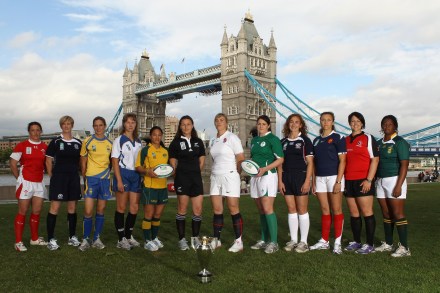
Tomorrow marks the beginning of the Women’s Rugby World Cup. Twelve teams will be competing for the title of World Champion right in our own back yard, at Twickenham Stoop. That's right: Britain, hosting a World Cup. So why haven’t we heard more about it in the press?   It seems to me to be symptomatic of a wider problem – the media’s general lack of interest in women’s sport. It’s not as if sports fans themselves aren’t interested – women’s tennis has become increasingly fashionable, and their games are often more entertaining than the men’s.

The equality landmines that Labour have left the coalition

From our UK edition

Oh dear, the Treasury is mired in another controversy about equality after the Guardian published a letter which Theresa May sent to George Osborne before the Budget. In it, she warned that the government could face legal action if it is unable to show that its decisions were made with a consideration to "existing race, disability and gender equality duties." As she puts it: "If there are no processes in place to show that equality issues have been taken into account in relate to particular decisions, there is a real risk of successful legal challenge by, for instance, recipients of public services, Trade Unions or other groups affected by these decisions.

The death of the male working class | 27 May 2010

From our UK edition

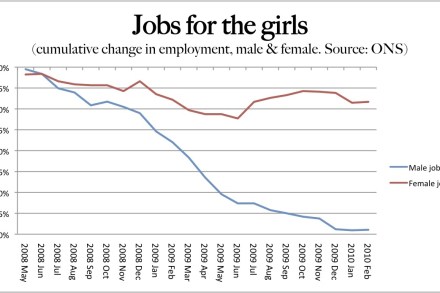
Gender discrimination is illegal in Britain – but tell that to the recession. It has hit male jobs harder than female jobs and in a cover story for this week’s Spectator, Matthew Lynn looks behind it. This has been, he says, a Mancession, where "the jobs lost in the last two years have tended to be ones done by men, whereas the preponderance of new vacancies are in areas of the economy in which women do best." I asked the ONS for the official figures – and here they are:   They show that, if you count everyone in Britain employed over the age of 16, there has been a 3.9 percent reduction in male jobs and just a 0.8 percent reduction in female jobs.

The equality dilemma

From our UK edition

Spare a thought for poor Theresa May. Judging by the reaction so far, she now faces the unenviable task of shouldering almost everyone’s preconceptions about Tory women in government – with Caroline Spelman, Baroness Warsi and the lower-profile Cheryl Gillan for back-up. She will no doubt continue to disappoint feminists and irritate reactionaries, and she will do so while responsible for the notoriously unwieldy Home Office, which has rapidly taken over from the Department of Health as the ministry where political careers go to die. Representation in politics does matter. It is not unreasonable to claim, as Katharine Viner did in Thursday’s Guardian, that “democracies simply don't work unless they represent those they govern”.

Flower power

From our UK edition

Mrs Delaney (1700-88) is an inspiring example for old age; also a reproach to those who think ‘upper class’ a term of abuse and that women have only recently had a life. Mrs Delaney (1700-88) is an inspiring example for old age; also a reproach to those who think ‘upper class’ a term of abuse and that women have only recently had a life. Her extraordinary cut-paper flowers, collected in the 10-volume Flora Delanica, are now enshrined in the British Museum as masterpieces of collage art. Looking at their remarkable intricacy and accuracy, it is incredible to think she made them between the age of 72 and 82. Nonetheless, these ‘floral mosaiks’, as she called them, are only the summation of her achievements.