Westminster

Where arms dealers meet do-gooders

From our UK edition

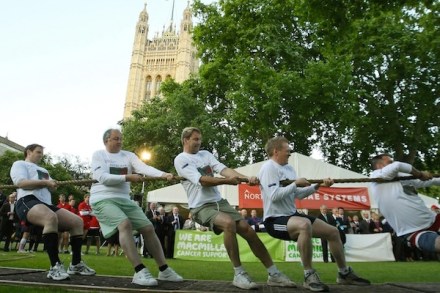
Yesterday saw the annual Commons vs. Lords Tug of War, in aid of Macmillan and sponsored by BAE. Battle was joined at Westminster College Gardens, behind the cloisters of Westminster Abbey. Teams of marines, fireman, hacks and staffers battled it out before the final show down between the elected and the unelected. Disappointingly for the aristocracy, the commoners bagged it.    Champagne and the dulcet tones of TV's James Landale kept the crowd entertained. Speaker Bercow, defence minister Gerald Howarth and education minister Tim Loughton cheered on their colleagues, while Labour's Lord Foulkes and Sharon Hodgson became well acquainted with the bar.
Today in Blundering: Government Relaunches Always Fail

From our UK edition

A government relaunch of the sort we've endured this week is inevitably a fraught, fragile affair. The problem with such enterprises is that they have this unfortunate habit of drawing attention to the fact that it is, well, a relaunch. Downing Street may hope differently but a relaunch inevitably draws attention to the very failures the relaunch is supposed to put behind us. You wouldn't be doing this if things were going well, would you Prime Minister?  Of course things are not going well. Nor will they get any better any time soon. Yesterday's Essex reprise of the chummy Downing Street coalition presser was a mistake. A necessary or at least understandable one perhaps but a mistake nevertheless. That's a river, as an old Greek said, in which you cannot bathe twice.

The House of Lords Makes No Sense; Which is Why it Works

From our UK edition

Of all the cockamamie ploys favoured by this government, House of Lords reform is close to being both the most pointless and the most aggravating. Iain Martin hints at this in his recent Telegraph post but he is, in the end, too kind to the Deputy Prime Minister. This is the sort of wheeze favoured by undergraduates blessed with second-class second-class minds. It is close to pointless because even if anyone outside the tiny world of "progressive" think tanks thought this a vital issue there is no evidence that it is in the slightest bit necessary. Which explains why it is aggravating. Th House of Lords, as presently constituted (that is, by patronage, divine blessing and a modest measure of hereditary good fortune), may not "make sense" but, despite everything, it works.

The Trouble with George: Politics & Economics Do Not Always Mix

From our UK edition

Today's top Westminster read is James Kirkup's article on the Treasury smart set. It builds a good foundation from which to argue that for all David Cameron and George Osbourne dislike being compared to Tony Blair and Gordon Brown, there remain good grounds for making that kind of comparison. And already we can see, as James says, some daylight between Numbers 10 and 11. Perhaps we should not make too much of this. Cameron and Osborne remain exceedingly close. Even if most Prime Ministers lose patience with thier Chancellors their relationship is not bound to end acrimoniously. Nevertheless, they begin from a position less propitious than that which faced Blair and Brown when the Labour pair moved in to Downing Street.

How Lobbying Works, Part XCII

From our UK edition

Today's Independent has an interesting demonstration of the insidious influence of lobbying. This is how it's done, people: The independence of a Government adviser on red tape appointed by David Cameron has been called into question as details emerge of a possible covert attempt by the tobacco industry to undermine the proposed introduction of plain cigarette packets with no branding or company logos. Anti-smoking campaigners have voiced concerns that Mark Littlewood, the director of the Institute of Economic Affairs (IEA), has been appointed as an "independent adviser" to the Government's Red Tape Challenge, which they believe might allow him to influence policy on plain cigarette packets. The horror of it!

MPs Need Longer Holidays

From our UK edition

Good sense from Dan Hannan: The House of Commons rises today, prompting traditional seasonal whinges. ‘MPs have already awarded themselves a number of bonus holidays this year so they risk looking out of touch by sloping off early at Christmas,’ says the TaxPayers’ Alliance. Hang on a minute. Isn’t the TPA forever complaining that we have too many laws and too much government? Why, then, does it want parliamentarians to linger over their law-making? Surely the TPA, of all organisations, should resist the view that legislating is the only 'real' work an MP does. Because the TaxPayers' Alliance, for all that their heart may often be sound, is also an organisation that knows the price of everything but not always its value.

Lobbying for a lobbyists’ register

From our UK edition

“I certainly think it’s a serious problem and I described it when we last discussed this as a canker on the body politic and I would stay with that,” said Jesse Norman on the World at One earlier today. The Bureau of Investigative Journalism’s sting, splashed by this morning’s Independent, of executives from lobbying/PR firm Bell Pottinger boasting of their influence over the prime minister has renewed the debate about regulating the lobbying industry, with calls for a public register to be established. Downing Street has outright denied the allegations, which do sound rather far-fetched. Bravado is, of course, the currency of thin-air merchants. The objection is not to the bragging (how else can one tout ‘influence’?

In the middle of the march

From our UK edition

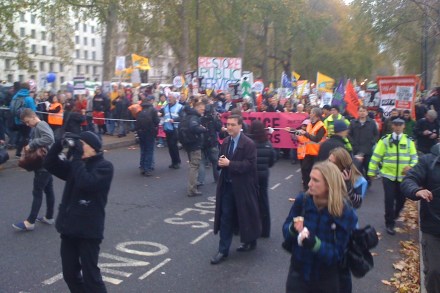
Walking through Parliament Square this afternoon, you’d be forgiven for wondering whether some kind of bomb threat had been made on Westminster Palace. The fleets of police vans and hoards of fluorescent-jacketed officers seemed absurdly disproportionate to the motley pickets of public sector strikers gathered serenely outside parliament’s gates. ‘Actually, I shouldn’t be working today,’ one officer told me, chuckling. ‘It’s my day off. That’s ironic, isn’t it?’ As Pete remarked this morning, there wasn’t a huge amount to see along the Westminster picket lines, apart from the policemen.

The Autumn Statement Makes a Tory-Lib Dem Electoral Pact More Likely

From our UK edition

Amidst the economic doom and gloom (though all the forecasts are always wrong so who knows how things will look by 2015?), the politics of the coalition government remain interesting. So Danny Alexander's performance on Newnight tonight was very interesting. The Chief Secretary of the Treasury told Jeremy Paxman that the Liberal Democrats were committed to the new spending and borrowing plans announced by George Osborne yesterday. Furthermore, the spending cuts announced for the first two years of the next parliament (though said plans can only be aspirational since they cannot, surely, bind the next parliament?) would be part of the next Liberal Democrat manifesto. I doubt Tim Farron or Simon Hughes or even Vince Cable think this a good idea.

First Lord or First Among Equals?

From our UK edition

Well, James, hang on a minute. The three "schools of thought" you identify in relation to last night's Tory rebellion on Europe are not three distinct schools at all. That is, one may consider the Tory party "unmanageable" on europe and believe that the leadership got caught up in the madness yesterday. But it is your final school that really have it wrong: The third lot are the ones who have grasped the significance of last night's events. Despite being loyalists, they are in no doubt about the need for Cameron to change his style of party management. They want him to stop acting like a medieval monarch and start behaving in the manner of someone who is first among equals when it comes to his parliamentary colleagues. Up to a point.

The Rebels and Government Agree: There Will Be An EU Referendum.

From our UK edition

In principle, I agree with Fraser's admirable post previewing Monday's debate (summarised excellently by ConservativeHome here) on an EU-referendum but I suspect that wily old Blairite John Rentoul is right to argue that there was no way the government could wash its hands of the affair since, whatever it chose to do, The headlines would be about a divided Tory party, come what may. Which is reasonable enough since the Tory party is divided. Granted, the primary division is between the Get Out Now team and the Renegotiate Everything team but the point remains: this has been a blunder. The government has mishandled this affair and been embarrassed by its own backbenchers. Nearly half the non-payroll Tory vote declined to back the Prime Minister yesterday.

Eustice: If the government won’t back my amendment, I’ll vote for the EU referendum motion

From our UK edition

George Eustice’s comments just now that if the government doesn’t support his amendment  to the EU referendum motion, then he’s "minded" to vote for the original motion is a sign of how Downing Street is losing the parliamentary party on this issue at an alarming rate. Eustice having been press secretary to David Cameron is not an instinctive rebel nor can he be being accused of motivated by personal animus.   Equally telling is Eustice’s saying that he’s being pushed towards supporting the motion because "the government’s not going to deal with the party in a responsible way on this". This is a sign of just how fed up normally supportive MPs are with Number 10’s handling of this whole issue.

Amendment to EU referendum vote put down

From our UK edition

Tonight, George Eustice, David Cameron's former press secretary, and several other eurosceptic members of the 2010 intake have put down an amendment to the EU referendum motion that will be put on Monday. The amendment reads: "This House calls upon the government to publish a White Paper during the next session of Parliament setting out the powers and competences that the government would seek to repatriate from the EU, to commence the renegotiation of Britain's relationship with the EU, and to put the outcome of those negotiations to a national referendum." As I said before, this renegotiate-referendum strategy is Cameron's best chance of heading off a full-scale rebellion on Monday, but it remains to be seen if the government will throw its weight behind this.

The Human Rights Act Protects the Innocent

From our UK edition

Meanwhile, in the day's other Supreme Court judgement, the justices struck down the government's ban on non-EU spouses under the age of 21 coming to live in Britain. This legislation was, it should be noted, well-intentioned and aimed to make it harder to arrange forced marriages in this country. So far so admirable. But, as is so often the case, the law cheerfully entrapped the innocent as well as the guilty. And so, as is so often the case, there's a balance.

Three Cheers for the House of Lords | 12 October 2011

From our UK edition

As a general rule complaints that the opposition are too beastly for words should not be taken too seriously. They reflect a sense of entitlement on the part of the governing party that, whenever it may be modestly frustrated, quickly becomes peevish, sour and silly. If this is true of parliamentarians it is even truer when considering the bleatings of partisan pundits cheering on Team Red or Team Blue. Again, if you judge these squabbling teams by different criteria then you forfeit some right to be taken seriously. So it's depressing to see a commentator as urbane and generally sensible as Benedict Brogan make such an ass of himself in this piece about how nasty Labour types and "organised" Crossbenchers are - the beasts - frustrating the government in the House of Lords.

Catflap Latest: Sack Theresa May!

From our UK edition

Good god, #Catflap shows no sign of abating. And people are losing their minds over it. Poor old Tim Montgomerie is the latest fellow to see the rumpus as an excuse to get rid of Ken Clarke. Apparently a "Cabinet minister should never publicly attack a colleague" and so Ken must be sacked as soon as possible. Personally, I'd rather Cabinet Ministers ceased behaving like idiots and since May is the idiot in this case, if a head must roll it should be the Home Secretary's. She started the Catflap after all and only in the topsy-turvy political land could Ken carry the can for telling the truth while May escapes without censure despite wilfully (or, if you prefer, carelessly) misleading the public. And what is Ken's crime?

The danger to a free press

From our UK edition

“In Britain, a free press is non-negotiable,” Ivan Lewis has just said – before suggesting ways that Government might, ahem, oversee this freedom. The shadow culture secretary has an idea: a register system to license journalists. “As in other professions, the industry should consider whether people guilty of gross malpractice should be struck off,” he said. He wants “a new system of independent regulation including proper like-for-like redress, which means mistakes and falsehoods on the front page receive apologies and retraction on the front page”. It’s an odd type of independence: one that would be prescribed by the political elite. And what type of journalists might it target?

Texting times

From our UK edition

After the education email furore earlier this week, discussions are underway in ministerial offices about private emails: are they subject to the freedom of information act? The answer is probably yes, which may not be what the government wants to hear. But the problems that this will cause are nothing compared to what might happen next, when attention moves on to text messages. Whitehall buzzes with texts: Ministers text SpAds; SpAds text journalists; journalists text ministers, and so on. Often the messages are short and inconsequential, but not always. There is the potential for even greater embarrassment than exists with emails.

A revealing episode

From our UK edition

The row about which email account special advisers use for which emails is, I suspect, of very little interest to anyone outside SW1. But today’s FT story certainly has set the cat amongst the Whitehall pigeons. At the risk of trying the patience of everyone who doesn’t work within a mile of the Palace of Westminster, I think there is something here worth noting about our political culture. Christopher Cook’s story in the FT this morning is about an email that Dominic Cummings, one of Michael Gove’s special advisers, sent urging various political people not to use his Department of Education email. In this case, the email was perfectly proper. Ministers and special advisers aren’t meant to use official resources for party political activity.

Arresting the West’s crisis of confidence

From our UK edition

What’s the most important geo-political event of this century? Most people would say 9/11. The Foreign Secretary believes that it is the Arab Spring. But in The Times today (£), Emma Duncan makes a persuasive case for it being the collapse of Lehman Brothers. Duncan argues that Lehman Brothers’ fall has three claims to be an epoch-making event. The first is its contribution to the financial crisis and subsequent economic stagnation. The second is the way that it has catalysed China’s economic rise vis-à-vis the US, with China now predicted to become the world’s largest economy within this decade.