Vladimir putin

The rise of Sudden Oligarch Death Syndrome

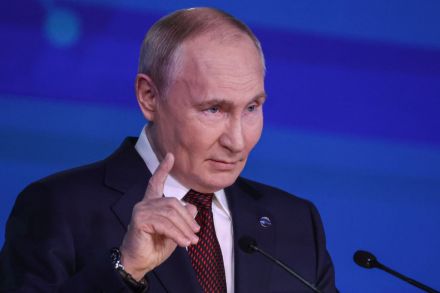
Since Moscow launched the invasion of Ukraine in February, the deaths of Russian oligarchs seem to be constantly in the headlines. Despite the official causes of death given, Cockburn has a sneaking suspicion that Vladimir Putin might have something to do with it. Death by unusual, news-making circumstances is a hallmark of his regime. The Russian leader intends for such deaths to make the news and for the world to blame the Kremlin for them. It forms part of his strategy of intimidating potential opponents and dissidents. Enemies of Putin that have gone to the West have faced radiation poisoning and attacks with powerful nerve agents. Those who have countered Putin in Russian politics have been jailed or gunned down in the streets. Now, apparently, oligarchs are in the crosshairs.

sanctions putin russia davos oligarch

Putin mentions the war

So much for "don’t mention the war!" Russian president Vladimir Putin has called the conflict in Ukraine a war for the first time on Thursday. Cockburn is quite flummoxed — this is the same Putin who has made an industry out of locking people up who refused to call the war a “special military operation”. On December 22, while addressing the situation in Ukraine, Putin said, “Our goal is not to spin the flywheel of military conflict, but, on the contrary, to end this war.” The irony alone of this statement is too much to handle. The man who invaded his neighbor and disregarded the laws of war is now saying he does not want to “spin the flywheel of military conflict”?

nuclear tactical putin war

Could Joe Biden’s Ukraine support define his presidency?

With his whirlwind visit to Washington, Volodymyr Zelensky cemented his bromance with Joe Biden. Even as MAGA Republicans have been sniping at Ukraine — Donald Trump, Jr. derided Zelensky on Wednesday as an “ungrateful welfare queen” — Biden declared that he will support Ukraine “as long as it takes.” Welcoming his Ukrainian counterpart to the White House, he went out of his way to depict support for Ukraine as bipartisan and unflinching. Like Herman Melville in his novel White-Jacket, Biden believes that “we bear the ark of the liberties of the world.” The Russian invasion and Ukrainian defiance are the making of Joe Biden’s presidency. Biden may well go down in history as the man who finally drove the stake through the heart of the Russian empire.

Biden and Zelensky
putin

Biden needs to stop ceding the initiative to Putin

Washington will provide Patriot missiles to Ukraine, bolstering Kyiv's air defenses in the new year. This is welcome news — but it should have happened a long time ago. One word best characterizes the Biden administration’s response to the war in Ukraine: reactive. The president’s lack of proactive measures both gives Putin an edge and prevents Ukraine from achieving a swift victory. US weapons began arriving in Ukraine in December 2021 from a $60 million package approved in August, with another package worth $200 million being approved in December and arriving in January. Both lacked the firepower needed to deter Moscow. The administration knew by October 2021 that Putin might invade — and that Russia had been building up forces around Ukraine since the spring.

The US must punish Iran for aiding Russia

Russia’s brutal war in Ukraine has been disastrous for Vladimir Putin, but it has been a boon for the Islamic Republic of Iran. Western nations are increasingly concerned about Tehran’s profitable cooperation with Moscow, as Iran leverages Russian desperation to fuel its own ambitions. So far, Iran has sent hundreds of drones to Russia along with training personnel, and may soon send ballistic missiles. Tehran has continued its malign activities in the Middle East as well, attempting to steal American drones and blind American ships, attacking and endangering American forces and personnel, and supporting destabilizing groups such as the Houthis in Yemen. Iran has also ruthlessly repressed widespread protests at home.

The other Brittney Griners

Was WNBA star Brittney Griner the subject of so much White House attention because she was an important showpiece? Nobody can claim they are unhappy Griner is home safely. No one can sit here and say she should have been left to suffer in Russia. But at the same time, Griner, through all fault of her own, ended up in the middle of a foreign policy struggle.

brittney griner

Don’t condemn Ukraine for its ‘illiberal’ measures against Russia

The war in Ukraine is being fought on two fronts: the battlefield and the information space. From the beginning of Russia’s interference in Ukraine in 2014, the information war has been a key factor in the Kremlin’s strategy for victory. Because of this, Ukraine has taken a series of wartime measures to stabilize and protect itself, from political restrictions to media regulations. Some in the West have used these measures to paint Kyiv as undemocratic, but such rhetoric rings hollow. What these criticisms miss is the fact that Ukraine, unlike other Western democracies, has been in a state of war for eight years.

It’s time for Pope Francis to speak out against China

There is a lot to dig into amid Pope Francis’s recent interview with America magazine, but the most interesting tidbits might be his commentary on foreign affairs. Whereas the traditional head of state represents the interests of a nation, the Holy Father’s most important duty is the shepherding of the Catholic faithful. His message thus carries much weight, not because of the raw power at his disposal, but because it is backed by the moral authority of the Catholic Church. The pope has been in some hot water recently over both the war in Ukraine and the Vatican’s relations with China. Though he has long condemned the violence in Ukraine, he has not been as clear in condemning Russia and Putin specifically.

The Europeans are complaining, again

All is not well in the transatlantic relationship. This might come as a surprise given that the United States and Europe have been remarkably unified on Europe’s most urgent security crisis in the post-Cold War era. Despite Russian President Vladimir Putin’s attempt to inject division into the pro-Ukraine coalition by throttling gas supplies to Europe, the West is sticking to its guns, maintaining sanctions on Moscow until either the war ends or Russian troops are forced to withdraw. This consensus, however, has masked disputes between Washington and its European allies that are becoming more difficult to manage.

NATO acquits itself well in the Poland missile crisis

Mid-afternoon Tuesday, a missile struck the town of Przewodow in eastern Poland close to the Ukrainian border, killing two. The incident immediately set off alarm bells around NATO and the world, as Poland, a member of the military alliance, could invoke Article 5 of the North Atlantic Treaty, bringing all 30 members to its defense. The Polish government is considering invoking Article 4 of the treaty, which allows any member state to call a meeting of all members to discern if "territorial integrity, political independence or security… is threatened." NATO was due to meet on Wednesday anyway, but the tragedy in Poland has superseded the gathering’s planned lineup.

Winter is no time for weakness in Ukraine

With the recapture of the key southern port city of Kherson, Ukraine has achieved yet another success in its nearly nine-month war with Russia. But as winter approaches and conditions worsen, both sides will face new challenges, and the West’s support will be tested. As the Institute for the Study of War indicated in a recent assessment of the conflict, it is unlikely that combat activity will drop significantly in the coming months. As the early winter rains roll over Ukraine, the region’s infamous mud will prove to be an impediment to maneuver warfare. That period will then give way to the freezing temperatures that characterize the Eastern European winter. Those temperatures will put an end to the mud, allowing forces to more effectively continue operations.

WATCH: Germans are dancing to stay warm this winter

The world's eyes have been on America this week, thanks to the midterms. Cockburn, however has been gazing across the Atlantic with amusement. A new dance class is being offered in Germany called "Let’s Move — Tanzt Euch Warm," or "dance yourselves warm," to combat rising energy costs as the temperature falls. https://twitter.com/reuters/status/1590588816716242944 Watching the footage of the chilly krauts cha-cha-cha-ing, Cockburn can’t help but recall former president Donald Trump’s speech to the United Nations back in 2018, where he warned that "Germany will become totally dependent on Russian energy." At the time, the German delegation laughed and shook their heads at what they considered yet another absurd broadside from the American president. https://twitter.

tanzt euch warm

The strange alliance between progressives and natcons on Ukraine

If you listened only to the rhetoric of so-called national conservatives, you would think progressives were their polar opposites. But on the issue of foreign policy, it seems like they can find some common ground. It was reported on Tuesday that the Congressional Progressive Caucus sent a letter to President Biden asking him to negotiate with Russia. It was later reported that the same letter had been hastily withdrawn after massive backlash within the Democratic Party. The missive was apparently written and signed in June, updated recently, and somehow carelessly published without all of the signatories’ consent. Either way, it seems to represent something real within the Democrats' progressive wing.

America and Russia are finally talking to each other again

Defense Secretary Lloyd Austin and Russian Defense Minister Sergei Shoigu haven’t really been on speaking terms. That is, until last weekend, when the two defense chiefs conversed with each other twice in three days. The readouts released by the Defense Department are about as brief as brief can get. They don’t tell us much about what was said, other than the general observation that Austin, a former four-star army general, swatted away Moscow’s explanations for the war in Ukraine. What the conversations illustrate more than anything is just how rare they've been. Indeed, the reason why so many news outlets wrote about the Austin-Shoigu calls was because they were extraordinary.

How long can Europe’s support for Ukraine last?

Can Ukraine sustain a war effort that is proceeding far better than most military analysts ever expected? Part of that answer, of course, depends on the extent to which the Ukrainian army can keep their troops in the field equipped, supplied, and motivated. That challenge comes as the Russian military increasingly relies on so-called “kamikaze drones” to strike deep into Ukrainian territory (on October 17, a Russian drone attack killed four people in Kyiv during the morning rush hour). But another factor that will determine success or failure is whether Europe remains onboard — or, more to the point, whether Europe’s support to Kyiv will continue as the war enters a dreary, unforgiving winter.

The Russia-Iran axis that’s menacing Ukraine

Russia’s brutal war in Ukraine is coming up on its eighth month, and the costs to the Kremlin’s military have been immense. Increasingly isolated on the world stage, Vladimir Putin has joined the world’s club of pariah states, the only group willing to give him support. Chief among his allies is the Islamic Republic of Iran, a state with similarly imperialistic designs and global isolation. This axis has been brewing for some time — the two nations worked together extensively in Syria, for example — but the relationship has reached new heights as the Russian armed forces buckle under the strain of war. Perhaps the most potent symbols of this relationship are the hundreds of Iranian drones flooding into Ukraine to fill a gap in Russia’s weapons inventory.

elon musk ian bremmer

Elon Musk vs Ian Bremmer: who’s telling the truth?

Cockburn wasn’t surprised to hear that Elon Musk had found himself in yet another spat, but he was somewhat shocked to hear that this one was a matter of national security. This week's he-said-she-said involved political scientist Ian Bremmer. In a newsletter sent to his Eurasia Group subscribers, Bremmer wrote that Tesla CEO Musk had told him that Putin was “prepared to negotiate,” but only if Crimea remained Russian, if Ukraine accepted a form of permanent neutrality — and Ukraine recognized Russia’s annexation of Luhansk, Donetsk, Kherson and Zaporizhzhia. So, not asking too much then. Musk hit back in response to a tweet asking whether Bremmer's statement was true, replying: “No, it is not. I have spoken to Putin only once and that was about eighteen months ago.

Why is Biden giving up on nuclear deterrence?

What’s more alarming than President Trump trying to frighten Kim Jong-un with “fire and fury”? President Biden trying to frighten Americans with Putin. “I don’t think there’s any such thing as the ability to easily [use] a tactical nuclear weapon and not end up with Armageddon,” the president riffed at a New York fundraiser, while fretting to supporters about his need to find that elusive off-ramp for the Russians. Biden’s loose talk about Putin’s formidability contrasted with US handwringing fits a pattern. Pervasive throughout Putin’s war has been far too much focus on what the United States should do to help Putin find these mythical off-ramps, and on how to restrain Ukraine to prevent it from getting nuked.

putin

How the Ukrainians personally humiliated Putin

The Russian army has been the source of an endless list of shortcomings and embarrassments over the last eight months. There are simply too many of them to count, from the failure to move through Kyiv’s suburbs in March to the sinking of the flagship Moskva in April to the loss in September of more than 3,000 square kilometers of territory in just days. But by far the most humiliating to Vladimir Putin personally was last weekend’s attack on the twelve-mile bridge that connects mainland Russia with Crimea, the peninsula Moscow annexed in 2014. That bridge, which cost more than $7 billion to build, was one of Putin’s pet projects, a visible signal to the world about Moscow’s staying power in the region.

Vladimir Putin is simply mad

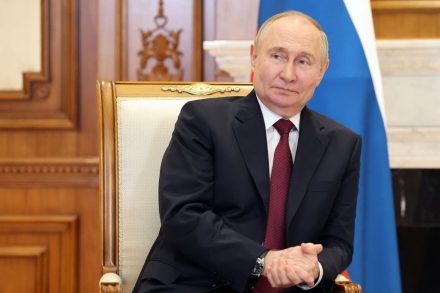
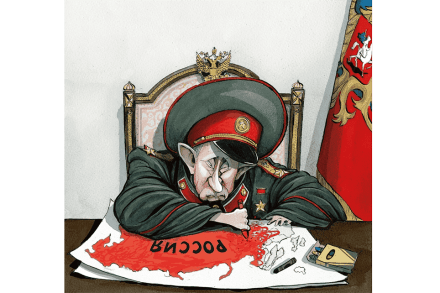
Vladimir Putin is mad: not in the cognitive but in the emotional sense of the word. He is an odd mixture of the cold, the plotting, the calculating, and the bloodless; the emotional, the impulsive, the hotblooded, and the sentimental. He is mad, in other words, in precisely the way that Adolf Hitler was mad. And like Hitler, Putin is disconnected from the world of fact but not of logic. This is a fundamental truth about the man that I think the West had never experienced before February. His condition became apparent in the diatribe against the West that he gave on Friday, which corresponded almost exactly to Hitler’s customary rants.

nuclear tactical putin war