Vaccination

Why we can be confident in the safety of Covid vaccines

From our UK edition

At the beginning of the Covid crisis, some expressed the hope that a pandemic might at least bring a divided country back together. Instead, public discourse descended to new levels of bitterness as a fresh schism replaced that caused by Brexit. On one side were those who thought tens of thousands would die because government action was too slow and half-hearted, and on the other, those who thought lockdown to be an over-reaction that inflicted grave damage on our economy and society. Both sides ought now to be able to agree that this week marks a significant turning point in the pandemic. The first shot of an approved Covid vaccine to be administered in a public programme anywhere in the world was given to Margaret Keenan, a 90-year-old woman in a Coventry hospital.

The problem with ‘immunity passports’

From our UK edition

Just a few months ago it was not certain that we would find a vaccine for Covid-19. Now, we have three, with potentially more on the way — and the rollout of the Pfizer jab due to begin next week. It’s an extraordinary achievement for the research community, our best hope of restoring normal life and a bloody relief after a year of disappointments. But the government, at least, should beware of geeks bearing gifts. To get us to herd immunity, they have to persuade somewhere between 60 per cent to 90 per cent of us to get vaccinated. You can see Boris Johnson’s problem. If he makes vaccination completely voluntary, we may never hit the target we need for herd immunity. It’s not just anti-vaxxers.

How to win over vaccine sceptics

From our UK edition

We have a vaccine. In fact, we have three — and more are on the way. While we still need to scrutinise the full data from the Pfizer, Moderna and AstraZeneca trials, the initial reports are stunning: vaccines that in some cases exceed 90 per cent effectiveness, and might be ready within weeks. Previous surveys showed a big appetite for the vaccine, but more recent ones are concerning. According to YouGov, only 67 per cent of British people say they’d be ‘likely’ to get the Pfizer virus, with 21 per cent saying they’d be ‘fairly’ or ‘very’ unlikely to. Other polls also find that scepticism towards the vaccine is increasing.

Which countries are most sceptical about vaccines?

From our UK edition

Gloss over Should we be worried that the head of research into respiratory drugs at AstraZeneca is called Dr Pangalos, given that his near namesake, Dr Pangloss, is a byword for foolish optimism? Dr Pangloss was tutor to Candide in Voltaire’s satire on Gottfried Leibniz’s work on theodicy: the attempt to reconcile why a benevolent and all-powerful God should allow evil, tragedy — or a pandemic — to exist. Dr Pangloss’s favourite phrase, ‘all is for the best in the best of all possible worlds’, encapsulates Leibniz’s belief that the Earth, for all its apparent faults, was the best that God could possibly have created.

Nationwide vaccination could end social distancing in April

From our UK edition

The NHS plans to vaccinate everyone who wants a jab by early April, according to leaked documents seen by the Health Service Journal. This marks a shift in strategy from the government’s previous plan to only vaccinate the vulnerable. If successful, it would mean that all social distancing measures could be ended in April. The documents operate on a 75 per cent take-up rate for the vaccine among the general population, which seems a touch high given polling on the subject. It assumes that the NHS would be vaccinating 4.5 million people per week and for both the Oxford and Pfizer vaccines people would need to take two doses, 28 days apart.

How moral is it to refuse a vaccine?

From our UK edition

Well thank goodness for that, eh? Just as we reached our darkest hour and resigned ourselves to an endless series of lockdowns and the ruination of everything we once took for granted, we heard that help might be at hand. With the announcement of a Covid vaccine, what the Prime Minister called the ‘distant bugle of the scientific cavalry’ was at last audible. Think Pheidippides staggering into Athens, or the great horn of Helm ringing out. My instinct, and I expect yours, was to think something like: ‘Phew! It’ll take a month or two, maybe a year, but we’re in sight of things going back to normal. There is light at the end of the tunnel.

The dangers of censoring anti-vaxxers

From our UK edition

Earlier this week, the Labour party wrote to the government urging it to bring forward legislation so that social media companies which fail to ‘stamp out dangerous anti-vaccine content’ can face financial and criminal penalties. ‘The government has a pitiful track record on taking action against online platforms that are facilitating the spread of disinformation,’ said Jo Stevens, Labour’s shadow culture secretary. ‘This is literally a matter of life and death and anyone who is dissuaded from being vaccinated because of this is one person too many.’ My first thought on hearing this was how pitifully out of touch the Labour party is.

What does it mean to be ‘fit as a butcher’s dog’?

From our UK edition

Boris and the butcher’s dog Who first coined the phrase ‘as fit as a butcher’s dog’? It has been traced to Lancashire. It is not the only quality attached to butcher’s dogs, however — such animals were perhaps widely observed as a result of customers having to entertain themselves somehow while the butcher prepared their cuts, and a dog gave them something to watch. A variant has someone as ‘happy as a butcher’s dog’. John Ray, in his collection of English proverbs from 1670, describes the expression ‘as surly as a butcher’s dog’.

The questions we must ask about the Covid vaccine

From our UK edition

After a difficult nine months, we are naturally all sick of lockdowns and other Covid restrictions. Everyone misses parts of their pre-coronavirus lives, from seeing friends and family, to pubs and restaurants, to the theatre and concerts and, yes, even our workplaces. It was therefore no surprise that this week’s news of a vaccine breakthrough was widely applauded. It is human nature, after all, to cling on to things that give us hope. Hope that was encouraged by leading scientists such as Sir John Bell. After the Pfizer news broke, the Oxford professor was asked on BBC radio whether we would be returning to normal by spring. His response? ‘Yes, yes, yes.’ This was a When Harry Met Sally moment that proved to be music to the ears of millions of Britons.

Letters: Wales has been betrayed by Westminster

From our UK edition

Woeful Wales Sir: Allison Pearson succinctly points out the absurdity of the so-called Welsh government and its assembly, now trying to masquerade as a parliament (‘Wales of grief’, 31 October). For those of us living in Wales it is difficult to talk of the Welsh Assembly without using the F-word: failure. For the past 20 years it has failed the Welsh people at every conceivable level, while building a conceit that it is a true government. The only irony of the current Covid-19 debacle is that for once it has been forced to actually do something instead of talking endlessly around a subject before doing nothing. I have described its failure as the Sadim effect.

The problem with fast-tracking vaccines

From our UK edition

You have to admit it, Operation Warp Speed is a good moniker. It’s the name for the American interagency programme, initiated by the Trump administration, to produce 300 million doses of a safe vaccine for Covid-19 by January. Who couldn’t get behind this all-hands national effort to defeat the virus and end the pandemic, excitingly named after the faster-than-light space travel in Star Trek? While we wait for clinical trials led by the University of Oxford and AstraZeneca in the UK, America warps ahead. Warp speed allows the Starship Enterprise to put aside the laws of physics. Vaccine development also has its own laws, or rather guides, that describe the way things usually happen.

‘Herd immunity’ is impossible without a vaccine

From our UK edition

My great-grandfather did not fight in the war. He wasn’t a conscientious objector — he was a scientist helping to develop radar. It’s tempting to imagine family history repeating itself. I’m not alongside my colleagues on the NHS front line; instead I’ve been part of a large team at the Crick Institute, helping to develop tests for Sars-CoV-2, the causative agent of Covid-19. For the first phase of our struggle against this virus, we’ve had minimal testing capacity — no radar — and we’ve suffered the consequences.

The return of measles and the age of idiocy

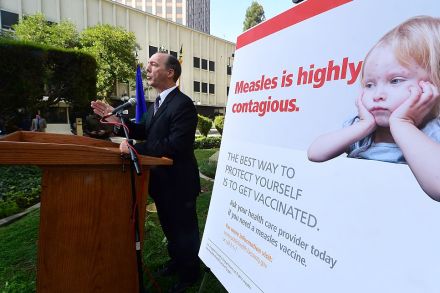
Measles, a disease considered eliminated in 2000, is now rampaging through the country. The causes of this latest outbreak are symptomatic of what ails our society: a slavish devotion to celebrity, the elevation of emotion over facts, the failure of science and math education, the rejection of evidence, and the inability to discern authoritative sources from a crackpot behind a keyboard. Our national health relies on Americans understanding the difference between peer-reviewed research and a discredited study, just as our political health demands that we distinguish between fake news and reliable sources with attributed quotes, between research and facts and garbage.

measles