Universities

After Charlie Kirk, Trump should crack down on campus ‘safetyism’

An assassin who wants to silence a debate in America’s colleges can’t do it just by killing Charlie Kirk. Although Kirk was an exceptionally effective campus speaker – maybe the most effective since William F. Buckley Jr. in his heyday – he was far from alone in voicing conservative ideas in academic settings where they are generally unwelcome and at times violently opposed. There are others who will pick up Kirk’s microphone. But Kirk’s murderer has allies who can do systematically what the gunman could only do once. His allies in silencing voices like Charlie Kirk’s are university administrators who respond to violence by imposing stifling security costs on the targets of violence and intimidation.

Charlie Kirk

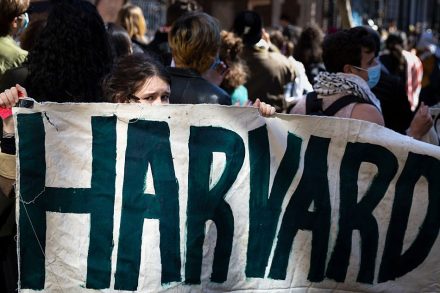
How Harvard lost America

President Trump’s proclamation, “Enhancing National Security by Addressing Risks at Harvard University,” pays a compliment to that crossroads of brilliance and turbidity. It treats Harvard as a serious educational institution, and one that in its misbehavior “presents an unacceptable risk to our Nation’s security.”    Trump was not referring to the risk of immersing some of America’s brightest and most ambitious students in a toxic soup of anti-Semitism, DEI and disdain for our republic. Nor were the “risks” he had in mind “everybody-gets-an-A" grade inflation or a curriculum that wastes the students’ intellectual talents on courses that sound more like entertainment (e.g.

harvard

Trump’s revolution is coming to the UK

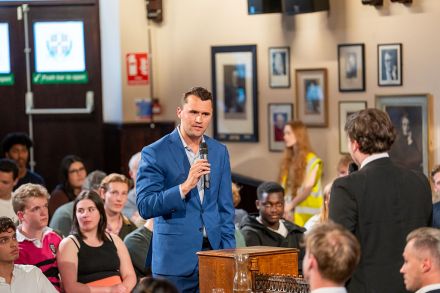
In May, Charlie Kirk, who died today from a gunshot wound, visited the United Kingdom to debate the students of Oxford and Cambridge, Britain’s two most prestigious universities. The Spectator asked him to write about the experience. The result was this well-observed, funny and now strangely prophetic-sounding piece about the condition of England. Charlie Kirk believed in free speech. He died speaking freely. RIP. Oxford and Cambridge When I was growing up, people often said British politics were where America’s would be in five, ten or 20 years. What this meant was that Britain was more to the left of America: more secular, more socially liberal, more environmentalist, more globalized.

Cambridge charlie kirk

The reviving of the American mind

In his 1987 book, The Closing of the American Mind, Allan Bloom argued that higher education no longer taught US citizens how to think. “We are like ignorant shepherds living on a site where great civilizations once flourished,” he wrote. “The shepherds play with the fragments that pop up to the surface, having no notion of the beautiful structures of which they were once a part.” Now, almost 40 years later, we’re even more clueless. The rot in academia has spread throughout the education system and can be found all over American life. Rational thinking has now been almost entirely usurped by the baser passions of anger and grievance, as we saw all too clearly in the collective insanity of the Black Lives Matter riots of 2020.

Trump
Trump

The Trump administration is giving us excellence, not equity

Americans are not a naturally gloomy people. We don’t necessarily expect things to go our way, but when they don’t, we can laugh it off. In my part of Vermont there’s a place called Hateful Hill, for example, so-named by stagecoach drivers who had a tough time with the steep road. But Hateful Hill is also a beautiful elevation. Today, even those who don’t “get” Donald Trump need to start seeing the upside. He doesn’t always get his way, which is probably a good thing, but he is leading a long-overdue revival of the American spirit and allowing for the return of optimism and the pursuit of excellence.

universities

Wokeism is stifling thought in America’s universities

The American education system needs drastic reform from bottom to top.  Our K-12 schools, both public and private, have come to be dominated by radical left-wing ideas. Schools not only indoctrinate students with a one-sided view of history and society, but they also increasingly fail in their core mission of imparting the basic skills needed to function in our advanced and complex society. Likewise, our universities, professional schools and graduate schools are in the grip of a far-left ideology that has compromised their traditional missions of truth-seeking, knowledge creation and the preservation and transmission of western culture and the advanced skills essential to its vitality and prosperity.

Another spring, another round of anti-Semitism on campus

The weather is growing warm, which means anti-Semitic demonstrations are blooming at elite universities. The hatred of Jews is no longer hidden, as it was in the days when Jewish enrollment was quietly limited by quotas. Now, it is displayed openly by a campus coalition led by hardline American leftists (students, faculty, and administrators) and Muslim students, some from America, some from the Middle East.  Their hatred is screamed at Jewish students and pro-Israeli speakers—and then at anyone who dares support them or simply demands the basic right to speak or be heard. Any support for Israel is damned as “genocide” and then shouted down, shamed, or worse.

campus

Harvard’s intricate China ties

Scratch almost any major US political story and sooner or later you’ll hit a big red nerve that belongs to the Chinese Communist party (CCP). Tariffs, energy, TikTok, the border, Fentanyl, Greenland, Panama, the Gulf of America – on all these subjects the Trump administration is, one way or another, trying to limit Beijing’s power in the West. And Donald Trump’s "war on Harvard," it turns out, is no exception. It’s clear that the President is pushing against anti-Semitism and the Diversity, Equity and Inclusion madness on America’s most famous campus, as well as in countless other colleges and universities.

Harvard

The mental health election spiral

My first semester of college coincided with the 2012 presidential contest between Barack Obama and Mitt Romney. I was a conservative from a small rural town at an elite liberal university, and this was not great for my social life. My freshman floormates at Georgetown defaced my political signs, made nasty comments to me in the hallways and on election night my RA dropped by my room to rub it in my face when the race was called for Obama. The following morning, we all went back to class and started preparing for midterms. Four years later, universities across the country all but shut down when Donald Trump won the 2016 election. Suddenly the mental health of the losers was priority number one. Classes were canceled to allow students space to grieve.

mental

Why plagiarism matters

Harvard president Claudine Gay’s troubling history of appropriating other people’s idea and words and passing them off as her own has a well-worn name: plagiarism. Every college and university in the United States prohibits plagiarism. Most present students with explicit rules against it and lay out the possibility of drastic punishments, such as failing a course and, depending on the severity of the offense, expulsion from the college. Typically, instructors in freshman English include lessons on the proper ways to quote, paraphrase and cite sources.  Why? What is so wrong with plagiarism? We don’t punish actors for reciting their lines and failing to add, “Mr. William Shakespeare wrote that.

plagiarism

The dangers of faux-education

François-Marie d’Arouet (1694-1778), commonly known as Voltaire, devoted his life to waging intellectual warfare against Christianity — the Catholic Church and Catholic culture in particular — along with its historic political and social allies, royalty and monarchy, which he condemned as a monstrous entity in his famous battle cry“Écrasez l’Infȃme!” Given his aims as a polemicist, a deist and a republican, Voltaire did not misconstrue the enemy whose destruction he called for.

education

The China influence puzzle

A “Chinese puzzle” in its classic version is a game where you must fit a variety of ill-assorted boxes inside other boxes. The term came to mean any intricate problem, especially one in which what looks like the way forward leads only to new obstacles.   These days, in which we are warned not to use ethnonyms for fear of giving offense, it might be safer to say something like “brainteaser.” But the efforts of the Chinese Communist Party (CCP) to manipulate American society genuinely deserve the old term. The news this past week adds a few curious details to those efforts. Details first; explanations to follow.

china ccp

Art history is now ‘Islamophobic’

At a private liberal arts college in Minnesota, art history is now Islamophobic. In October, an art history professor at Hamline University was teaching Islamic art, a segment that included two depictions of the Prophet Mohammed in fourteenth- and sixteenth-century paintings with significant historical value. The professor alerted her students beforehand, careful to ensure that observant Muslims who object to the depiction of their prophet would not have to see him on screen. It seems that the professor had done everything right: providing images of famous paintings for her students’ edification but allowing students to opt out of viewing them if doing so ran contrary to their religious beliefs. But who are we kidding? This is a liberal arts college in the twenty-first century.

Quaran

How Qatari money is undermining free speech at universities

“It is often said that history will judge us not only for what we said and did in times of strife, but also for our silence.” So wrote Northwestern University Medill School of Journalism dean Charles Whitaker in 2018. The statement was released following a heated exchange between former president Donald Trump and CNN reporter Jim Acosta, which resulted in the White House revoking Acosta’s press pass. Whitaker believed it was important for an “institution as prominent as Medill” to defend the journalism profession against such an “attack.” Four years later, Northwestern has failed to practice what it preaches: it fell silent when Qatari security officials threatened to smash a Danish journalist’s camera during a live TV report on the FIFA World Cup.

The dangerous rise of academic diversity quotas

Who should be the custodians of science? For centuries, scientists themselves have been. Now, their custodianship is under threat. Science has long operated as a sort of guild, with the guild managing its own practice and traditions. This holds for the guild’s continuity: admission of aspiring members to the guild is controlled by the guild itself. For the sciences, aspiring members must clear a competitive series of hurdles: apprenticeship (graduate school), journeyman (post-doctoral fellow and assistant professor), then full membership (tenured professor). For the past few decades, science’s stewardship has been shifting into the hands of an arriviste managerial class with no idea what science is or any real respect for it.

We don’t need more literary magazines

At CNN, Leah Asmelash laments the demise of many “long-standing” literary magazines. “The Believer,” she writes, which was started in 2003, “was once at the top of the literary magazine game. A leading journal of art and culture, the Believer published the work of icons like Leslie Jamison, Nick Hornby and Anne Carson. It won awards, it launched careers.” But the University of Nevada, which has housed the magazine since 2017, announced that it was shutting it down: “In a statement explaining the decision, the dean of the school's College of Liberal Arts called print publications like the Believer ‘a financially challenging endeavor.’” Oh, boy. Leslie Jamison, an icon? The Believer, a publication that “launched careers”?

How China meddles in American academia

"Congress has dropped language from a must-pass bill governing US defense policy that would have effectively prevented US scientists from participating in Chinese programs aimed at attracting foreign scientific talent,” reported Science, the journal of the American Association for the Advancement of Science (AAAS) in December. The journal cautions, however, that the provision may reappear in another bill. The AAAS is the most authoritative voice for American scientists. It has generally opposed any restrictions on relations between US academics and China, and favored the US government’s stepping back from investigating and prosecuting scientists for lying about their service to China.

china ccp

The University of Austin: a meteor aimed at higher ed?

Americans are beginning to seek alternatives to our established menu of colleges and universities. In fact, not just Americans. Students from other countries are also choosing alternatives to studying in the US. The combined effect has been a sharp drop in American college enrollment, which is down overall by about 8 percent over the last two years, and more than 14 percent at community colleges. International student enrollment is down a total of 15 percent, but that masks an even more serious problem: enrollment of new foreign students fell last year by 46 percent. Some of this, of course, is due to Covid. And some of it is due to a demographic shift: fewer babies born 17 to 20 years ago means fewer young people to fill the seats in lecture halls.

university

Why trigger warnings don’t work

The science is in, but don’t expect that to change anything. According to at least 17 recent studies, trigger warnings — those advisories posted ahead of content some readers may find distressing — not only fail to alleviate suffering in the emotionally disturbed but may actually induce greater trauma in those individuals. There are, to date, no studies that indicate trigger warnings work to their intended purpose. They were dreamed up in the 1970s after psychologists began to diagnose a new condition, post-traumatic stress disorder, in Vietnam War vets. But trigger warnings only reached popular consciousness in the 2010s, when feminist blogs used them ahead of content about sexual violence.

trigger
columbia

The problem with Ovid

'The Rotation Method’ is one of the most amusing sections of Kierkegaard’s Either/Or. The second-most famous melancholy Dane has some good advice for dealing with irritating absurdity: cultivate arbitrariness when confronted with flagrant examples of it. There is someone whose conversation you find insufferable. What to do? Kierkegaard’s narrator has some tips: ‘I discovered that he perspired copiously when talking. I saw the pearls of sweat gather on his brow, unite to form a stream, glide down his nose and hang at the extreme point of his nose in a drop-shaped body.’ There is much about cultural life today that can be profitably approached with the Rotation Method.