Universal basic income

Why progressive politics is like air travel

I was recently flown cross-country on a first-class ticket by a very kind outfit. It was my first time flying up front, and I told myself to make a note of everything in case it proved to be my last. Early in the flight, I noticed that I didn’t want the plane to land. It was a curious feeling and became harder and harder to ignore as the journey progressed. To be sure, the seat was not more comfortable than my easy chair at home. The food was not as good as the food at home. And the wine was certainly nice (it comes in a glass in first class; who knew?), but it wasn’t as good as the wine at home. So why didn’t I want that plane to land?

progressives

Andrew Yang is 2020’s ad blocker candidate

Every so often, a political candidate rises to the fore fueled by the grievances of people who are seriously annoyed. Donald Trump, for example, stoked the fires of an America in perceived decline. Ron Paul in 2008 capitalized on the backlash to the costly military interventions of the Bush era. In 2016, Bernie Sanders drew together a coalition of the young, the far-left, and the people who didn’t want to cast a vote for a Clinton ever again.

andrew yang

Would UBI actually work in America?

It seems like the perfect socialist ideal: massive unemployment, inequality in income and jobs along with growing class divisions can all be met by a common income that keeps every family fed, housed and healthy. Such is the current debate that is engaging every country that fears the fallout from the Artificial Intelligence revolution that is likely to eliminate tens of millions of jobs – up to 33 percent of all jobs in the US according to a McKinsey study. At the same time, many students leaving high school or graduating from college may face the reality of never being able to work. With social tensions across America already high, the idea of a Universal Basic Income for all seems like an attractive solution.

ubi yang

My evening with the Yang Gang

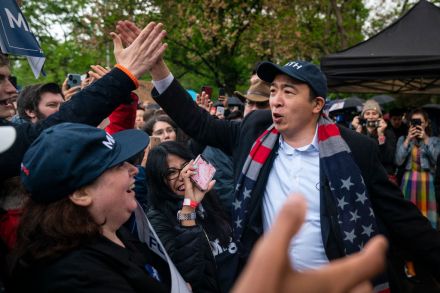
On Tuesday evening, I left my office suited up in a raincoat and a t-shirt that featured a picture of the nightmarish and internet-famous Philadelphia Flyers mascot, ‘Gritty.’ I was going to Democratic presidential candidate Andrew Yang’s rally in Washington Square Park, where thousands were expected to turn out despite the rainy weather (or, as my friend Cody commented, Blade Runner weather) to see the tech entrepreneur give his pitch for the presidency. I wasn’t quite sure what people would wear to a rally for Yang, a candidate who rose to prominence through memes and podcast appearances and whose supporters have been known to wave around signs that say ‘MATH’ and chant out ‘PowerPoint! PowerPoint!

andrew yang gang

The yin of Andrew Yang

Single issue campaigns are often built around whimsy. The Polish Beer Lovers’ Party springs deliciously to mind, as do Jimmy McMillan’s tireless efforts to remind New Yorkers that the rent was too damn high. Andrew Yang’s attempt to become the Democratic Party candidate for the 2020 elections is based on an idea that might seem whimsical and yet he is a deeply serious man. His campaign is to address the problem of automation: how, in other words, to make the best of a future where machines have rendered millions of jobs redundant. The first thing to be said is that Yang has about as much of a chance of becoming the Democrat nominee as this author has of becoming the UFC heavyweight champion.

andrew yang