Uk politics

The Prince is playing politics

From our UK edition

Lord Mandelson argues in the Evening Standard that Labour’s legislative programme has the Tories running for cover. The forthcoming debate should prove this thesis to be nonsense. 7 minutes of largely rehashed policies, including all the old favourites – equality, the ‘smarter’ state and so forth, is unlikely to give Cameron sleepless nights. I suspect Mandelson knows this as there is little substance to his argument. The article contains more insinuations than an episode of Midsomer Murders. Mandelson writes:     ‘David Cameron seems to be getting a little rattled. Following his flustered performance at PMQs last week, he seems shocked and disconcerted to be facing a political fight again.

Nothing to see here

From our UK edition

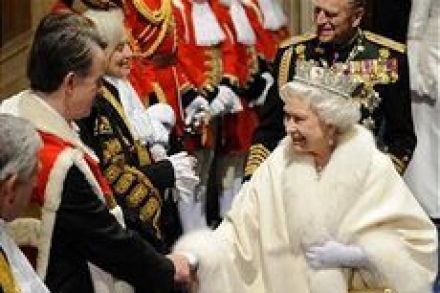
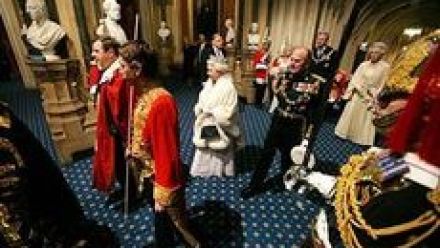
Blink and you missed it.  After seven minutes, the Queen had rattled through the Government's legislative agenda for the next few months.  It was all pretty much as expected – although it’s worth noting the “council of financial stability,” made up of the Treasury, the Bank of England and FSA, chaired by the Chancellor, and which was first mooted back in July.  The question is whether any of this will connect with the public.  I rather doubt it. We’ll put footage on Coffee House as soon as it’s available.

Last chance saloon

From our UK edition

So what to make of today's Queen's Speech?  Myself, I'm finding it hard to drum up much excitement.  After all, we already know most of its contents (if you want a primer, then check out this excellent Guardian summary article here), and much of it is either underwhelming, unworkable or – as everyone from David Cameron to Michael White has pointed out – self-servingly political on Labour's part.  Tory peers are saying that they'll block the proposals, but you've got to doubt whether they'll be enacted before the next election anyway.  All in all, Danny Finkelstein's analysis is attractive.  As he puts it: "who cares?" But there is one sense in which this Queen's Speech matters.

Things are as they seem

From our UK edition

Steve Richards writes a stirring defence for what is likely to be Labour’s last legislative programme. Richards argues that if you suspend your disbelief and ignore everything you have read about current political situation and you will see not a tired, regressive government but a radical political force. ‘Perhaps none of the proposals will be implemented by the election. Maybe they will all turn into dust, but they mark a departure from cautious incremental approaches usually adopted by the Government. The Conservatives' equivalent proposals have an echo with the mid 1990s, while their Euro-scepticism takes us further back, and their plans for spending cuts to 1981.

Afghanistan: air fares, not infantry needed

From our UK edition

The British government’s policy on Afghanistan has a spasmodic, yet regular kind of rhythm to it. The issue pops up at intervals, hovers menacingly over Brown’s premiership until the PM awakes from a period of inaction. He then goes into hyper-drive, promises all manner of things, and reverts to inactive type a few days later only to repeat the routine a some days/weeks/months [cross out as appropriate] afterwards.  This time is no different. While the government, along with our allies, wait around for the US president to make up his mind on an Afghanistan (and, by extension, how his first term will be remembered), the PM has been overflowing with schemes and speeches.

The gathering storm

From our UK edition

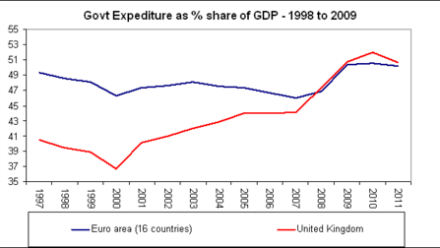
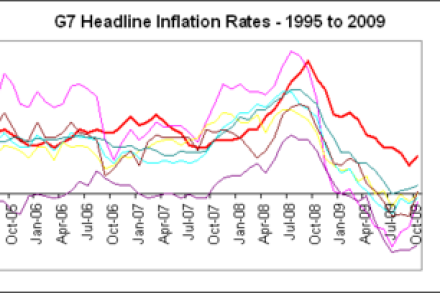
The UK inflation rate again “surprised” to the upside today, registering at 1.5%. As the above chart shows, the UK now has by some margin the highest inflation rate in G7. Were it not for the temporary VAT cut – which takes about 1% off the current CPI rate – the rate would be moving quickly above the Bank of England’s target of 2%. It would seem that the deflation threat, used as justification for the Bank of England deciding to finance the Government’s deficit this year through printing money, has not transpired. A severe recession and rise in unemployment has hit the economy, but this seems to be one where wages stagnate but the prices of what we consume continue to rise.

Your chance to grade Gordon

From our UK edition

The public's judgement on Gordon Brown will probably come with the general election, but CoffeeHousers may have fun with this webpage in the meantime.  It has been created by the clean-up-politics organisation Power 2010, and will let you grade Gordon Brown in the aftermath of tomorrow's Queen's speech.  Naturally, the grades run from A ("Top of the class") to F ("Brown fail"); you can leave comments; and Gordon will receive a school report in December.  I suppose it's meant to help close the democratic deficit between Downing St and the rest of the country – but it could just help some folk let off a little steam...

The liberal centre’s continuing confusion on challenging the BNP

From our UK edition

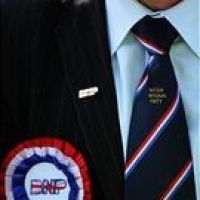
My recent post about the BNP has offended liberals as well as the hard right. Liberal Conspiracy’s Sunny Hundal writes: ‘David is highly confused. This is because he says: "The Spectator has maintained that the party’s domestic policies are inspired by racial supremacist ideology and that its economic policies are like Dagenham – that is, three stops beyond Barking." Yes, I’ll agree with that. The party’s domestic policies are indeed inspired by a racial supremacist ideology. Which is why people should avoid following those policies right? Except, he does on to say centrist parties “must engage with (and I mean engage with, not shout down)” BNP policies. What a muddle.

Brown misjudges the Afghanistan waiting game

From our UK edition

There's something futile about Gordon Brown's and, now, David Miliband's speeches on Afghanistan.  After all, the world is still waiting to hear what Obama's strategy is for the country.  Will he increase troop numbers – and by how much?  What does he actually want to achieve with them?  Until that's known, it's a little premature to talk about a "comprehensive political framework" for handing security responsibilities over to the Afghan army. Worse, though, the PM's statements may actually be damaging.  Sure, it's frustrating that the US President is leaving his allies hanging.

Is Blair’s bid for the EU presidency still alive, after all?

From our UK edition

I still think there are too many hurdles standing in the way of Tony Blair, but it's worth noting this passage from Ben Brogan's latest blog post about our former PM's chances of becoming EU President – particularly the bit I've highlighted in bold: "When the manoeuvring [by EU leaders] is stripped out, who is their first choice [for the EU presidency]? Weirdly, 12 or 13 say Blair. Strip out the ones who are dead against – Belgium, Luxembourg and Austria (now there’s a triple alliance to conjure with – talk about surrender monkeys) – and the Swedes who hold the presidency and that leaves you a sizeable majority and the chance of winning a few more over.

Cameron fires a broadside at ‘petty’ Brown

From our UK edition

David Cameron has written an apoplectic editorial in the Times condemning Gordon Brown’s partisan hijacking of the Queen’s Speech. Here is the key section: ‘We are mired in the deepest and longest recession since the Second World War, with deep social problems and a political system that is held in contempt. The State Opening of Parliament tomorrow ought to be about radical ideas to deal with this triple crisis. Instead, by all accounts, the Queen’s Speech will be little more than a Labour press release on palace parchment. Don’t take my word for it. As The Times reported yesterday, a Cabinet minister has been boasting about the contents of the speech. What was said? That it was the most ambitious since Labour had come to power?

Balls dumps Brown into another lose-lose situation

From our UK edition

Things never seem to go smoothly for Gordon.  On a day when the Telegraph carries details of his Whitehall savings programme, the FT has news that one of his closest allies, Ed Balls, is calling for relatively hefty spending increases elsewhere.  Apparently, Balls has asked the Treasury to grant his department – the Department for Children, Schools and Families – real-terms spending increases of 1.4 percent until 2014.  That's an extra £2.6 billion in total – and goes beyond previous Labour commitments to "protect" schools spending. It's a brassy move by Balls and one which is sure to aggravate his colleagues.

Carry on camping | 16 November 2009

From our UK edition

Over at his blog, Nick Robinson has put together a useful digest of the different attitudes towards Brown's premiership inside the Labour party.  Putting it briefly, he thinks Labour MPs fit into three distinct "camps": 1) The plotters: "...believe that Mr Brown is taking their party to certain oblivion and are still desperately searching for ways to remove him and to install a new leader by January." 2) The quitters: "...agree with [the plotters'] analysis but have given up hope of installing a new leader who just might do better." 3) The fighters: "...are beginning to hope that a recovery might just be possible." It's a neat outline, albeit one which is pretty intuitive.

Going broke and going for broke

From our UK edition

The Times has a fascinating story on how Labour’s lack of cash is forcing it to give up on seats and groups of voters. The paper reports that seats with a majority of less than 3,000 have been effectively written off. So even before the campaign has begun, Labour is basically forfeiting 60 seats. By contrast, the Tory marginal seat operation — funded by Lord Ashcroft’s cash — is pushing further and further up the Tory list of target seats. (I was talking to one Tory candidate recently who thought that the resources poured into her seat — currently held by Labour — in the last 18 months or so had made it an almost certain gain for the party, barring disaster during the campaign).

Unnecessary respite from reform

From our UK edition

This snippet from Jon Snow's latest blog-post (with my emphasis) is jaw-dropping: "To add to matters, I have learned that the Labour party is now going through its ranks of peers to determine where their 'principal residence' is. This after years of wholesale abuse of the system in which lords and ladies of all persuasions have claimed distant holiday homes to enable them to get the accompanying unreceipted travel expenses. I have also learned that 'arrangements' have been made to allow serving ministers in the Lords to claim a residence out of town 'for necessary respite', retrospectively protecting ministers and law officers who may have claimed for such provision.

Labour’s next election broadcast

From our UK edition

Over at his New Statesman blog, James Macintyre reveals that Labour's next election broadcast will be the sentimental, two-and-half minute history of the Labour party shown before Brown's speech at the last party conference.  We've embedded it below, for the – ahem – benefit of CoffeeHousers; so I'll repeat the question I asked during our live blog of Brown's speech: "This is clearly a Labour crowd-pleaser, but will it make any difference outside the conference hall?

The Tory leadership could be talking like Boris soon

From our UK edition

So Boris is attacking the 50p tax rate again - and rightly so.  In his Telegraph column today, the Mayor of London repeats the lines he pushed in April: that the measure will drive business talent away from our shores, that it will damage London's competitiveness, and that it could actually lose money for the Exchequer.  It all comes to a punchy conclusion: "What Gordon Brown wants to do is therefore economically illiterate." I imagine a few commentators will see that last line as a veiled attack on the Tory leadership, given that they're committed to the tax rate too.  But, as Tim Montgomerie says over at ConservativeHome, and going off conversations with Tory types, I doubt that Cameron and Osborne would disagree with the thrust of Boris's article.