Uk politics

The axeman cometh | 27 November 2009

From our UK edition

Philip Hammond, the man the Tories have tasked with overseeing spending cuts should they get into power next year, has just given a speech to Policy Exchange on reducing waste and improving efficiency. Much of it reheated existing arguments about, say, transparent public spending - which doesn't make those arguments any less valid.  But there are one or two other points worth mentioning here First, the very fact that Hammond was making this speech.  Introducing him, George Osborne complained that the Labour government has made Hammond's potential role - Chief Secretary to the Treasury - a non- job, and that the Tories would restore it to being "one of the most important jobs I'm government".
Commissioner Boris

From our UK edition

The Evening Standard reports that Boris Johnson is set to become the Tories’ first elected police commissioner. Chris Grayling told the paper: "We envisage the Mayor of London being the elected police commissioner. This would strengthen the role of the Mayor. However, I'm absolutely clear that no reform we introduce will allow any elected politician to interfere in operational policing and we will make absolutely certain that the independence of operational policing is protected in law." Under Tory proposals the mayor will be responsible for hiring and firing chief constables, tailoring police objectives to local requirements and budgeting. Naturally, the contrarians are gathering.

Dodgy doings in the desert

From our UK edition

Of all the lunacy engendered by this financial crisis, Dubai’s decision to call a six-month creditor standstill on its chief holding company is the most pronounced. Dubai’s successful but hideous entrepot model depends on the confidence capital markets, and as a rule markets don’t react to nasty shocks with a shake of the head and a song and dance routine. It’s as if plague has descended on every stock exchange in the world; investors are fleeing for safety. Overnight, shares in Asia collapsed between 3 and 5 percent, and the FTSE, Dax and Cac40 have opened around one percent down. Prepare for another black day. Will this blip develop into a crisis?

Turning Japanese

From our UK edition

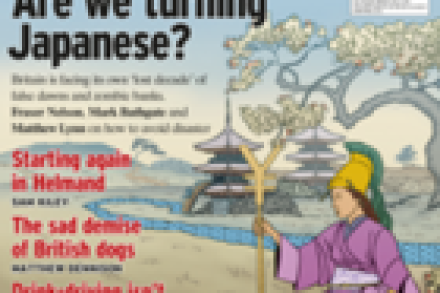
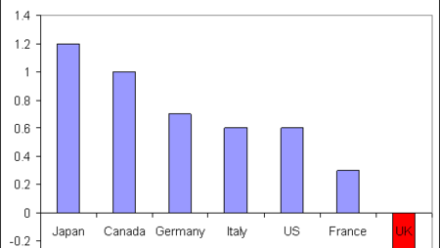
Is the British economy turning Japanese? Since asking the question last year on Coffee House, the evidence has been piling up – and it makes for a cover story in this week's magazine (which I have written with Mark Bathgate). The similarities are as follows: 1. Japan’s bust followed years of debt-fuelled growth which vain politicians saw as prosperity. 2. When the bust came, Japan’s government kept on spending. They did so in the name of Keynsian stimulus, thinking this would in itself kick start a recovery. All it achieved was to sink Japan deeper into debt. 3. Crucially, Japan didn’t do full disclosure on the collapsed banks. To fix the banks was, they figured, painful root canal surgery that this recession-struck country could do without. 4.

What Gordon thinks of London 2012

From our UK edition

Another good quote for the Brown 'n' Blair scrapbook, courtesy of Ben Brogan's column in the Telegraph: "Only once in the 20th century has a government that won the games survived to deliver them. A change of administration in the run-up to the Olympics might be expected to herald political trouble. Thankfully, David Cameron does not share Gordon Brown's loathing of what he refers to as 'Tony's f------ Olympics'. He is committed to ensuring stability by protecting London 2012's status as the Switzerland of politics, immune from partisan attacks." Brogan's wider argument is worth noting: that the Cameroons think 2012 could be the tonic the country – and their potential mid-term government – needs.  Myself, I still think there's a strong case for an Austerity Olympics.

The Red Tory

From our UK edition

Phillip Blond has been attracting a lot of publicity in the past few weeks and it was standing room only at the launch of his new think tank Res Publica. (I should say that I am on its advisory board). David Cameron gave the opening remarks, stressing the influence Blond's thinking has had on how the Tories think about poverty and public services, but he was also keen to point out that he doesn't agree with everything that Blond says. Ever since the trouble caused by last summer's Policy Exchange report advocating abandoning various northern cities, the Cameroons have been wary of getting too close to any think tank for fear of being tarred by association.

Smoking guns and missing memos

From our UK edition

Sir Christopher Meyer gave evidence to the Chilcot inquiry this morning. He spoke with characteristic flamboyance, awash with elegant witticisms and indiscretions calculated to amuse. Amid this tour de force, Meyer released one potential weapon of mass destruction. Hans Blix was given too little time to conduct a satisfactory inspection. Courtesy of Andrew Sparrow, here is the relevant transcript: ‘The real problem, which I did draw several times to the attention of London, was that the contingency military timetable had been decided before the UN inspectors went in under Hans Blix. So you found yourself in a situation in the autumn of 2002 where you could not synchronise the military timetable with the inspection timetable.

Johnson: the Tories aren’t the “nasty party” when it comes to immigration

From our UK edition

There are plenty of noteworthy snippets in Mehdi Hasan and James Macintyre's interview with Alan Johnson today, but it's this passage which jumped out at me: "Johnson even chooses to defend the Tories on immigration, saying they represent a 'mainstream, centre-right' party engaging in a 'decent, centre-ground debate on immigration'. This, despite the Tories having stuck to the 2005 pledge, under Michael Howard, for an immigration 'cap', which - along with campaign posters asking 'Are you thinking what we're thinking?' - led to accusations of 'dog-whistle' politics." It's a truism that in order to have a sensible debate, you've got to be willing to actually have a debate – so it's encouraging that Johnson is taking this more conciliatory approach to the question of immigration.

Byrne draws a dividing line over decentralisation

From our UK edition

Good work by the Guardian, who have got their hands on leaked sections of a government report into downscaling Whitehall.  At first glance, it all looks kinda promising.  There are provisions to reduce the cost of senior civil servants, to cut the numbers of quangos, and to make it more difficult to establish new quangos.  Surely, these are measures which will be necessary to fix our broken public finances. But it's the headline idea which could give you cause for concern: namely, that the government "wants a review" into relocating around 200,000 civil servants and other public sector workers away from London and the South-East.  It's meant to strengthen localism and reduce costs - which is nice, if it works.

The man who hopes to unseat Harman

From our UK edition

The papers have been stuffed with articles recently about the current crop of Tory party candidates – but few have been as readable, or as encouraging, as Rachel Williams' profile of Andy Stranack in today's Guardian.  Stranack is the Tory PPC in Camberwell and Peckham – Harriet Harman's seat – and his background is really quite remarkable: "In 2001, Stranack ignored the concerns of his family ('They thought I was mad'), gave up his £30,000 a year council policy officer job in Croydon, south London, sold his maisonette, and moved to the borough's deprived Monks Hill estate. He stayed there, living on the poverty line and doing church-backed community work, for six years.

A game of chess

From our UK edition

Fascinating details dominated PMQs today. Instead of the usual custard pie-fight this was a game of chess. Things began with talk of downpours and sandbags. Both leaders were concerned that the sodden folk of Cumbria are receiving enough hot soup and blankets. The PM reminded us that he’d recently popped up there to squelch around in his wellies shaking people’s hands and nodding sympathetically. Then Cameron pulled out a firecracker. He accused Brown of shambolic incompetence in allowing public money to flow into the hands of a front organization for Hizb ut-Tahrir, an extremist group whose constitution denounces non-Moslems in virulent terms. ‘They are combatants in the battlefield. Their blood is lawful, as is their property.’ One thing’s for sure.

Cause for concern

From our UK edition

That Ipsos-Mori poll is still making waves, with both Steve Richards and Daniel Finkelstein devoting their columns to the prospects of a hung parliament. Steve is excited by the possibility, thinking that it would restore the Commons to its rightful place as the cockpit of the nation. Danny is concerned by it, fearful of the consitutional damage it could inflict. But it strikes me that the real reason to worry about a hung parliament is the financial markets. How would gilts traders react to a weak government that was incapable of making cuts? One of the few advantages Britain has - as it strugggles to deal with a deficit which is almost three times as large as a proportion of GDP than when we called in the IMF in the 1970s - is that our system tends to create strong governments.

Missing the point | 25 November 2009

From our UK edition

The Today programme really let Paul Myners off the hook this morning. The interviewer obsessed with why the loans had remained secret for so long. It’s a fair question, and it seems bizarre that we only learn of them ten months after the borrowing was repaid in full. However, there are more important questions. As I wrote yesterday, these disclosure’s most potentially volatile revelation is that Gordon Brown was propping up HBOS whilst urging Lloyds to purchase the ailing giant. Was this issue examined in any depth? No, though it must be determined whether the Lloyds’ board understood HBOS’s predicament in its horrific entirety. The equally crucial question of how the government is addressing the banking system’s continued frailties received scant attention.

With friends like these | 25 November 2009

From our UK edition

Bob Ainsworth has publicly criticised President Obama’s slothful deliberation on an Afghan troop surge. The Defence Secretary said: ‘We have suffered a lot of losses. We have had a period of hiatus while McChrystal's plan and his requested uplift has been looked at in the detail to which it has been looked at over a period of some months, and we have had the Afghan elections, which have been far from perfect let us say. All of those things have mitigated against our ability to show progress... put that on the other side of the scales when we are suffering the kind of losses that we are.

There are more pressing financial concerns than this

From our UK edition

The two top dogs at the Treasury Select Committee, John McFall and Michael Fallon, give remarkably different reactions to the news that ministers withheld details of emergency loans to RBS and Lloyds for over a year. McFall argues that secrecy was necessary to avoid a run on the banks; Fallon expresses outrage that Lloyds’ shareholders were not privy to all information when considering the disastrous purchase of HBOS, urged on them by the Prime Minister.   Both have their points. Blind panic is the defining recollection of those autumnal days. If the situation had been exacerbated by full disclosure of the mess RBS and Lloyds were in then God alone knows what pandemonium would have ensued.

Will Chilcot be any different?

From our UK edition

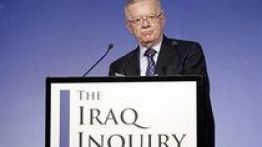
The Chilcot inquiry’s precedents don’t auger well. It's unfair to describe the Hutton and Butler inquiries as 'whitewashes', but their colour was certainly off-white. That said, the condemnatory characterisation of Sir John and his panel as ‘establishment figures’ is redolent of a lower-sixth common room circa 1968. Who else could conduct this inquiry? Mohammed al-Fayed? Pete Doherty? The Bishop of Bath and Wells? The Iraq controversy has not abated and a panel of angels would not be pure enough for some. But it’s absurd to suggest that anyone besides officials and foreign policy experts, with an intricate knowledge of the practices and issues concerned, should or can decide such matters.

Yet another poll for the mix

From our UK edition

After the Ipsos MORI hullabaloo, it's tempting to treat the YouGov/Telegraph poll on Westminster voting intentions in Scotland with extreme caution.  But, for the record, here are the headline figures, and a hefty rise for Labour: Labour --- 39 percent (up 9 points from August) SNP --- 24 percent (down 2) Conservatives --- 18 percent (down 2) Lib Dems --- 12 percent (down 6) As this fits in with another recent poll, it's safe to say that Labour have solidified their support in Scotland during and after the Glasgow North by-election.  And there's more discouraging news for the SNP: at 29 percent, support for Scottish independence is hardly overwhelming – even if it's practically unchanged since the last poll on the issue.

Mandelson downplays Van Rompuy and Ashton – and bigs up the EU’s financial influence

From our UK edition

To my eyes, there's more than a little dose of mischief in Peter Mandelson's article for the FT today.  Discussing the recent EU jobs grab, he seems to suggest that the new economic and financial commissioners may have a more important role to play than either Herman Van Rompuy or Lady Ashton, the EU’s president and high representative, respectively: "Some commentators felt that the EU’s choices for its new president and high representative for foreign affairs lacked this kind of continental ambition. Herman Van Rompuy and Lady Ashton will no doubt aim to prove them wrong. But Europe’s dilemma is not just one of influence projection. Europe’s influence will inevitably be tied to its economic strength.