Uk politics

The choice facing the Tories

From our UK edition

If you'd like a step-by-step preview of Labour's next election campaign, then do read Alastair Campbell's latest blog post.  All of Brown's attacks from PMQs are in there, and then some: "tax cuts for the rich"; a lack of "policy heavy lifting" on Cameron's part; the Tories "haven't really changed", etc. etc.  The spinmeister has been in closer contact with Downing Street recently, and it shows.  It's all gone a bit bar-brawling. The Tories now face a choice between, broadly speaking, three different responses: i) Ignore Campbell.

Might there be some fight left in the class war after all?

From our UK edition

The Tories are in mild shock following PMQs, they never expected Cameron to get clunked like that. Brown is clearly going to try and use Tory inheritance tax policy to ram home the message that a Cameron government will be a government of the rich, by the rich, for the rich. But the Tories are taking comfort from their belief that Brown’s ugly class war politics won’t work, pointing to how they failed in Crewe and Nantwich. But the attacks on Edward Timpson backfired, at least in part, because Timpson was a bad target. It is hard to portray someone as an out of touch, uncaring toff when their family have fostered 80 odd children and have a long history of local philanthropy.

Graph of the day

From our UK edition

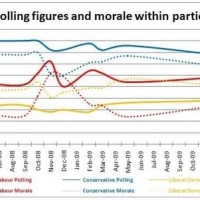
Here's a neat little graph from PoliticsHome, which plots the three main parties' opinion poll ratings alongside their "party morale rating" from the PHI100 tracker.  As PolHome put it, it kind of tells us what we know already: that party morale more or less correlates with poll position.

Etonians and Bolsheviks

From our UK edition

A terrific PMQs today. This exchange had it all. Noise, laughter, rhetoric, anger, humiliation, jokes, and dramatic swings in the balance of advantage. We even had a sighting of that great Westminster rarity – a fact.  Cameron’s first question elicited simple information. Would our troops start returning from Afghanistan in 2010 or 2011? Brown didn’t quite answer it but said that by 2011 the combined forces, including Afghans, would number 300,000, by which point the military burden ‘will start to change’. Cameron clarified. ‘That sounds more like 2011.’ Brown didn’t demur.   Turning to the economy Cameron asked why Britain is the last G20 country to come out of recession.Brown: We aren’t. What about Spain?

A PMQs to damage Brown?

From our UK edition

A quick tour around the political blogoshpere, and it seems everyone is saying Brown came out on top in today's PMQs.  For what it's worth, I'd agree with them – but only to a point.  On the one hand, Cameron was unusually clumsy, which allowed Brown to land some pretty decent blows.  But, on the other, I suspect some of those blows won't play well on TV later.  And, let's not forget, the entire point of PMQs, from the leaders' perspectives, is to score some coverage on the Ten 'O' Clock News.   It all depends on what the broadcasters pick up on.  If it's Brown's gag that the Tories' IHT policy was "dreamed up on the playing fields of Eton", then it will hardly reflect well on the PM.

Diplomacy in action

From our UK edition

It's obviously excellent news that the five British sailors incarcerated by Iran on Monday night have been released without incident. Exacerbating already strained diplomatic tensions would have been an enormous temptation to the Iranian regime and David Miliband is right to commend their "professional" conduct in this matter. Miliband said:  "The Iranian authorities gave us every indication that they wanted to deal with this in a straightforward, consular way. It was never a political matter and I welcome the fact they have dealt with it in this professional way." The Foreign Secretary added, "it proves that diplomacy can work".

This small man thinks he’s St. Joan

From our UK edition

I sympathise with Alistair Darling and his defence of the City. When he’s not contending with Gordon Brown’s suicidal Tobin tax proposals, Darling has to confront Nicolas Sarkozy’s calculated anti-Anglo popular politics. Yesterday, the Elysees’s Puss-in-Boots delivered a deliberately provocative and economically senseless attack on what he described as the “unconstrained Anglo-Saxon market model.

Testing times for the Tories

From our UK edition

The opinion polls are continuing to feed the story that the Tories are in trouble. Tonight’s Politics Home data which shows Cameron’s personal ratings dropping 15 points in the last 10 weeks follows a string of polls where the Tories have failed to break through the forty percent mark. Tory morale has been a bit shaken by these polls; Cameron could do with a decisive win at PMQs tomorrow to gee up the Parliamentary party. But turning these numbers around is, I suspect, going to require some policies that show us what David Cameron’s irreducible core is. Oddly enough, I don’t think these policies have to be particularly popular but they have to show the electorate that Cameron stands for something, that he isn’t just another say anything to win politician.

The case for NHS reform

From our UK edition

Britain remains the sick man of Europe. Professor Sir Mike Richards’s report finds that although progress has been made on cancer treatments, diagnosis rates, and therefore the chances of survival, lag behind European standards. A deluge of statistical analysis supports Richards's findings. The European Journal of Cancer’s recent research into solid cancers, such as breast cancer and melanoma, demonstrated that the speed of diagnosis and survival rates in the UK were “20% below” the European average. Additionally, the table below, which is taken from 2009’s OECD health data, illustrates that the gap between the number of cancer deaths per 100,000 population in Europe and the UK has widened.

Burnham enters the fray

From our UK edition

Oh dear.  The Labour leadership speculation is back in full effect, thanks to Paul Waugh's scoop in the Standard.  According to Paul, Andy Burnham is "prepared to throw his hat into the ring" to succeed Gordon Brown, should it all go wrong for Labour in the next election.  Apparently, he's even lined up Tessa Jowell as his campaign manager – although, naturally, the Health Minister is downplaying the claims. One thing's for sure: this story is badly timed for Labour – with their recent progress in the polls – and Brown could well do without another bout of leadership wrangling to undermine his premiership.  But what about Burnham – has he got what he takes to become Labour leader?

The good and/or bad news for the Tories is that there hasn’t been a Brown Bounce

From our UK edition

If you're still scratching your head over the latest opinion polls, then I'd recommend you read Anthony Wells' latest post over at UK Polling report.  In it, he outlines four potential reasons for the diminishing gap between the Tories and Labour: Cameron's "reverse" over the Lisbon Treaty; increased economic optimism; Labour performing better; and the absence of positive feeling towards the Tories.  To my mind, it's probably a case of "all of the above," to varying degrees – but, as Anthony concludes, "we can't tell for sure." One further point that's worth making is that the reduced gap between the parties isn't due to a "Brown bounce".

Paranoia rather than camaraderie

From our UK edition

Another one for the Brown as Nixon folder, courtesy of Rachel Sylvester's column today: "'It’s about style of government,' says one senior figure due to give evidence [to the Iraq Inquiry]. 'Blair would have a war Cabinet, but a small caucus would meet beforehand. The civil servants were frustrated. Gordon is just as bad. He gives lots of time to Peter Mandelson and Shriti Vadera and ignores the officials. There’s a darker side to the Brown machine — he’s more suspicious. It’s cliquiness driven by paranoia rather than camaraderie, but it has the same result.

The clock is ticking on Iran

From our UK edition

When I visited Israel last year, various sources there were convinced – adamant, even – that Iran was within a year or two of creating an atomic bomb.  That may or may not have been the case, but it's still ominous that that hypothetical timeline is nearly up.  We can all too easily forget that, in the background to all the column inches and comment pieces expended on Iran, there are genuine and pressing concerns that the country is on the cusp of becoming a nuclear power. Which is why the two latest news stories from the country are particularly worrying: the capture of a racing yacht by the Iranian navy and Tehran's plan to massively expand its uranium enrichment programme.

The Tories need a more positive message

From our UK edition

The Lib Dem’s policy to make everyone’s first 10 thousand pounds of income tax free is, whatever its imperfections, a significant doorstep offer. By that, I mean it is something that those canvassing for the Lib Dems can say in an attmept to get the voters to listen to them rather than shut the door in their face. This is something the Tories are short of. At the moment, the Tories have a bunch of smaller policies — abolishing HIPS, freezing council tax, only millionaires paying inheritance tax — that by all acounts go down well on the doorstep. But they lack a big policy that defines the party to voters. When I talk to Tory candidates I always ask them what their message on the stump is.

The doubts that remain after Brown’s Afghanistan statement

From our UK edition

So there we have it.  Gordon Brown has confirmed what we all expected: that 500 more British troops will be sent to Afghanistan, bringing the total UK presence up to around 10,000.  The "surge" will be rounded off when Obama announces something like 35,000 extra US troops tomorrow. Although greater manpower is A Good Thing for the mission in Afghanistan – and the mission in Afghanistan is certainly an important one – I can't help but have some qualms about the twin UK and US announcements.   For starters, there's the simple issue of numbers.  500 more UK troops and 35,000 more US troops falls short of the bar of 2,000 and 40,000, respectively, that some military figures had set.  It may not make much difference.

Labour’s free for all

From our UK edition

The potentially huge exposure of UK banks in Dubai, depreciating some UK bank share prices again this morning, is a reminder of just how much UK bank lending grew in recent years. The above chart shows the growth in external claims of the UK owned banks around the world over the past decade. The sums lent almost quadrupled to nearly $4 trillion in 8 years.  Anyone interested in discovering which bubbles the UK banks (and now taxpayers) have funded can find the data on the Bank of England website - $1.2 trillion in the United States, $125 billion in Spain, $183 billion in Ireland, $50 billion to the UAE/Dubai. Bank profits soared, and the “New North Sea Oil” of booming bonus pools was taxed to fund ever growing government spending.

Tory corporation tax plans become clearer

From our UK edition

During the Tory party conference, I wrote about how the Tories were developing plans to radically cut corporation tax. In recent weeks, the Tories have been dropping plenty of hints about this agenda but giving little detail on it. After reiterating the Tories' existing plans to lower the rates of corporation tax at the CBI conference last week, David Cameron said: "and we want to go further." Today, in an interview with the FT, the Tory treasurer Michael Spencer reveals that he is "hopeful that, over the next parliament...we will get corporation tax down towards the 20 per cent level." Spencer is close enough to the leadership to know what he is talking about, and his comments track with what is being said in private.