Uk politics

Burning bridges

From our UK edition

A noteworthy point from Tim Montgomerie in ConservativeHome's latest general election briefing*: "The Daily Mail continues to blast Labour for neglecting marriage, as in an editorial today. It accuses Labour of being 'deluded' and 'opportunist'. The Conservative policy is praised as 'creditworthy'. The family is one of the top concerns of the paper's Editor, Paul Dacre. Brown is undermining the last hope he had with Dacre by allowing Ed Balls to trash the Tory plan to save the two parent family." Of course, no-one really expects the Mail to turn out for Labour come the election, but – after the attack they launched on Cameron before Christmas – the Tories will certainly welcome a spell of less ambiguous support from the paper.
A matter of trust

From our UK edition

Oh dear.  Seems like Labour supporters don't have too much faith in their party of choice.  A new poll for PoliticsHome finds that only 47 percent of "natural Labour supporters" believe that their party is either "fairly likely" or "very likely" to fulfill its manifesto pledges.  That's against 77 percent and 75 percent for Tory and Lib Dem supporters, respectively. Of course, you'd probably expect this kind of result for a party which, thanks to 13 years of government, has had plenty of opportunity not to deliver on its promises.  But it still demonstrates just how difficult Brown will find it to convince the public about his "guarantees".

Making social reform affordable

From our UK edition

Last week we heard that the Tory leadership are considering limiting their £20-a-week marriage tax break to make the policy more affordable.  And, today, Iain Duncan Smith outlines just how that might work.  In his latest report for the Centre for Social Justice, he sets out a range of costings for the policy: For all married couples: £3.2 billion For married couples with dependent children or in receipt of Carers Allowance: £1.5bn For married couples with children under 6: £0.9bn For married couples with children aged 0-3, the most important years for a child’s development: £0.

The Tories’ simple moral purpose

From our UK edition

Education is the area where the Cameron agenda inspires most. The supply-side revolution the Tories are planning to enable, will transform education for the better in this country. This morning, the Tories launched the education section of their draft manifesto at the Walworth Academy in south London, one of the ARK schools.  The event was memorable for a compelling performance by Michael Gove. Gove, speaking with the passion of a preacher, set out the ‘simple moral purpose’ of expanding opportunity that lay behind his education reform proposals. He detailed how the gap between rich and poor grows as children spend longer in school and how more boys at Eton get three As a A-level each year than all the boys on free school meals in the country.

Three steps to cleaning up our toxic banks

From our UK edition

Fraser outlined the problem with the British banks in his earlier post, but I’d like to suggest a three-step solution.   1. To deal with the problem, you have to admit to the problem. This is the First Step for Alcoholics Anonymous 12 step plan but holds true for politics. Say it out loud: the banking system is still broken. It needs fixed, and the process won’t be pretty. There will always be a political temptation to turn a blind eye, as there was in Japan during its ‘lost decade’. 2. Use an objective and credible third party to analyse the ability of banks to withstand losses, and to go through their balance sheet with a fine tooth comb.

At last, a “brazenly elitist” approach to teacher recruitment

From our UK edition

The next target for the Tories’ policy blitz is teacher recruitment. Cameron will pledge a “brazenly elitist” system with considerable incentives to lure top graduates from law firms and banks and into state school classrooms. What will this entail? Well, holders of degrees of less than a 2:2 will not receive funding for teacher training. Maths and science graduates with firsts or 2:1s from the 25 top universities will have their student loans paid off if they go into teaching; repayment will be staggered to encourage teachers to remain in the profession. The Tories will scrap graduate teaching programmes and replace them with on the job training, modelled on the hugely successful Teach First scheme.

The burka is a symbol of division, but it should not be banned

From our UK edition

On the face of it, Nigel Farage is right: “There is nothing extreme or radical or ridiculous” about banning the burka. It is a manifestation of many British Muslims’ indifference to society; it is an expression of wilful separation and a symbol of a nation riven with cultural division. In the sphere of private behaviour becoming political, the burka engenders intolerance – reactionary Islam’s intolerance of liberal democracy and vice versa. In this atmosphere, writers and politicians of all hues have drawn the same conclusion and there is capital to be extracted (perhaps cynically) by taking the seemingly sensible decision to ban the burka. To do so would be misguided as well as intolerant.

Clegg has one great policy but he doesn’t know how to sell it

From our UK edition

Nick Clegg has one policy that he should be talking about at every opportunity, his plan to make everyone’s first ten thousand pounds of income tax free. It is a radical idea that would lift millions of people out of tax altogether and be a massive step towards making work pay. As one Tory candidate fighting a marginal seat said to me this week, ‘I wish we had something like that to offer people.’ But as Clegg’s appearance on Andrew Marr this morning showed, Clegg doesn’t know how to sell his policy. Rather than emphasising the first ten thousand point, he mainly talked about his plans for a mansion tax and removing the tax breaks on pensions contributions for upper earners.

The insiders bite back

From our UK edition

Another weekend, another set of embarrassing revelations for Gordon Brown.  The Mail on Sunday continues its serialisation of Peter Watt's Inside Out; this time focusing on what Watt wryly describes as Labour's "plans ... for swapping the most electorally successful Labour Prime Minister in our history for Gordon Brown."   Ok, so the Blairite-Brownite wars are nothing new, but this alleged Brown quote, made at the time of the cash-for-honours scandal, deserves adding to the notebook: "Later, rumours swirled in No10 of a furious bust-up between the Chancellor and the Prime Minister. ‘I’ll bring you down with sleaze,’ the Chancellor was said to have yelled.

“Conservative” silence on the British Council may undermine their value-promoting credentials

From our UK edition

The Conservative party’s security proposals have sparked a bit of debate, with many on the right concerned that democracy-promotion is getting short shrift. A lot of the attention has focused on Pauline Neville-Jones’ role in a future government, rather than anything the documents say. Though she is likely to take over Lord West’s job, rather than become the Prime Minister Cameron’s adviser -– in their security blueprint, the role of National Security Adviser is described as being taken up by “an official” –- many fear Dame Neville-Jones’ old-school, realist instincts will unduly influence Tory policy.

Osborne looks to Sweden, but let’s not turn Japanese

From our UK edition

The Tories have said plenty to dismay me in the last few weeks, so I was delighted to pick up the FT today to see George Osborne talking sense – and boldness. Given that we have to increase taxes, it’s an obvious one to raise. The “too big to fail” principle means that the state now provides de facto insurance to banks – so it’s reasonable that they pay for that insurance. The whole tone of Osborne’s interview is reassuring, especially as he indictates he is studing the aggressive Swedish reponse to the fiscal crisis. He indicates Tories are looking at plugging the deficit with 80 percent cuts and 20percent tax rises – even more radical than the 70:30 split which (as James told us back in October the Tories were then thinking about.

Gentlemen interrupt their lunch for no one

From our UK edition

Why did it take Peter Mandelson so long to support Brown on the afternoon of the snow plot? Well, his lordship was taking luncheon. His interview with the Telegraph contains the disclosure: ‘As the scheming by Geoff Hoon and Patricia Hewitt unfolded, the Business Secretary ate haddock with an old friend. “We had a good talk which did not focus on events back at Westminster. When I got back, I put out a statement suggesting that it was a very minor storm in an even smaller teacup. I called it right. By teatime it had become a two-hour wonder.”’ Mandelson must eat at a Gladstonean pace.

Will faith prove Cruddas’ undoing?

From our UK edition

What intrigues me most about the Cruddas/Purnell axis is their commitment to faith in public life. Many politicians discuss faith carefully and define its role in society as essentially passive – remember David Cameron’s recent interview with the Evening Standard. Cruddas and Purnell envisage faith and the civic mutualism it engenders as an active ingredient to renew both party and country. Writing in the Guardian earlier this week, Purnell wrote: ‘The Labour movement was built upon organisation, the practices of reciprocity and mutuality that, if successful, led to a shared responsibility for one another's fate...

The government caves in to the Muslim Council of Britain

From our UK edition

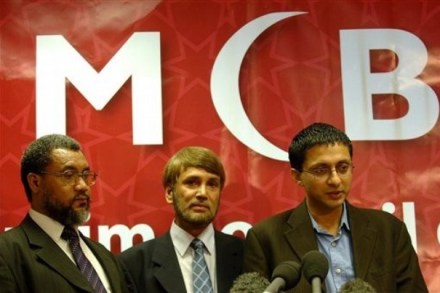
The government has caved in its dispute with the Muslim Council of Britain. The government broke off relations with the group over its deputy director-general Daud Abdullah signing the Istanbul Declaration. Indeed, Daud Abdullah even instigated legal action against the then Communities Secretary Hazel Blears over her statements about what the declaration called for. But now Stephen Pollard is reporting that the government is bringing the MCB back in. A DCLG spokesperson tells Pollard that an MCB commitment to examine “their internal processes and ensure that the personal actions of all members, including senior leaders, remain true to the organisation's agreed policies, avoiding a repeat of the issues which arose after one member signed the Istanbul Declaration...

Boothroyd slams quotas for women and ethnic minority MPs

From our UK edition

Andrew Neil’s guest on this week’s Straight Talk (BBC News Channel – Saturday at 0430 and 2230 and Sunday at 0130, 1530 and 2330) is former Speaker Baroness Boothroyd. There is a delicious anecdote about the time Boothroyd invited herself round to Bercow’s flat and advised him on several weighty matters, but I’ll leave you to discover what was said. With characteristic independence, Boothroyd set herself firmly against the decision to impose, presuming the election doesn’t alter the social make-up of Commons’ membership, quotas on parties to increase the number of women and ethnic minority MPs.

Burnham’s exocet misfires

From our UK edition

The sword of truth is working overtime this afternoon. First, Andy Burnham writes a letter to David Cameron demanding answers about a £21,000 donation from John Nash, chairman of CareUK, to the office of, oh dear, Andrew Lansley. As Paul Waugh notes, a conflict of interest scandal looms here because CareUK is a private firm that makes £400m running GP surgeries and so forth for the NHS. But the truth will out as they say. It turns out that the Chairman of BUPA, Lord Leitch, wasted £5,000 on Gordon Brown’s unopposed leadership campaign. BUPA also does rather well out of the NHS. The indefatigable Waugh has dug up this gem from a speech Leitch made to the Lords: 'When we debate healthcare in the UK, all too often the focus is on the NHS alone.

Surprise, suprise, inflation’s on the rise

From our UK edition

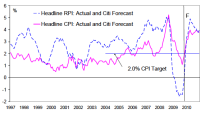
Oops! Britain's inflation is heading back to 4 per cent territory ­ as you'd expect with the Bank of England printing money and using the debt to finance government spending. If you create more money, you reduce the value of the money. Citi has done another brilliant research note, which it is putting online, laying out the implications. The punters are facing pay freezes, or settlements below 2 per cent. The cost of living is soaring. Result: misery. Here are the two graphs from Citi that spell it out. First, inflation (much affected by the VAT hike ­ in the same way that it was artificially reduced by the VAT cut. The resulting inflation was, of course, a great excuse to print money to finance Brown¹s fiscal debauchery.