Uk politics

The three Tory pin-ups are brave

From our UK edition

The three voters who have agreed to be featured in the Tories’ new ads are brave folk. I would wager a considerable amount that right now there are a whole slew of people digging into their pasts hoping to find some piece of evidence to discredit them. It might not be appealing but it is how politics is done. Remember how the American media hammered ‘Joe the Plumber’, the man who confronted Obama about his tax policy and the McCain campaign tried to turn into a poster boy for those worried about Obama’s economic policies, for owing income tax and not having the right kind of plumbing license. Just last weekend, ‘Joe’ was complaining about how the McCain campaign had used him and the whole experience had “screwed up” his life.

The Tories’ new poster campaign is a massive improvement over the last

From our UK edition

I know there's a danger of expending too many words on poster campaigns, so just a quick post to flag up the designs the Tories launched this morning.  There's one of them above, and two more based on the same theme - "I've never voted Tory before, but..." - which you can see here. To my eyes, at least, they're a massive improvement over the last, graveyard poster: refreshingly positive, while also attacking The Way Things Are Now.   Now, I know there are CoffeeHousers who liked the Death Tax poster precisely because it got down 'n' dirty, taking the fight to Labour.  But, despite their sunnier front, these latest posters will also hit Labour where it hurts.  After all, one of the ideas that Brown & Co.

The politics of Osborne’s co-ops

From our UK edition

There's plenty of buzz this morning about George Osborne's new policy proposal: allowing public sector workers to run schools, job-centres, hospitals and other services as cooperatives. James Crabtree, Tim Montgomerie and Spectator.co.uk's very own Martin Bright have exhaustive posts on why this might work in practice. It is, as they all suggest, pretty radical stuff.   But it's also clever politics.  It is something which appeals directly to people on the left (like Martin), as well as public sector workers.

Will Brown’s next interrogators be the public?

From our UK edition

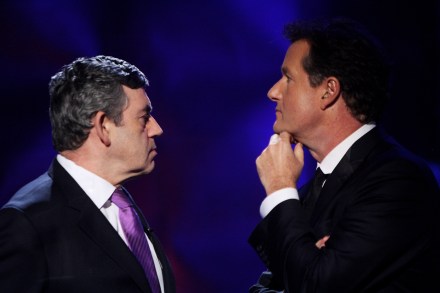
So what next for the new, more human, Gordon Brown (as seen on TV)?  Well, according to today's Times, there are some ministers who want him to take the show on the road.  The idea is to let voters tackle Brown directly - but about the topics Piers Morgan kinda skipped over: the economy, MPs' expenses, Afghanistan, and all the other big stuff.  And the hope, in turn, is that this "masochism strategy" will make the public respect Brown more. Would it work?  Well, just like the Morgan interview and its wider impact, that's something which is difficult to pre-judge from the confines of Westminster.

The best publicity Brown is ever likely to get

From our UK edition

Brown is very lucky to have a friend in Piers Morgan. He did him a great service in the ITV interview tonight - and while it would have made CoffeeHousers nauseous (if they watched it), it will be the best television the PM will get this year and probably ever. Mark my words: the Labour Party will not produce anything that shows Brown in such a sympathetic light. It was powerful, I'd say, because it was not party political propaganda: Morgan genuinely likes Brown and did his utmost to project the human side of him. Those hours of coaching from Alastair Campbell paid off. He kept smiling in a credible way - telling anecdotes in exactly the way that he does, in private, when he's trying to charm people.

The Tories take the fight to Labour over social justice

From our UK edition

Statistics about educational inequality in this country always tend to shock and dismay in equal measure.  And this latest piece of research from Michael Gove's office is no exception: "New analysis by the Conservatives shows that just 45 pupils on Free School Meals (FSM) make it to Oxford or Cambridge each year. One top London private school gets an average of 82 Oxbridge admissions a year – almost double the number of FSM admissions. One leading independent girls’ school produces the same number of Oxbridge entrants as the entire FSM cohort.  Just 1 per cent of FSM pupils go on to a Russell Group university." Just to be clear, the overall Oxbridge intake is about 6,000 students a year.  So 45 pupils on FSM represents 0.75 percent of that.

Ashcroft returns fire but the ‘scandal’ rolls on

From our UK edition

Lord Ashcroft looks like a man not to cross and he will do anything to protect his privacy. He faces down criticism with complete silence, patient before turning on his detractors. According to the Sunday Times, Ashcroft has attacked Labour over its ‘smears’ about his tax status. His tone is derisive but his intention is clear: back off. He has obtained documents held by the Labour party, detailing its strategy to expose Ashcroft. One activist wrote: ‘Think the Guardian most likely to go for it.’ Smart chaps these Labour wonks. Sure enough, the front page of the Observer trails an interview with Eric Pickles, who is ‘frustrated’ by his deputy’s obfuscation.

Cameron steps up his game

From our UK edition

There’s something about a trip to Scotland that brings out the best in Tories giving speeches, and David Cameron lived up to the occasion the other evening. He reprised his social justice passage – easily the best part of his 2009 conference speech. Listing how Labour has made the rich richer and poor poorer, and how the Tories are the party of Wilberforce etc. Promising a “radical zeal” Conservative party – Amen to that. “Some people will say 'you can't do things like that.  You can't afford to take those risks.' I say with so little money and so much failure we can't afford not to.” That’s the spirit.  “Those cuts are coming: make no mistake they are Gordon Brown’s cuts,” he added.

Cameron brings some clarity to the table

From our UK edition

Maybe it's just a slow Saturday, but the Conservatives' latest WebCameron video (see below) strikes me as one of the most effective yet. The pitch is straightforward: make an appeal to people who voted New Labour or who "have never voted Tory before".  So things like Sure Start and the minimum wage get a namecheck. But, aside from that, it's striking just how clearly and unequivocally Cameron sets out Tory commitments such as recognising marriage in the tax system. Indeed, the passage on the "root causes of our social breakdown", and how the Tories would deal with them, harkens back to his powerful address at the party conference.  Only, this time, it's a bit more conversational.  And there's a greenhouse in the background.

A ceasefire in the VAT war?

From our UK edition

Has another dividing line faded into the sand?  It sure looks like it, going off this Times report on how both Labour and the Tories are considering hiking VAT to 20 percent.  If you recall, it was thought that Brown blocked Alistair Darling's plan to introduce the rise in last year's Pre-Budget Report - and all so he could attack the Tories over reports that they would do similar.  The PM will find it a lot harder to stage that attack after this morning. A few weeks ago, the rumour was that Labour would make keeping VAT at 17.5 percent a "main election pledge".  Whether that pledge now appears, or not, will say a lot about the shifting balance of power between Brown and his Chancellor.

Darling enters election mode

From our UK edition

There must be something about stepping back onto Scottish soil that invigorates Alistair Darling, because his Edinburgh speech is one of the most political and confrontational he has delivered for some time.  Sure, Darling is a Labour man, so it's part of his job to oppose the Tories.  But, compared to his Cabinet colleagues, he's normally so restrained about it.  Here, though, the gloves are well and truly off. The Chancellor calls Cameron a "real risk to Scotland's future," and throws in a dash of Thatcher-baiting ("The Tories ... are as out of touch now as they were 30 years ago").  But, really, there are two passages worth dwelling on, for what they might tell us about Labour's election campaign.

The hunt for Hoon’s successor

From our UK edition

Not the most arresting headline I grant you, but bear with me. Geoff Hoon’s political corpse is still warm (well, lukewarm as it’s Hoon), but the search for his successor is underway. The indefatigable Paul Waugh has the runners and riders: John Knight (the leader of Ashfield District Council), James Connell (Hoon’s former SpAd) and Michael Dugher (another former Hoon SpAd who is now Brown’s Chief Political Spokesman). Mischievously, Waugh asks: ‘Will Labour insist on all-women shortlist? And if not, why not?’ Why not indeed? Perhaps Joanne Cash could complete her volte face and stand for Labour. What strikes me most about Waugh’s list is that all of the candidates are ‘career politicians’.

The Tories’ meddling is undermining the Unionist cause in Northern Ireland

From our UK edition

The Times reports that Owen Paterson, the Tories’ Northern Ireland spokesman, will review the process by which the Northern Ireland First Minister is appointed – by creating a Northern Irish executive and official opposition. The prospect of what Paterson describes as a “voluntary coalition”, presumably between the Unionist parties, has the potential to keep Sinn Fein permanently in opposition. Such a coalition jeopardises Cameron’s neutrality if he becomes Prime Minister, a point that Sinn Fein will exploit. The Conservatives seek to move Ulster’s politics away from sectarianism and into the mainstream, concentrating on public services. That is a welcome aim but their means are ill-conceived, stemming from a misunderstanding of Northern Irish politics.

Quote of the day | 11 February 2010

From our UK edition

Is it just me, or is there something grimly hilarious about The Man Who Claimed To Have Abolished Boom-And-Bust describing our recent economic turmoil as a "one-off"?  Yep, here's Brown in today's FT: "We are paying a one-off cost for globalisation." More seriously, this is the technocratic side of Brown which Downing St will hope to contain during the election campaign.  Calling the recession and its rocky aftermath a "one-off cost" is unlikely to play well with people who have lost their jobs and businesses.

Mandelson: Public sector will face cuts this year

From our UK edition

Peter Mandelson gave the Dearing memorial lecture last night and in a section responding to the criticisms of the budget cuts for higher education said:   "Much of the rest of the public sector will receive similar constraints in the course of this year or soon after." Mandleson has implied this before, most notably on Newsnight the day of the Hoon Hewitt plot. But it is a very different from the message Brown is putting out. We in the press should demand details from Mandelson about what these cuts in financial year 2010-11 might be with the same intensity that we did when the Tories said they would make in year cuts if elected. Who knows Mandelson's plans might be more ambitious than the £1.5 billion that the Tories have been able to find.

Lance Price: Brown became PM when his skills were declining

From our UK edition

Gordon Brown is a creature of habit. Every morning at 7:30 he holds a telephone conference with his cabal of Shakespearean fools, who review the papers for him. I imagine a scene of domesticity, of coffee and muffins, an adoring wife and child milling about offering tactile affection – a hand on the shoulder, a kiss on the head. But then again Brown is a latter day John Knox and this morning he must have sat in pale fury as an aide summarised the extract from Lance Price’s latest book, published in the Independent. Price, Andrew Rawnsley and Peter Watt share the same lexicon. ‘Unforgivable’, ‘not a nice place for people to work’, ‘psychologically flawed?

The White House is bluffing

From our UK edition

The Atlantic reports that the White House is considering altering intelligence sharing agreements with Britain in the light of the Binyam Mohamed case. White House spokesman Ben LaBolt briefed: "The United States government made its strongly held views known throughout this process. We appreciate that the UK Government stood by the principle of protecting foreign government intelligence in its court filings. We're deeply disappointed with the court's judgment today, because we shared this information in confidence and with certain expectations." I detect a bluff. Britain and the US share information on an hourly basis, providing an essential understanding in the combined operation against al Qaeda.