Uk politics

Will Nick Griffin become a victim of his own expense claims?

From our UK edition

If two things fuelled the rise of the BNP last year, then they were probably the mainstream parties' reluctance to talk about immigration and a general disillusionment with Westminster politicians in the wake of the expenses scandal.  There are tentative signs that the parties are getting their act together on the first.  And, now, Nick Griffin  may have undermined his own party when it comes to the second. After coming under fire for not being transparent about expenses since becoming an MEP, Griffin has now published a very loose account of them on his website.

Two blasts from the past

From our UK edition

Michael Savage observes that Cameron’s denunciation of Brown’s 'weak' premiership recalled Tony Blair’s famous savaging of the ‘weak, weak, weak’ Major government . Here it is: After watching that, I chanced upon an exchange between Blair and Cameron, dated November 2006. Their subject? NHS budget cuts. The first two minutes of the clip reinforce just how complicit the Conservatives were in Brown and Blair’s free for all. Cameron was aghast that "budgets were being raided to solve financial deficits".

The Tories’ Unite strategy is paying unimagined dividends

From our UK edition

The Tories Unite strategy has been so effective, even Peter Mandelson is peddling it. Led by Mandelson, Labour’s isolated right has questioned Unite’s influence over candidate selection. James Purnell’s preferred successor, Jonny Reynolds, was omitted from the Stalybridge and Hyde shortlist, compiled by the NEC, which has two Unite members on its board. Mandelson and Purnell have urged Downing Street to reopen the race. For its part, Unite responded. One of its preferred candidates for the seat, Glyn Ford, who failed to make the cut, demanded a right to appeal also. The Tories’ must be ecstatic. Their strategy, initially conceived to nullify the Ashcroft scandal, is paying unimagined dividends.

For the workers?

From our UK edition

One of the defences that Labour types are mustering over Unite is, bascially, that it's better to be funded by a body which represents some two million workers than by Ashcroft type figures who may have their own personal agendas. In which case, the question is: do Charlie Whelan and his coterie really represent the views and interests of Unite's members?  And, in answer, it's worth pulling out two snippets from today's papers. EXHIBIT A, courtesy of Danny Finkelstein: "A Populus poll of Unite members last year showed the majority preferring David Cameron to Gordon Brown and opposing Unite donations to Labour.

The Tory campaign is getting back on track

From our UK edition

Whisper it quietly, but there is a sense that the Tory campaign is getting back on track. The Tories have had three good days in a row, have Labour on the back foot over Unite and the polls appear to be moving in their favour. Certainly, Tory morale is better than at any point since the start of the year. One thing raising Tory spirits is Cameron’s own performance. As Iain Martin points out, on Sunday Brown met the voters and was incapable of finding the right tone. Cameron, by contrast, is at his best among ‘real’ people as Monday’s event demonstrated. Another thing bolstering Tory morale is their campaign against Unite’s influence. After taking a kicking over Ashcroft for more than a week, CCHQ staff are delighted to be the ones on the offensive.

The EU has moved on from 1983

From our UK edition

A lot of things, you will agree, have changed since 1983 - even in the world of diplomacy. For one, the EU has moved from a loose federation of states towards a new kind of polity - never a United States of Europe, heaven forbid, but more than just a loose arrangement of member-states. But reading George Walden's comment about Europe's putative diplomatic service in the Times I can't help but feel that he is still living in the age when he left the Foreign Office - when David Cameron was 17. The EU diplomatic service is not the novelty that pro-Lisbon politicians claim. To a large extent, it already exists in the more than 120 European Commission delegations and the 11 high-level EU envoys.

Nick Clegg pulls those fences down

From our UK edition

Continuing the current vogue for sensible economic debate, here's what Nick Clegg said on Radio 4 just now: 'We're not entering into this dutch auction about ringfencing. Good outcomes aren't determined by drawing a redline around government departmental budgets.' Given the current speculation about a hung parliament, you've got to wonder what this might mean for any potential Lib-Con partnership.  The common wisdom, almost certainly correct, is that the resulting political paralysis would sink the public finances.  But it would be intrigiuing to see if Clegg could get the Tories to tighten their fiscal plans, and perhaps even smash a few of their ringfences.

ECR’s record so far

From our UK edition

The decision by David Cameron to pull the Tories out of the EPP and form the ECR was a victory of principle and party politics over pragmatism. While many Tory grassroots howled with joy, it is worth examining the practical consequences on Tory influence in the European Parliament – not to reverse the decision, but validate or disprove the oft-made charge that the decision has made the Tories impotent.   Let us eschew any discussion about the views of key members of the ECR on Jews; let us also not dwell on whether the Tories have cut themselves off from other centre-right leaders. The first point is a matter of opinion and the second is uncontestable. Let us instead focus on how the ECR has done its work in the legislature.

Brown faces the horror of the petrol pumps

From our UK edition

Yes, I know, cause and correlation aren't the same thing – but Mike Smithson's latest graph over at Political Betting is still incredibly striking.  It shows that the Tories' strongest poll position over the last few years coincided with a high in the petrol price.  It also shows that the smallest gap between Labour and the Tories coincided with when petrol prices were at their lowest.  Which all makes today's Telegraph story about petrol potentially hitting a new high of 120p a litre, as the election approaches, very resonant indeed. The problem for the government is twofold.  First, rising petrol prices are something which millions of people will understand and feel, so much more so than abstract talk about cuts, deficits and the like.

Tories to outline spending cuts after the Budget

From our UK edition

Now here's a turn up: according to Nick Robinson, the Tories are going to announce details of what spending they would cut in the forthcoming fiscal year after next week's Budget.  So it looks like Cameron might come good on his promise, after all. We'll have to wait and see before judging whether those cuts are credible.  But, along with George Osborne's FT article today, it does seem that the Tories have rediscovered the will to take on Labour over when and what to cut.

Brown sets the stage for a scorched earth Budget

From our UK edition

Gordon Brown must be feeling generous today, for he did the Tories two favours on Woman's Hour earlier.  David has already mentioned the first one: Brown saying that he would "keep going" as party leader even if Labour loses the next election, which ups the potential for more summertime Sturm und Drang on his own side.  But the second, as Ben Brogan points out, is his claim that the state of the economy makes it difficult for the government to detail any spending cuts.  The Tories will happily seize on that to justify their own "wait until we see the books" approach. More broadly, Brown's claim also sets the stage for next week's Budget.  The obvious insinuation is that it won't contain much by way of cuts or new deficit reduction plans.

Cameron must win outright

From our UK edition

Heaven forbid that the Tories and LibDems end up in coalition - but the Guardian asked me to write a piece war-gaming what would happen if they did. The result is here. I really do believe it would be a short-lived calamity because no one would be playing for the long-term. The Westminster system does not handle coalitions, and hung parliaments lead to second elections. From day one of any Lib-Con coalition, everyone would have an eye on that second election. The Tories would want to accuse the LibDems of recklessly pulling the plug, the LibDems would be briefing against the Tories making out that they were the only competent ones in the coalition.

Brown dithers over BA

From our UK edition

At last, Gordon Brown has been forced from the comfort of silence on the Unite/BA strike. Yesterday, Lord Adonis said that he "absolutely deplored the strike” because the “stakes were too high”. Brown has done nothing more than echo those sentiments, but that is at least a step in the right direction. Obviously, the strike poses an enormous problem for the government. Betting men would get decent odds on BA collapsing, but it is a failing business that needs to change. Labour is a near insolvent party that needs Unite, and not just for its funds but for Charlie Whelan’s tireless work in support if the PM in an election year. So I doubt Labour will take any meaningful action.

Osborne colours the water blue

From our UK edition

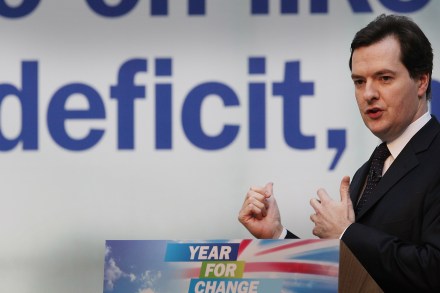
George Osborne has long been in the City’s crosshairs, and criticism peaked last week when less than a quarter of a City panel believe he has the mettle to be Chancellor. Today, Osborne fights back in the FT, with a piece co-penned by Jeffrey Sachs. The pair set out an argument for immediate ‘frugality’, rather than ‘cuts’, and damn Brown’s economic policy as short-term politicking: ‘We are sceptical that a sustainable economic recovery can be based on either reinflating the sectors that have declined or believing future job creation can come simply from the public sector payroll.

Cameron is synonymous with change

From our UK edition

It was mostly standard fare for a political interview, but the Cameron/Trevor McDonald show reminds you of what I think is one of Cameron’s foremost positives, and one that is welcome amid the Tories' current self-doubt. Cameron and his team turned the unelectable Tories into a modern and truly representative force. Jonathan Freedland may argue that the change is cosmetic, but candidates, such as Shaun Bailey, selected by the Hammersmith association, say otherwise. If Cameron saw-off grass-roots interests who were still fighting Margaret Thatcher’s early battles, if not those of Churchill too, he has the resolve to tackle the legacy that Gordon Brown is likely to bequeath him.   I’d expected to be left slightly flat by this interview.

A welcome return of defence diplomacy

From our UK edition

Shadow Defence Secretary Liam Fox has given an interview to the Sunday Express, where he talks about overcoming a sense of "colonial guilt" bestowed by revisionist historians and the need for a new government to forge defence links with commonwealth nations, such as Australia and New Zealand, but he also cited India and Saudi Arabia. They have a “strong appetite” for closer defence links with the UK, he argues.   Looking at variable defence relationships with countries like India, and non-NATO partners like Australia makes good sense. Nicolas Sarkozy has done the same – and even invited Indian troops to march down the Champs-Élysées last year on Bastille Day.

Down with declinism | 14 March 2010

From our UK edition

Everywhere you turn, it is hard to escape the sirens of decline. Their song echoes through Coffee House: “Buy supplies”, they sing, “take the kids out of schools, close down the hatches - for Britain is going under, broken beyond repair, stuck in a rot from which it cannot escape, while the weaklings of yesteryear (like China and Brazil) roam free on the land that our forbears toiled.” Next month, they will take the stage at a Spectator Debate.   I have even succumbed to their sentiment. It is easy to do.

34 percent  think a hung parliament is in the country’s best interests

From our UK edition

It would be news if the Tory lead didn’t contract every Sunday. James has already noted the latest retreat in the Tory lead, detailed in the Sunday Telegraph's ICM poll. Tory poll contractions are the new banking bailouts - so numerous you scarcely notice them. What struck me about this poll is the large minority who want a hung parliament. Not just those who think such an outcome is likely, but actively seek its realisation - 34 percent according to this poll.   I do not understand this impulse. Coalition and co-operation are laudable but, as the recent care row proves, fanciful aims. Other than fighting World Wars, modern British politics has struggled to accomodate coalitions.