Brown’s defining gaffe: now with video footage
From our UK edition
From our UK edition
From our UK edition
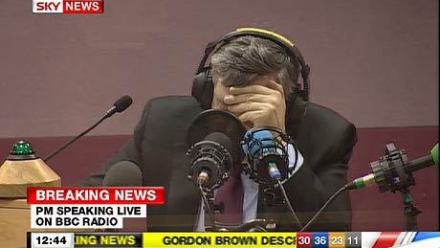
… Well that ain’t the half of it. Brown has just made the most garbled apology imaginable on the Jeremy Vine show: “I apologise if I said anything like that.” Well, unfortunately, Brown had, and Vine duly played the tape. Brown had to apologise again: “I apologise if I’ve said anything remotely hurtful…there were comments about immigration...which I didn’t get the chance to reply to...that were annoying…you've got to remember, it's a case of me being helpful to the broadcasters who have recorded and played my private conversation.” He might be cowering, but verbally Brown simply comes across as arrogant and unrepentant. Small wonder that politicians are loathed.
From our UK edition
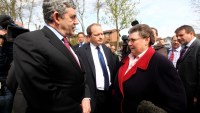
Wow. Just when you thought Labour's campaign couldn't get any worse, they go and wheel out Brown in front of ordinary voters. And this is the result: he has been caught on mic describing a member of the public as a "bigoted woman". Speaking to one of his advisers, he added "you shouldn't have put me with that woman. Whose idea was that?" Classic. This may be trivial beside the big questions about the economy, etc. - but you can expect is to become one of the defining TV moments of the campaign. It's one thing to insult and attack the politicians who serve alongside you, but quite another to do similar to someone whose vote you're courting. Toxic, toxic stuff.
From our UK edition
Jonathan Bartley, the man who ambushed Cameron yesterday, has written a piece for the Guardian. In it, the education establishment’s counter-productive monopoly is exposed. Bartley writes: ‘Either we are for inclusion or we aren't. To include children with special needs in mainstream schools takes commitment and a lot of work. Indeed, it requires "bias" – which has actually been lacking in the education system, despite all the talk of inclusion from Labour. There are few parents of children with special educational needs who would not want their children to attend their local school with brothers and sisters and friends, provided that the school is properly resourced, equipped and able to successfully include their children.
From our UK edition
Cleggmania may be in remission. A Populus poll for the Times puts the Tories up 4 at 36 percent, the Lib Dems down 3 at 28 percent and Labour down one at 27 percent. Com Res has Labour and the Lib Dems tied on 29 percent with the Tories up 1 to 33 percent, whilst You Gov has the Tories on 33 percent, Labour on 29 percent and Clegg’s party on 28 percent. A hung parliament remains the probable outcome next Thursday. Anything other than a decisive Tory victory will sustain the Liberal surge, as Clegg would hold the balance of power or a Lib-Lab coalition would seek to inaugurate electoral reform.
From our UK edition
The UK Conservative leader David Cameron says that any Prime Minister not 'directly elected' by the public should be forced to hold a general election within six months. He has in mind his Labour opponent Gordon Brown, who in June 2007 was catapulted into the position by a secret ballot in his own party, rather than by an open election of the people. And if, after the forthcoming general election on May 6, Labour chose to ditch Brown and catapult that gap-year kid...ah, yes, David Miliband...into the top job in order to stitch up a coalition deal with Nick Clegg's Liberal Democrats, well, Cameron would give him only six months to get a public mandate too. On the surface, this looks like a good idea.
From our UK edition
The New Statesman has interviewed Douglas Alexander, who appeals, as Andrew Adonis has, to Liberal Democrat voters to back Labour to inaugurate what he terms a ‘New Dawn for Labour and progressive politics.’ Progressive is a vague term, but the best definition for it is reform to encourage social mobility. In this morning’s Times, former Fabian Stephen Pollard argued that only the Tories can guarantee this. For the time, Pollard says, he will vote Conservative and all because of Michael Gove’s schools reform. ‘Mr Gove has promised that within four years of a Tory government, all parents will have the option of sending their child to an independent school offering to educate the child free.
From our UK edition
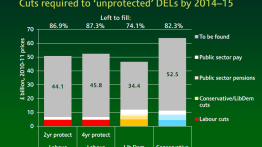
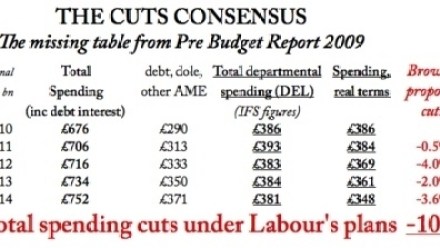
If you want a sense of where our politicians are when it comes to sorting out the nation's finances then I'd recommend you read this briefing paper which the IFS released earlier today. What it shows, in stark graphs and charts, is what Adam Boulton, Andrew Neil et al were getting at in Labour's press conference earlier: yes, we know that there are significant cuts to come, but none of the parties are really letting on just where they will come from. To my eyes, this chart tells the story particularly well. It depicts how much each party will cut "unprotected" departmental spending by - and how much of those cuts has still got to be identified.
From our UK edition
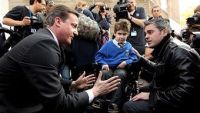
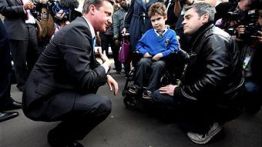
David Cameron has just taken his first real “kicking” of the campaign from a parent of a disabled child. Handled it brilliantly, I think. The parent is angry, understandably, about the problems he has finding a normal school for his wheelchair-bound son. The Tories are suspicious of the “inclusion” agenda – often a code for denying special-needs children the extra tuition that they deserve. But, as the father of a severely disabled son, Cameron knows more about this subject than almost anyone else in Westminster. “It should be your choice, sir” he said: and he’s right. The voucher system would make a disabled child worth north of £22,000 a year to teach – four times more than an able-bodied pupil.
From our UK edition
Fireworks at Labour's press conference this morning, thanks to some brilliant questioning of Mandelson and Balls about the cuts which Labour is concealing from the public. A while ago, the FT did its own version of a table that Coffee House ran in February: the implied cuts that departments will make under HM Treasury forecasts. I reprint it below. The IFS has sought to quantify these cuts. So Sky's Adam Boulton read out this list and confronted Mandelson: which of these would Labour not do? Freezing benefits? Cutting public sector pay? Halving the spend on teaching assistants? Cutting funding to Wales and Scotland? Nick Robinson from the BBC piled in too: Labour has asked broadcasters to focus on the issues, so why can't it discuss this issue?

From our UK edition
The New Statesman’s George Eaton admonishes Chris Grayling repeating his ‘false claim that violent crime has risen dramatically under Labour.’ Eaton cites the British Crime Survey’s findings that violent crime has fallen by 41 percent since 1997. True, the BCS asserts that violent crime has fallen since 1997. Changes in recording practice in 2002-03 mean that comparing current statistics with those compiled a decade ago is inherently inaccurate – a point conceded by UK Statistics Agency head Sir Michael Scholar with regard to Grayling's police statistics, but not the BCS'. The independent House of Commons Library gave a more accurate assessment, finding that violent crime rose from 618,417 to 887,942 last year, or 44 percent.
From our UK edition
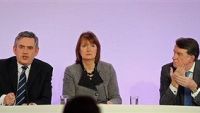
Labour’s press conference this morning highlighted the party’s problem. Labour is demanding that the media cover policy more than process and personality. But when the discussion turns to the biggest policy issue of the day—how to cut the deficit—Labour doesn’t want to engage. This morning, Nick Robinson, Adam Boulton, Andrew Neil all pushed Mandelson, Balls and Cooper on this issue. All of them were clearly frustrated by Labour’s lack of answers. Ironically, all the memorable lines from Labour’s press conference came when process and personality were discussed.
From our UK edition
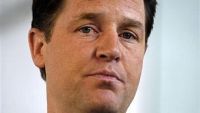
No, in short, he hasn’t. Clegg was deemed to have compromised his party’s intricate anti-politics strategy by ruling out a ‘progressive’ coalition with Labour led by Gordon Brown, a stance that suggested Clegg sought the affections of David Cameron. Clegg has since clarified his position: "I think, if Labour do come third in terms of the number of votes cast, then people would find it inexplicable that Gordon Brown himself could carry on as prime minister. As for who I'd work with, I've been very clear – much clearer than David Cameron and Gordon Brown – that I will work with anyone. I will work with a man from the moon, I don't care, with anyone who can deliver the greater fairness that I think people want.
From our UK edition
Clegg won’t join without proportional representation; Cameron says he won’t countenance such a ‘con’. Indeed, it runs deeper than that. Iain Martin has canvassed Tories from across the party and found that Cameron will get short shrift if he tries to reform the voting system at all. There is another consideration. This election has the potential to blow traditional party structure out of the water. Labour’s right will be marginalised by the unions’ grip over the party and Liberal Democrats like David Laws and Clegg (up to a point) have more in common with the One Nation Tories than they do with out and out left wingers like Kennedy and Cable.
From our UK edition
Britain’s role in protecting the downtrodden and protecting the weak has significant historical pedigree. The British role in abolishing the international slave trade was one of the first liberal interventions. And as Abigail Green's biography shows, Britain’s Sir Moses Montefiore was not just a pre-eminent Jewish figure of the nineteenth century, but his pioneering approach to the problem of Jewish persecution helped transform the international response to abuses of human rights. No party, though, is going to the election with the kind of commitment to promote human rights abroad as Robin Cook did when he unveiled his ideas for an “ethical” foreign policy. This is hardly a surprise.
From our UK edition
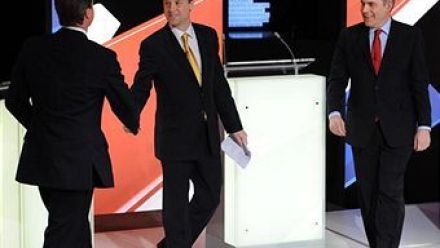
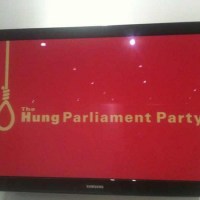
Arresting, to the point and right. But tactically it leaves the Tories open to claims about 'scare tactics', of which the Tories accuse Labour. UPDATE: This one is more effective because it avoids the other one's tactical shortcomings.
From our UK edition
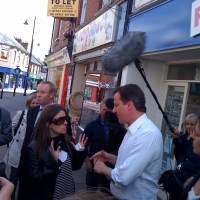
Cameron is now in Lib Dem held Romsey. After a walk-about, where he received a largely positive reception, he delivered a stump speech. His message was that Nick Clegg, with his comment that PR is a pre-condition to getting Lib Dem support, is trying to hold the whole country to ransom. “It is now becoming clear he wants to hold the whole country to ransom just to get what would benefit the Liberal Democrats." The aim is simple: portray Clegg as just another politician, interested in power and his own self-interest. As I say in the magazine this week, how quickly the Clegg bubble bursts will be determined by how quickly the public concludes that Clegg is not some tribune of the people but just another politician.

From our UK edition
Well no surprise there – the Politics Home poll projection suggests that the Tory recovery, started by Cameron on Thursday night, comes at the expense of Labour but remains indecisive: ‘In the new projection, which incorporates all polls published up to and including Sunday 25th April, The Conservatives would be thirty six short of a majority, with 289 seats - 11 more than they were projected to win last week. Labour are projected to win 234 seats and the Lib Dems 94. Labour’s projected total has fallen by nine, while the Lib Dem total has fallen by four. The Tories are projected to gain a 35.1 per cent share of the vote, Labour 27.0 and the Lib Dems 28.4.’ No party has significant forward momentum.
From our UK edition
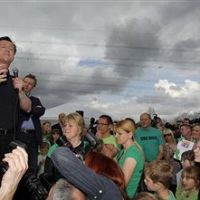
David Cameron is visiting Hampshire today, hitting both Labour and Lib Dem held seats. In a visit to Southampton University, he was confronted by a feisty Lib Dem supporting student who accused him of planning changes that would make it more difficult for working class kids like her to go to university. Cameron dealt with the question well. He said that the Tories would keep bursaries and that there simply isn’t the money to abolish tuition fees. He also pointed out that currently only 40 odd children on free school meals go to Oxford and that Tory plans to bust open the state monopoly in the provision of education would improve the quality of state education and thus social mobility.
From our UK edition
Post-election deals are tough for those on the wings of political parties - the activists, the die-hards, the idealists. Those in the middle, by definition the pragmatists, find it easier to prioritise aims or to compromise in the short-term in order to win over the long-term. Any Con-Lib deal will be tough for the left-wing of the Lib Dems and the right-wing of the Conservative party. But both will have to accept that power is better than opposition and that being able to implement part of your party programme is better than carping on the sidelines, your manifesto languishing on never-visited websites.