Uk politics

The trimmers mobilise

From our UK edition

The Independent on Sunday reports that a cabal of four disgruntled/horrified Lib Dem MPs have held secret talks with Labour to amend contentious elements of the Budget, such as the VAT hike. Four rebels will not be enough to defeat the government, but it is the first indication that Simon Hughes’ call to arms will be answered by the social democrat wing of the party, damaging the coalition’s long-term prospects. Of course, it is healthy that government backbenchers scrutinise and improve government legislation for whatever cause – the odd amendment to public borrowing clauses would have been welcome over the last decade. Scrutiny does not imply revolution, stressed Andrew George, the four members’ leader. But scrutiny is a double edged sword.

Post-Budget polls show drop in Lib Dem support

From our UK edition

ICM’s post Budget poll for the Sunday Telegraph confirms YouGov’s finding that the Lib Dems have dropped after the Budget. It has them down five to 16. By contrast, the Tories are up two to 41. Labour have also risen four to 35. YouGov has the Lib Dems on 16, the Tories 43 and Labour 36. These polls matter because they will add to the jitteriness that some left-leaning Lib Dem feel about such a fiscally conservative Budget. There is a feeling in Lib Dem circles that they could do with some things to please and reassure their base in the coming weeks. The Coalition is planning a policy push before the Commons breaks for the summer and I’d be surprised if there aren’t some things announced soon that are ‘Lib Dem wins’.

Cameron and Clegg’s love-in deepens

From our UK edition

What began as a coalition of expediency is maturing into a pact of principle – or at least that’s what Cameron and Clegg would have you believe.  Of course, relations may sour and enormous efforts are being made to preserve Cameron and Clegg’s public cordiality. Journalists are being briefed that plans are in progress to enable Cameron and Clegg to speak at each others’ party conferences.   It will be little more than a public relations exercise if it goes ahead, and an extremely hollow one in all probability. What are they going say? It’ll be a cartoonist’s dream, as Clegg is politely applauded by the contemptuous Colonels, and Cameron, shandy in hand, schmoozes the socks and sandals brigade.

Britain’s foreign aid should empower women

From our UK edition

Here is a question. Which politician said the following: “We’ve seen too that when women are empowered economically they are more likely to have a voice in the community and to be advocates for other women.” Or “Britain will be placing women at the heart of the whole of our agenda for international development”. Clare Short? No. Hillary Clinton? Nope. Harriet Harman? Wrong. It is former Army officer and International Development Secretary Andrew Mitchell speaking yesterday to the think-tank Carnegie Endowment in Washington DC.   To some, his comments will illustrate how the Conservative Party has moved to far away from its roots.

Unwinnable war?

From our UK edition

Today is Armed Forces Day, and I don’t recall seeing such collective negativity from newspapers and broadcasters on the Afghan war.  It borders on despair. Most news outlets have dissected David Cameron’s comments yesterday, where he could only offer the hope that troops would be withdrawn by the end of this parliament. Cameron’s non-committal answers, the regular drip of casualties and the sense that the surge has become a slog have led journalists and analysts to conclude, en masse, that the war is unwinnable.   Three interviews are particularly striking. Nick Harvey, the armed forces minister, re-iterated Cameron’s comments in the exact same terms. As I argued yesterday, the vague statements pose questions not answers.

Cameron wants troops out of Afghanistan by 2015

From our UK edition

Everything about the Cameron government comes in fives. Five year terms, a five-year coalition and now we learn that it is Cameron’s considered opinion that British troops cannot remain Afghanistan for another five years. All Cameron has offered is the hope that troops will be home before the proposed May 2015 election. Five more years in Helmand on the current trajectory would be extremely costly and unpopular, especially given the political pressure surrounding defence cuts. Cameron realises this but will the nature of Britain’s engagement change? The assumption was that Britain would mirror President Obama’s timetable and begin a gradual withdrawal next year. That political and military strategy depended on the success of COINS entirely.

Abbott gives no answers

From our UK edition

There’s one thing that people want to talk about today and that’s Diane Abbott’s appearance on This Week last night. As you can see above, it was a total disaster for Abbott. She was all over the place on her taxi claims and she got into a total tangle on whether she had meant to imply with her comment that ‘West Indian mothers will go to the wall for their children’ that West Indian mothers were better than mothers of other ethnicities. Under repeated questioning, all she would say is that she had said all she was going to say on the subject.  Even when it was clear that this answer was not sufficient, Abbott had nothing to add.

Union backing is an indication of how far David Miliband has shifted to the left

From our UK edition

Paul Waugh has news that David Miliband has received the backing of USDAW, the shop workers’ union. Block union voting is a thing of the past, but this endorsement is a surprise nonetheless. It’s lazy to categorize Miliband as a ‘Blairite’, but he is certainly on the right of the party – vigorously pro-European, pro-business and an avowed social democrat. USDAW’s general secretary John Hannett is said to be impressed by Miliband’s defence of Labour’s record in office. To be honest, Diane Abbott is the only candidate who has lacerated the Blair/Brown governments, all the others are ‘proud of our record in government but recognise the need for change.

WEB EXCLUSIVE: Time to leave?

From our UK edition

The Spectator’s summer debating season ended with a strident appeal. ‘Too late to save Britain. It’s time to leave’. Proposing the motion, Rod Liddle claimed to have mis-read his invitation. ‘I thought this was a foregone conclusion and we’d come here to arrange the tickets.’ Surging immigration, he said, was ruining the education system and our love lives. ‘By 2029 no one will be having sex, we’ll be so crowded out.’ The recent election had proved nothing but democracy’s impotence. ‘The poverty gap keeps widening, financiers still get bonuses and schools support Lesbian Gay and Trans-gender History Month.’ Soon he predicted that the definition of disability ‘will cover everyone except Ray Mears.

Cameron takes to the global stage, orating for a domestic audience

From our UK edition

From the point of view of historical curiosity, it is a pity that the great Victorian statesman predeceased the era of global summits. What would Palmerston or Melbourne have made of the pageantry? What might they have said to permeate it? Would they have wanted to? Modern British Prime Ministers have moulded themselves on the world stage: Blair as a liberal interventionist, Brown as a Keynesian. Judging by an article David Cameron has written in the Globe and Mail, he hopes to lead the world to fiscal re-trenchment and inaugurate lasting and real prosperity through free trade. Once again, Cameron’s premiership appears to be descended from Gladstone.

Hughes and Davis fomenting rebellion?

From our UK edition

From opposing sides of the coalition's strait, two warning shots have been fired across the government's bows. David Davis has challenged Theresa May’s decision to renew the 28-day detention limit for six months pending a review. And Simon Hughes has declared that he and a like-minded posse will seek to amend ‘unfair’ aspects of the Finance Bill. Neither is an outright revolt. Neither move amounts to what Ed Miliband termed ‘cracks appearing in the coalition’. Both Davis and Hughes remain in support of the coalition agreement – Hughes will ‘support the Budget’, and Davis, to his enormous credit, has made excessive and illiberal detention periods his raison d’être.

The Budget PR battle enters a second phase

From our UK edition

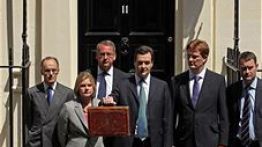
The government is on the defensive. The IFS’ pronouncement that the Budget was ‘regressive’ and the VAT hike ‘avoidable’ has given sustenance to the opposition and their supporters in the media. At the time, Harriet Harman’s response to the Budget seemed execrable. Now, I’m not so sure. Harman is like a Swordfish bi-plane attacking a battleship: she is so slow and obsolete that her superior opponents cannot bring their modern guns to bear. So she closes the range and scores a hit. Tuesday was one of her more successful strikes. As John Rentoul notes, Harman had a point beneath the bluster. The OBR is George Osborne’s weak spot; it downgraded growth forecasts in light of his Budget.

Cable begs for protection

From our UK edition

Vince Cable is announcing to Metro that "We do not want to make such deep cuts to transport, energy, science research and universities." Really? According to whom? The science budget, which has shot from £1.3bn to an indefensible £3.7bn, is a prime example of a cost that should not be borne by the taxpayer. Scientists are best left to get on with this themselves, and companies are more than capable of funding research. On energy, again, there are many expensive vanity projects just begging for the axe. Given that Cable is in charge of the universities brief - the most important part of his otherwise non-job - you can expect him to want to protect it from cuts. But to lobby openly like this is not something that Theresa May or Liam Fox would do.

The true meaning of Osborne’s Budget

From our UK edition

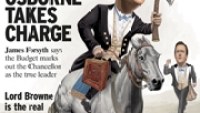
To understand the budget properly, read James Forsyth's cover story in The Spectator today. Sure, it was about reducing the deficit - but within it lie several political strategies which explain how George Osborne hopes to win a majority Conservative government. James says that those around Cameron will not entertain this notion - they "have been persuading themselves that coalition government is the best possible result". But Osborne, he says, finds it deeply unsatisfactory and has a twin mission: fix the economy, and win outright next time. "He has been observing recently that Gordon Brown spent 13 years successfully creating Labour voters — mainly through state dependency — and that the Tories need to reverse this process if they are to win.

RIP Lord Walker

From our UK edition

Peter Walker, Baron Walker of Worcester, has died aged 78. He served as a Cabinet Minister in both the Heath and Thatcher governments. He was what might be termed derisively as a ‘Wet’, and was a leading figure on the liberal side of the Conservative Party for thirty years. He was a founder member of the Tory Reform Group, which propounds One Nation Toryism and economic efficiency, ideals that have, it might be argued, profoundly influenced David Cameron’s leadership. Walker served with distinction throughout the Thatcher government, carrying the brief for Wales, Energy and Food and Fisheries. As Energy Secretary, he was a key figure during the Miner’s Strike.

How good intentions can be counterproductive

From our UK edition

Might the coalition’s emphasis on fairness be making it harder to get people off welfare and into work? Not a question that I can answer with confidence, but certainly one which has been thrown up by the IFS's Budget briefing. Take the government's action on child tax credits, for instance. By increasing it at the lower end of the income distribution, and restricting it at the upper, some claimants now stand to lose more, more quickly, by moving up the income ladder. Or, as the IFS put it, their marginal effective rate of taxation has increased. Of course, this will have been offset by other measures such as the rise in personal allowances. But it does present a conundrum for government policymakers, eager to prove that their measures aren't hitting the poor.

IFS: there could be deeper cuts to come

From our UK edition

An unfamiliar mood before the Institute for Fiscal Studies' Budget briefing today: many of the gathered journalists, economists and policymakers had decided that, for once, this wouldn't be an exercise in spotting the Chancellor's deceptions, because, quite simply, there aren't many. And they could well be right. In his introductory remarks, Robert Chote, the director of the IFS, said that "the government is certainly to be congratulated for the transparency with which it presented [yesterday's policy announcements]." What we've heard, so far, backs up that tribute.

Loving Hattie

From our UK edition

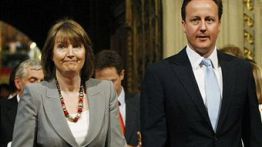
The unthinkable has happened. I’ve started to admire Batty Hattie’s performances at PMQs. Her career may be over, her party may be trashed, her movement may drift leaderless, and her colleagues’ reputation may have been shot to pieces but Hattie always turns up and gives it everything. Nature has not overburdened her with talent. She can’t count. She can hardly speak. She reacts to events about as quickly as a self-timing oven but she has epic quantities of pluck. Every week she pounds out into the surf, like a battleship equipped for the last war but two, and heads for the centre of the fray where she refuses to sink under the heaviest fire.