Uk politics

Meetings galore

From our UK edition

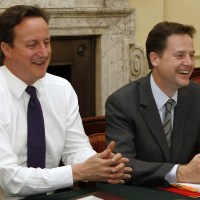
All of a sudden, the coalition partners can't get enough of their backbenchers.  Last night, it was David Cameron meeting the 1922 Committee to reassure them about their mutual relationship.  And, today, Nick Clegg is going on an "away day" with that half of his party which isn't in government, all to explain his close affair with the Tories.  Presumably, flowers and chocolates will be involved. The Clegg meeting, in particular, is worth dwelling on – and Sam Coates and Greg Hurst do just that in an insightful article for this morning's Times.  For those who can't travel beyond the paywall, here's the line which stands out: "Lib Dem MPs will be warned that history shows that small parties that walk out of a coalition are destroyed at the polls.

McFadden talks sense

From our UK edition

Pat McFadden, the sullen-looking Shadow Business Secretary, has given an important speech to the Fabian Society. He said: ‘Fight the cuts is a tempting slogan in opposition, and there are indeed some that must be fought. But if that is all we are saying the conclusion will be drawn that we are wishing the problem away.' He is the first shadow minister to recognise that Labour’s current approach is counter-productive, and Ed Balls’ philosophy is suicidal. He notes: ‘In fact, that is the position the Tories and the Lib Dems would prefer us to adopt. They want Labour to retreat to its comfort zone and allow them to say that they alone are capable of facing up to Britain's problems.

A lap of honour for the Hatwoman

From our UK edition

This is amazing. People could scarcely believe it. No less an organism than the Big Society was spotted briefly at PMQs today. Angie Bray, Tory member for South Acton, asked David Cameron to praise a voluntary programme which enables her constituents to share skills and expertise with their neighbours. ‘This is what the Big Society is all about,’ declared Bray, (with the quietly jubilant tone of one who knows her elevation to government will not be long delayed.) Cameron’s delight was palpable. He beamed at everyone. Then his eager ears picked up the groan of a Labour cynic opposite and he instantly switched into a mode of preachy dismay which he may well have learned from Nick Clegg.

Perverse though it sounds, prisons can be a haven for opportunity

From our UK edition

So much of the welfare debate is lost in jargon and the numbingly large and depressing numbers. John Bird, founder of The Big Issue, has just been on The Daily Politics and he condensed the specious waffle into plain but evocative sound bites. ‘You don’t have a broken society without a broken system. The usual suspects come in and advise Blair, Brown and now Cameron that what you need is money for the poor. The poor don’t need more money; the poor need more opportunity.’ Bird admitted that prison made him upwardly mobile. He left it being able to read, write and paint, and was given the confidence to pursue his entrepreneurial instinct.

Labour still don’t get it

From our UK edition

As Pete asked at the weekend, will Labour ever start love-bombing the Lib Dems? Ed Miliband has mumbled that he wouldn’t oppose a possible Lib-Lab coalition, but that’s about it. According to the irreproachable Lord Mandelson, David Miliband and Ed Balls were opposed to a coalition and presumably remain so. Labour has greeted the government’s Liberal Democrats with jeers and contempt, particularly over the VAT rise, which passed last night without amendment. Now, John Denham, an arch-pluralist who has long dreamt of forming a ‘progressive coalition’, has told the Fabian Review that Nick Clegg would be the price of any Lib-Lab coalition.

Prison works, but not as well as it might

From our UK edition

Ken Clarke has laid another argument against prison. There is no link, he alleges, between falling crime rates and spiralling prisoner numbers. Well, perhaps not, but it’s quite a coincidence. Clarke has been tasked with the impossible: assuring an easily frightened public that releasing prisoners will not lead to more muggings, robberies and intimidation. There are arguments on both sides. A recent Spectator editorial took the Michael Howard line that prison works and crime costs. The opposition does not contest either of those propositions, just if prison alone is the best way to reduce crime. The outgoing Chief Inspector of Prisons, Dame Anne Owers, argues in the Guardian for investment in remedial programmes.

Balls clutches at straws

From our UK edition

Many CoffeeHousers will have heard Ed Balls' preposterous performance on the Today programme this morning. We have transcribed it below, to put it on the record. Three things jump out at me. The way that Balls is the last purveyor of Brownies, still talking about new jobs when all of the new jobs can be accounted for by immigration. Next, the way he airbrushes his record to strip out all the disasters. It was the Balls-Brown economic model which rigged the Bank of England so it would keep rates artificially low, flooding the economy with dangerously underpriced debt and putting not just the government but the whole economy on a debt binge, as John Humphrys rightly points out.

GP Commissioning will be good for patients and the NHS

From our UK edition

Quite why people are surprised that Andrew Lansley has stuck to his plans to introduce GP Commissioning is a mystery.  I’m struggling to recall one of his speeches or policy documents in recent years where it wasn’t mentioned. Anyway, let’s be clear, widespread control of commissioning budgets by GPs was where the NHS was headed until Frank Dobson took over in 1997 and unravelled a decade’s worth of market based reforms.  Rebuilding that position has taken another decade of circular re-organisations to fix.  No wonder the NHS is ambivalent about reorganisation.   These proposals are, of course, radical.  But they are needed to address the fundamental flaws in the NHS commissioning landscape.

Are the OBR’s growth forecasts too optimistic?

From our UK edition

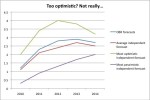
Much ado about the Office for Budget Responsibility's growth predictions in the Treasury Select Committee earlier, especially as an OBR official admitted that the cuts and tax hikes in the Budget could conceivably tip us into a double-dip recession. So are the OBR's official forecasts too optimistic, as some are now claiming? Only time will tell, but we can get a decent sense of things by comparing them with the independent forecasts that the Treasury collect here. And this is the result: In other words, the OBR growth forecasts stick pretty closely to the average independent forecast, although they are a touch more optimistic. Admittedly, these independent forecasts were collected before the Budget (but after the election), so they may be tweaked in a month or two.

Hard going for the government

From our UK edition

A tough morning for the government at the hands of Tyrie, Fallon and rest of the Treasury Select Committee. Sir Alan Budd apologised for his naivety, Robert Chote described the Budget as ‘regressive’ in the main and the banking levy has been criticised on the grounds that is de-stabilising banks’ capital bases, which will affect lending. The government would prefer silence on these issues but the damage was far from total. Budd was an interim figure and the spat that has developed around him is largely political – there is no question that Budd was ‘nobbled’. Robert Chote deserves his reputation but he is not infallible. And Treasury Chief Economic Advisor, Dave Ramsden, put paid to the criticism of the banking levy.

Still spinning

From our UK edition

According to the Spectator’s literary editor, Peter Mandelson wrote the most boring book review ever published by the Spectator. I imagine he did. You don’t read the Mandelson memoir; you wade through it in leaking gum boots. The lack of illumination is nothing compared to the faceless prose. Mandelson cannot evoke the personality of Alan Clark’s or Chris Mullin's diaries. Form is crucial in that memoirs justify and diaries observe. Clark’s love of Mrs Thatcher and his self-importance match Mandelson’s love of Blair and his preening conceit that there was a ‘Third Man’ at the heart of New Labour's tenure in office - Mandelson spent most of it in exile.

Tony Blair, everywhere

From our UK edition

To be honest, these Mandelson memoirs are already losing their lustre. I was planning to do a summary of this morning's revelations, as yesterday – but swiftly lost the will. It's not that this first draft of New Labour's history is unappreciated, of course. But so much of it is just plain unsurprising: ministers thought Labour was cruising for an electoral kicking; Alistair Darling proposed a VAT hike; David Miliband was considering running for the leadership in 2008; and so on and so on. Sadly, it's not quite enough to enliven this grey morning in Westminster. One general observation does emerge from the latest extracts, though: the omnipresence of Tony Blair.

Will the coalition defeat the roadblocks to reform?

From our UK edition

The biggest reform to the NHS since its inception since 1948. A move away from bureaucracy towards a proper internal market. GPs commissioning. A revolution, taking on the vested interests. Yes, there was so much to savour in the NHS Plan of 2000 - enough, Alan Milburn would later joke, that he kept re-announcing its policies for the next three years and getting headlines. Well, the Tories can play at that game too. Now, it has been reannounced by Andrew Lansley and called the coalition NHS White Paper. This is, in my book, a compliment to Lansley. In opposition, he sided with the unions and attacked Labour from the left on the "stop the cuts" platform. Now, he is picking up some of the discarded Blair reform agenda – centrally, GP commissioning.

Ducking the issue?

From our UK edition

As I wrote earlier, a large proportion of Andrew Lansley’s white paper had to be devoted to accountability. Much of it is, but little is explained. Patients are central. The creation of GP consortia is for their benefit and they will hold the consortia to account by excercising choice (4:21). Choice is the tyrannical panacea that does not exist. A patient can only improve a treatment if they are given it; and many GPs are closer to Doctor In the House rather than Dr.House. GPs are independent practitioners working within the NHS framework. For example, it is impossible for the patient to make recommendations about unavailable cancer drugs. In addition to the patient, the NHS Commissioning Board will regulate the consortia.

A question of accountability

From our UK edition

In theory, curbing bureaucracy in the NHS should have you reaching for the Champagne. But giving GPs control of £80bn is an enormous risk. GPs know their patients' needs, so Andrew Lansley’s thinking is that empowering GPs will improve patient care, and therefore patient outcomes. Many GPs will be chomping at the bit to get their hands on budgets; on the other hand, many will not – it takes a certain kind of mind to be thrilled by balance sheets. Also, those that are may fight their corner rather too vigorously, which would merely deepen imbalance in the health service. The success or failure of Lansley’s initiative depends on ensuring that GPs will be accountable for the public money they manage - the White Paper must address that question.

The Mandelson question

From our UK edition

As Peter Mandelson has us knee-deep in Kremlinology already, it's worth pointing out this insight from Mary Ann Sieghart in the Independent: 'It was quite clear in 2008 and 2009 that Brown was going to lead Labour to defeat, whereas a messy leadership contest was by no means certain ….  Mandelson by then knew that Labour would lose under Brown. 'Surely you know we can't win with Gordon as leader?' a colleague asked him last year. To which the reply was, 'Do you think I'm mad? Do you think I don't realise that?' But Mandelson was convinced that Labour couldn't win a majority under any leader. His big strategic mistake was to overlook the possibility of winning enough parliamentary seats to be able to govern in coalition with the Lib Dems.

Five highlights from the Mandelson serialisation

From our UK edition

So now we know what happened during those uncertain days following the election in May – or at least we know Peter Mandelson's side of it.  The Times begins its serialisation of the Dark Lord's book today with a front-page photo of Nick Clegg and the legend, "Clegg the Executioner".  And, inside, Mandelson explains how the Lib Dem leader made Gordon Brown's departure a precondition of any coalition deal with Labour.  Not the most surprising news ever, but worth having on record nonetheless. Aside from that, there's little of much weight in these first extracts, but plenty of titbits for political anoraks. Here are five that jumped out at me: 1) Blair thought that a LibLab deal was an "error".