Uk politics

Cameron, Villa and the succession

The Prime Minister is, as we know an Aston Villa fan. So we can expect him to be disappointed at Martin O’Neill’s departure. On his trip to Birmingham the other week, Cameron’s support for Villa caused the PM to, as the phrase has it, misspeak. He told the Birmingham Post that with “the Governor of the Bank of England as a supporter, the next King of England and the current Prime Minister, [Aston Villa] got a good set” of fans in high places. But his reference to the next King of England being a Villa fan will raise a few eyebrows as it is Prince William — not Prince Charles — who is the Royal Villain. Now it is obvious that Cameron just slipped up and that he didn’t mean to impart any information about the succession.

Cable’s 50-50 warning

As compliments go, there's something slightly backhanded about Vince Cable's claim that, "Having worked with [the Tories] at close quarters, I've been pleasantly surprised that they're not as I'd envisaged them." And that's just one of the little nuggets embedded within his interview with Decca Aitkenhead this morning. The Business Secretary touches on everything from what he thinks of George Osborne ("he's clearly able") to his own ability to craft a joke ("I'm actually quite good at one-liners"). If you want a sense of where Cable is at, then Aitkenhead's piece is worth a quick read.

Will the Tory right oppose a graduate tax?

One of the vulnerabilities of the Coalition is that when Labour moves position one of its flanks can be exposed. When the Coalition agreement was drawn up, it seemed sufficient that the Lib Dems would maintain the right to carry on opposing tuition fees as both Labour and the Conservatives were in a favour of them. The Lib Dems would still be able to tell students, a key constituency for them, that they were the only party committed to abolishing fees. But as soon as the Labour leadership contenders started moving rapidly towards a graduate tax, the Lib Dems had a problem.

Maintaining the private sector motor

There's a lot of economic speculation swirling around the Westminster washbowl at the momment, but little of it is as eyecatching as today's report from the Chartered Institute of Personnel and Development. Its finding that a third of employers are expecting to cut jobs in the next quarter is bound to spark double-dip fears, even if that expectation is more keenly felt in the public sector than in the private. 36 percent of public sector employers foresee job losses, against 30 percent in the private sector. Perhaps more worryingly, both sectors are expecting more redundancies than they did in last quarter's report. Look below the headline figures, though, and there are signs that the private sector is driving on ahead regardless.

Opposing social housing reform looks like a marginal issue

The Sunday Times YouGov poll (£) contains some statistics that will warm Cameron’s cockles. ‘The poll also backs the idea, floated by the prime minister last week, that new tenants in council and social housing should have a limited term of five or 10 years before they have to make way for others if their circumstances have changed. The proposal, criticised by Simon Hughes, the Liberal Democrat deputy leader, is supported by 62% and opposed by 32%. Even among Liberal Democrat supporters there is strong support for the idea, by 67% to 26%. Tory supporters overwhelmingly back it, by 78% to 18%. Labour voters are only narrowly in favour, by 48% to 47%.’ The figures for Liberal Democrat and Labour support are surprising.

Sour milk

David Cameron can’t afford to be known as ‘The Milk Snatcher.’ It is for that reason that N0. 10 has airily dismissed Anne Milton’s suggestion that free school milk for the under fives be cut. Still, it is encouraging that Milton has the freedom to think the unthinkable in government – her immediate predecessors were subject to a maniacal control-freakery. Despite the restitution of cabinet government, Ben Brogan asks if Cameron remains ‘too tight’ with his ministers, denying them the latitude they require run byzantine bureaucracy. This is an important point: ministers will only find cuts if they are allowed to get their hands dirty.

Cameron makes the cuts more presentable

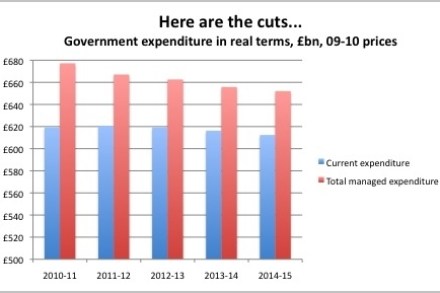
David Cameron's neatly-constructed article in the Sunday Times (£) perfectly typifies the balancing act he is performing ahead of this autumn's Spending Review. The Prime Minister has to sound tough on the deficit because, thanks to the fiscal brinksmanship of one G. Brown, that's the job he has been appointed to do. But he doesn't want to come across as sadistic or gloomy, lest it alienate voters and coalition partners alike. The edges of the cuts need to be rounded off, made more presentable. To that end, Cameron suggests first that the cuts aren't ideological. There are, he says, items of spending that he'd like to keep – but wider budget constraints mean that he can't.

The Treasury’s cutting difficulty

Among the most eyecatching, and potentially important, stories of the day is this one in the Telegraph. It suggests that various departments have "failed" to outline a "worst case scenario" of 40 percent cuts that was demanded by the Treasury. And it even names and shames Caroline Spelman's Department for Environment, Farming and Rural Affairs as one of the offenders. Mrs Spelman, we're told, has now "been forced to use the time before her holiday to work up the projections with her officials and permanent secretary." Nothing like a last minute job, then. To be fair to Whitehall civil servants, there is a general sense that they have set about identifying cuts with some flair – although, obviously, the process won't go entirely smoothly.

Alan Johnson, summarised

What became of the likeable lads, that group of New Labour politicians who seemed more decent than the government in which they served? Alistair Darling was one, and he has effectively retired from the frontline of British politics. Alan Johnson was another, and today he gives a frank and wide-ranging interview to Rachel Sylvester. In it, Johnson spends much time cheerleading for David Miliband, and criticising Ed Miliband quite harshly, but there are some points which are worth recording. So here goes: 1) What a drag. As Sylvester puts it, "The [leadership] contest has, in [Johnson's] view, already gone on too long and should not have been extended until September." This is an opinion which many Labour types seem to share.

Will Hughes succeed in stirring up trouble over Right to Buy?

Simon Hughes led the angry response to David Cameron's thoughts on social housing, and now he's stirring it up again. In an interview with the South London Press – picked up by Sunder Katwala over at Next Left – the Lib Dem deputy leader has attacked the Right to Buy, saying that local councils should decide whether to offer it or not. Given the Thatcherite roots of the policy, there's a firecracker quality to Hughes's comments: lobbed into the debate, and designed to provoke the Tories. I'm not sure the Tories will be too perturbed by Hughes's intervention, though. Of course many of them are proud and supportive of Thatcher's Right to Buy policy – and rightly so.

The politics of the Lib Dem conference

It's only gesture politics, but sometimes gestures matter – which is why the Tories are thinking seriously about dispatching a party envoy to the Lib Dem conference in September. The idea, naturally, is to cement the bonds of friendship between the two sides, as well as to suggest that the Tories are happy to mix it with the wider Lib Dem party. But there's a problem: that wider party doesn't seem eager to play along. As soon as there were rumblings that Cameron might speak at their conference, they slapped the idea down with the unswerving efficiency of an executioner. And they've done similar today in response to reports that William Hague is being lined to up deliver a "witty" address in Cameron's stead.

The FCO’s dubious Prevent grants

A few weeks ago I wrote for Coffee House welcoming the Government’s decision to scrap Prevent grants administered by local authorities. In that article, I cautioned that scrapping something should actually mean scrapping it, not just moving resources around. Today, the TaxPayers’ Alliance has released research showing that the Foreign and Commonwealth Office (FCO) also distribute funds through Prevent. Again, money has gone to projects of questionable value in the fight against extremism, violent or non-violent.   One of the more dubious projects was a “mobile cinema for justice”. What’s worse is that it was administered by an American charity called the International Research and Exchanges Board. Why is that bad?

Democracy in the BBC

What is that quote at the end of King Lear?  I think it is something like “the wheel has come full circle”. I felt a sense of that wheel with the announcement by Mr Miliband yesterday that the BBC should be democratised and become some sort of mutual co-operative. I have been campaigning for democratisation of the BBC licence fee for a while now, first writing about it on ConservativeHome in 2008 and most recently tabling an Early Day Motion, only a couple of weeks ago. Inevitably a few brickbats were thrown.

The unions up the ante

The front cover of the Times (£) provides a dreary snapshot of what the coalition can expect once the cuts start to bite. Unison have responded to job losses in the NHS by arguing that the government is "conning" the public over the impact on frontline services. And they're threatening to all get all litigious about it. As one of the union's spokeswomen tells the paper, "If we are not happy with the [government's reply], we are reserving the right to issue urgent judicial review proceedings." You wonder whether they'd have done the same against Labour's proposed 20 percent cuts. And this will be just the start of it.

Cable, Cameron and speaking out in public

For the foreseeable, Vince Cable is going to be a political barometer figure: journalists and other innocent bystanders will sift through everything he says to check the temperature of the LibCon coalition. In which case, they'll find little to excite or worry them in his cool interview with the Newcastle Journal today. The Business Secretary says all the right things about staying his role for the full five years ("that's my intention, yes") and about the internal dealings of the coalition ("it works in a very business like way"), even if he does quash the idea of a full merger between the two parties. It's all unsurprising, uncontroversial stuff.

Miliband’s Big Society

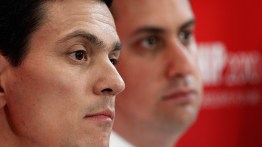
Paul Waugh has already noted David Miliband and Tessa Jowell's proposal to turn the BBC into a co-op. But the language they use to outline the idea is striking in itself. Here's an excerpt: "In confronting the big challenges ahead of us, whether it's rebuilding our economy, tackling climate change or protecting frontline public services – the need for collective action is greater than ever. This is a moment for mutualism, which offers us the opportunity to take collective action in step with individual aspiration, drawing on the values and practices of the cooperative movement and today's Coop party.

Why Gove’s school reforms could go further

The latest issue of the magazine is out today and, with it, all of the articles from last week’s edition have been made available online to non-subscribers. Among them is Toby Young’s column which raises some important points about, and criticisms of, Michael Gove’s school reforms. Toby, if you hadn’t heard, is working to set-up a free school himself – so he’s very much operating at the coalface on this, and his thoughts deserve attention. In which case, here’s the entire article for CoffeeHousers’ benefit: It has been described as the most radical overhaul of the school system since the introduction of comprehensives.