Uk politics

A bill that deserves trimming

From our UK edition

The electoral reform bill has passed comfortably, by 328 votes to 269. Now comes the hard bit: this bill is going to be deservedly lacerated in committee. The bill drew opprobrium from all sides of the house throughout this afternoon’s long debate, notably from both wings of the Tory party. First, the government has coupled boundary reform to the alternative vote referendum. Peter Hain, Labour’s most articulate attack dog, unleashed his thesaurus and referred to the bill as a ‘smoke-screen for colossal gerrymandering’. He was speaking for his ardently hypocritical and opportunistic party. The government’s motives were not so cynical; it coupled the bill’s two aims to aid swift progress through the commons.

Against the Political and Constitutional Reform Bill

From our UK edition

MPs are back today from their long summer recess, and the Political and Constitutional Reform Bill is right at the top of the agenda. This is likely to dominate politics for the immediate future, since it might have profound effects on how politics in this country operates.   The Bill combines two different reforms in one package – the referendum on changing the electoral system to the Alternative Vote (AV) and reducing and equalising constituencies. These two issues address what Nick Clegg has called the “deep unfairness” in the electoral system. This unfairness is exemplified by the last two elections: Labour won a majority of 66 with a vote share of 35.3 percent and a lead of just 3 percent in 2005; in 2010 the Conservatives gained more votes (36.

May’s straight-bat technique

From our UK edition

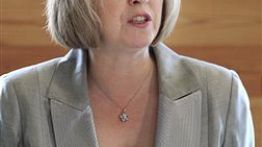
Theresa May channeled Chris Tavaré today, every question on this phone tapping scandal was met with a solid defensive answer. She was helped by the number of Labour MPs who overreached — one compared it to Watergate while Dennis Skinner, who is nowhere near the Commons performer he once was, produced an ill-judged demand that Cameron come to the Commons and sack Coulson. Those MPs who were most effective were the ones who kept their cool. The personal testimony of Chris Bryant was particularly powerful.   Perhaps, the most noteworthy element of the proceedings was how a particularly glum looking Ming Campbell and Simon Hughes kept whispering to each other with concerned expressions on their faces. Neither man appeared to be happy with May’s answers.

Blair pulls out of book launch

From our UK edition

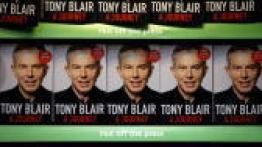
It is profoundly depressing that Tony Blair has had to pull out of his London book signing. Whatever you think of Blair, he is a man who led his party to three general elections victories and is the second longest serving Prime Minister of the post-war era. There is something very wrong if he feels he has to cancel an appearance at a book shop because of the threat of disruption from protesters whose intentions do not appear to be entirely peaceful. One other thing that should be noted is that the polling suggests that Blair is nowhere near as unpopular in this country as much of the coverage of his book suggests. A YouGov poll, timed to coincide with the book’s launch, found that a plurality, albeit narrow, of voters believe Blair was a good Prime Minister.

Coulson loosens the noose

From our UK edition

The New York Times has produced what last year’s Guardian phone-hacking campaign lacked: direct testimony against Andy Coulson. Sean Hoare and an unnamed former News of the Screws editor allege that the practice was widespread and that Coulson encouraged it. These new revelations have rightly forced the Met to re-consider the case. At present, the political furore surrounds the Met’s incompetence not just the allegations against Coulson. Bill Keller, executive editor of the NYT, has claimed categorically that the ‘police already have evidence that they have chosen not to pursue’.

Rebels ‘owe’ David Cameron their support

From our UK edition

I bumped into a Tory MP earlier who one might have expected to be rebelling tonight. But he told me he was, reluctantly voting for the AV bill, because “I owe him [David Cameron] this.” His logic was that Cameron had come to the parliamentary party and told them he was going to offer the Lib Dems this so the party was honour-bound to vote it through. This argument has resonance with Tory MPs. The only thing that limits its appeal is a feeling that Cameron might not have been entirely straight with them about why he had to offer the Lib Dems AV. I expect tonight’s rebellion to be relatively small, 10 to 12 according to those on the backbenches who should know. But the real drama will start in the committee stage when all sorts of amendments are put down.

Tonight’s the night

From our UK edition

There's no rest for the wicked. Conservative whips have spent a frantic summer urging Tory opponents of electoral reform to retreat from their opposition. According to Paul Goodman, the whips have been blunt: the government could collapse if its reform bill is defeated tonight. Their scaremongering seems to have had the desired effect. The Financial Times reports: ‘Members of that group told the FT they were likely to advocate not opposing the government now, but supporting amendments at a later stage on the timing and threshold of the referendum in future debates.’ The Mail carries a similar report, with David Davis anointing himself rebel-in-chief and stating that he hopes to ‘get the bill modified to take on board certain things’.

What you need to know ahead of the Spending Review: the Irish experience

From our UK edition

This is the latest of our posts with Reform looking ahead to the Spending Review. The first six posts were on health, education, the coalition’s first hundred days, welfare, the Civil Service, and the New Zealand and Canadian experiences. Ireland As Colm McCarthy, Chair of Irish Special Group on Public Service Numbers and Expenditure, noted at a recent Reform conference the macroeconomic downturn in Ireland has been more severe than in almost any other European country: -- The budget deficit, excluding the Exchequer cost of the banking collapse, went from near zero in 2007 to 11.5 per cent of GDP in the current year, despite fiscal cutbacks which began in July 2008.

David Miliband has the best of it as the Labour leadership candidates debate

From our UK edition

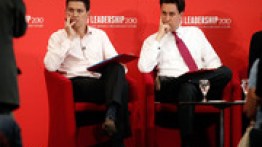
David Miliband’s performance in Sky News’ Labour leadership hustings will have calmed the nerved of his supporters. In the run-off between him and his brother, David came out on top. His answers were generally sharper and he managed to parry away Ed’s criticisms on tuition fees and foreign policy. (In a pointed remark, Ed said that the Labour government’s foreign policy had been based on ‘old ideas’.) Indeed, Ed Miliband only seemed to get going in his closing statement which was pitch-perfect David’s best moment came when the contenders were asked to pick between Blair and Brown. Ed Balls opted for Brown, Diane Abbott said that Brown ‘was the better man’ and then it was the elder Miliband’s turn.

Cameron and Clegg’s message to Tory AV rebels

From our UK edition

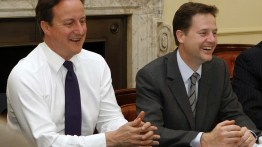
So, Cameron and Clegg end the summer break much as they started it: with a public statement on the aims and successes of the coalition government. Their article in today's Sunday Telegraph hops across all the usual touchstones – reform, deficit reduction, people power, and all that – but it lands with an unusually combative splash. In anticipation of tomorrow night's bellwether vote on the AV referendum and redrafted constituency boundaries, the two party leaders write: "This is an important moment for political renewal. We have different views on the future of our voting system. But we both recognise that there are genuine concerns about the current system. And we emphatically agree that the decision is not, in any case, for government alone...

Gove to introduce baccalaureate for 16 year-olds

From our UK edition

Fixing the education system in Britain is absolutely crucial to promoting social mobility, the principal domestic social policy aim of the coalition. So Michael Gove’s announcement on the Andrew Marr show this morning that the government plans to introduce an English baccalaureate is to be welcomed. The baccalaureate programme will end at 16, still allowing specialisation at A-Level—one of the things that allows undergraduate education in this country to be far more intellectually rigorous than in the States, and will require pupils to do English, maths, science, a foreign or ancient language and a humanity. This should help stop the drift to softer subjects at GCSE and place pressure on all schools to enter all their pupils in all these subjects.

“Ed does not need to hold the broccoli”

From our UK edition

A Thick of It style interlude from Ann Treneman's interview (£) with Ed Miliband today: "There is also a visit to something called a 'communiversity' where he is confronted with what, for a Miliband, is a scary sight: a bowl of fruit. 'Us Milibands are funny about funny shaped fruit,' he notes, plucking out an apple and avoiding the yellow peril that gave his brother the nickname Milibanana after he was pictured holding one and looking, well, a bit bananas. Later, on a trip to a community farm I feel on the brink of a major news scoop when someone tries to make Ed hold a broccoli. 'Ed does not need to hold the broccoli,' says his press handler as the green blob was extended.

Surmountable problems for Nick Clegg

From our UK edition

Curious times, getting curiouser, for Nick Clegg. The Lib Dem leader might have thought that bringing his party into government would ensure him a triumphant reception at their conference in two weeks. But, instead, he faces a number of stories that could unsettle proceedings. Today, we hear that more Liberal Democrat councillors have resigned in what they claim is protest at the cuts being implemented by central government. What's more, a number of Lib Dem figures have added their voices to the general cacophony surrounding Andy Coulson. And that's before we consider the underlying, but most urgent, threat to the stability of the coalition: the Lib Dems' spluttering poll position. But Clegg should not be unduly concerned.

First free schools will open next September

From our UK edition

Tomorrow’s Guardian front page says Michael Gove dealt fresh blow as only 20 'free schools' approved. But this is actually not a bad rate of progress. The 20 refers only to the new schools that will open in September 2011, more will open in 2012 and 2013 and so on. One would expect the numbers to increase as momentum behind the programme builds. As soon as parents see what these schools can do, there’ll be greater demand for them. Ed Balls is out tonight with a typically pugnacious statement claiming that this proves that parents don’t want free schools. But it is worth remembering that Tony Blair, a man who knows a thing or two about what the public want, goes out of his way to praise Tory school plans in his autobiography.

Liam Fox rows back on carrier sharing

From our UK edition

For a while then, it looked as though Britain and France really were going to share aircraft carriers as a mesure d'austérité. But, today, Liam Fox seems to have put a block on the idea, describing it in Paris as "utterly unrealistic". He did, though, add that we could pool some of our transport planes and helicopters with the French (which sounds like the military equivalent of hitching a lift, if we happen to be going in the same direction). And Fox's spokesman has since said that there still might be "strategic co-operation across the maritime domain," whatever that means. So some sort of link-up with the French should be expected.

What you need to know ahead of the Spending Review: the New Zealand experience

From our UK edition

This is the latest of our posts with Reform looking ahead to the Spending Review. The first five posts were on health, education, the coalition’s first hundred days, welfare and the Civil Service. International examples of public finance rescue missions Other countries can provide important lessons on what does, and what does not, work in devising a plan to bring government spending down. Several countries have undertaken major programmes of reform that have set out to restore fiscal credibility and improve the quality of their public services. Examples include New Zealand, Canada and Ireland. Reform has drawn on the experiences of senior figures from these countries, and lessons from the New Zealand experience are discussed below.

Balls turns on the man he called Labour’s ‘greatest ever leader’

From our UK edition

The ever-pugnacious Ed Balls was on the Today Programme this morning denouncing Tony Blair for saying that the coalition was, broadly, right in its deficit reduction plans. As Balls warmed to his task, he started reeling off Blair’s failings—his advocacy of entry into the euro, his one-sided account of things in his autobiography and the like— and I wondered: if this is his opinion of the man he called Labour’s greatest ever-leader, what on earth does he think of the other men who have led the party?   But in all seriousness, the coalition needs to start hitting back at the ‘growth denier’ charge that Balls keeps hurling at them.