Uk politics

This is not a 10p tax moment

From our UK edition

Last night, one minister came up to me nervously and asked, ‘is this our 10p tax moment?’ He was talking, obviously, about the decision to take child benefit away from households with a higher rate taxpayer in them.   My answer was no. The comparisons with Brown’s removal of the 10p tax rate miss a crucial point: Brown tried to hide what he was doing. In his final Budget statement to the Commons, the abolition of the 10p rate wasn’t even mentioned. Instead Brown boasted about a 2p reduction in the basic rate, to huge cheers from the Labour benches.   By contrast, the Tories have been upfront about the fact that there are losers from this change.
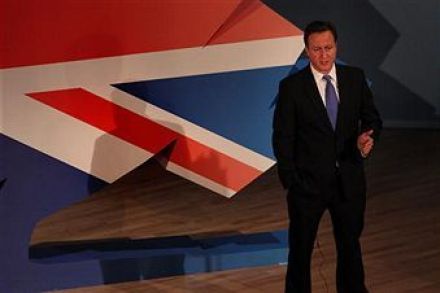
Cameron tries to defuse the child benefit row

From our UK edition

Whether you agree with the plan to restrict child benefit or not – and, broadly speaking, I do – there's little doubting that it has met with some fiery resistance in the papers today. The Telegraph leads the attack, calling it "a hastily conceived about-turn bundled out on breakfast TV". The Daily Mail highlights the "blatant anomaly," currently riling up the Mumsnet crowd, that a single earner family on £44,100 a year might lose the benefit, while a dual earning family on £87,000 can keep it. And the Independent does likewise. It should be said, though, that the Sun, the Times and the Financial Times are considerably more generous about Osborne's proposal. The FT even calls on the Chancellor to go further.

Clarke ups the ante

From our UK edition

Perceptions count and the coalition are perceived to be vulnerable on crime. Its policy of reducing the number of prisoners on short-term sentences has been caricatured as a reduction in sentencing per se, a liberal assault on the consensus that prison works. I don’t agree with that analysis (which overlooks that excessive sentences in disorganised and overcrowded prison can create habitual criminals, who cost society in perpetuity thereafter) but readily concede that it’s easy to traduce the government as soft on crime, and I was surprised that Ed Miliband didn’t do so last week – as were plenty of Tories. In fact, opposition comes from within the Tory party, even from the government.

Withdrawing child benefit at 16 would be the wrong call

From our UK edition

In the last few weeks, there has been much speculation that child benefit would be stopped when a child reaches 16. Today’s announcement suggests that this is not going to happen, although the Tories are refusing to rule it out. If there are to be changes to child benefit — and given the financial situation there need to be — then removing it from households with a higher rate taxpayer is a better move than stopping it at 16. Child benefit ending at 16 would send out a message that at 16 a child should start earning its way in the world. This would, for obvious reasons, have a negative impact on social mobility as it would likely lead to fewer children staying on at school post 16.

The beginning of the end of universal benefits

From our UK edition

The most important line in George Osborne’s speech was this one: “It’s very difficult to justify taxing people on low income to pay for the child benefit of those earning so much more than them.” Logically, this argument applies equally to all other universal benefits. Why should someone on £12,000 a year be paying tax to help cover the cost of Ken Clarke’s pension? Personally, I’m quite happy to see universal benefits go. The end of universal benefits would, though, change the nature of the welfare state. Quite rapidly, it would become a safety net not a contributory system. This is why Labour will oppose so vigorously taking child benefit away from those on the higher rate of tax.

Is there an alternative to cutting child benefit?

From our UK edition

Beware a mother scorned. George Osborne’s copping some stick on Mumsnet, social forum for the Latte-drinking classes, and with good reason. 'Hard-working families’, many of them far from rich, will feel abandoned by the party that ought to be theirs. IDS, Cameron and Osborne have taken a huge a political gamble, as James noted earlier, and they have also taken an enormous social risk. It is telling that the Centre for Social Justice, IDS’ think tank, are lukewarm about the proposal, describing it as ‘probably appropriate’ but calling for an alternative.  Skipping through the comments on Mumsnet and you can see why.

Boris vs the unions

From our UK edition

It was all so Osborne-a-go-go earlier that we didn't have chance to mention Boris's speech to the Tory conference. By way of rectifying that oversight, here's footage of the Mayor of London taking on the trade unionists who have organised a Tube strike today.

Osborne’s benefit risk

From our UK edition

George Osborne’s announcement that child benefit will be taken away from any family with a higher rate taxpayer in it to help fund welfare reform shows how far Cameron and Osborne were prepared to go to keep Iain Duncan-Smith on board. During the campaign and in the Budget, Cameron and Osborne had strongly implied that child benefit would remain universal. The move carries it with considerable political risks. The measure takes effect from 2013, so before the country will have seen the benefits of welfare reform.

Osborne can go even further on middle-class benefits

From our UK edition

George Osborne had been expected to subject child benefits to tax. Instead he is to abolish them entirely for higher-rate taxpayers. I've spent this morning talking to friends, whose judgment I respect, who are furious about Cameron hitting the squeezed middle. I cannot agree, and here's why. We are not talking about the "squeezed middle" here – of the 30.5 million income tax payers in Britain, just 3 million pay the top rate of tax (figures here). They're the best-paid 10 percent – and I have never worked out why the tax of the average worker (who's on £22k) should be higher to afford the payment to those on twice as much money. Osborne reckons he will save £1 billion by this measure. If there are to be cuts, this strikes me as a fair cut.

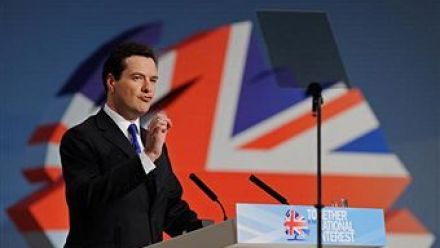
Osborne takes to the stage, armed with cuts

From our UK edition

Rewind the tape to last year's Tory conference, and David Cameron was assuring us that, "It will be a steep climb. But the view from the summit will be worth it." Today, it falls to George Osborne to tell us more about both the arduousness off the ascent and the beauty of that view – although I expect that there will be a heavy empasis on the former. Already, the main passages are spilling into the papers and, as you'd expect, it's mostly cuts and debt. On that front, the main argument seems to be similar to that made by Nick Clegg in Liverpool: that the longer it takes us to pay down our debts, the more money we waste thanks to interest payments and the like. Or as Osborne will put it, "Delay now means pay more later. Everyone knows it's the most basic rule of debt.

OBR Watch

From our UK edition

When Sir Alan Budd was head of the Office for Budget Responsibility, there was an insistent argument in opposition circles that the independent body was biased in favour of the coalition. Much of this cented around the OBR's growth predictions. How on Earth, came the question, can growth hit 2.3 percent next year and 2.8 percent the year after? Isn't that a bit optimistic in view of all the warnings about a double dip? Won't the cuts stifle growth? And so on and so on. A few months ago, I produced a graph which showed that, when compared to a range of independent forecasts, the OBR's growth predictions weren't really optimistic at all.

The Coulson story returns (again)

From our UK edition

Call it a professional hunch, but I suspect the Tories won't be too pleased that this Guardian story has come out on the first day of their conference. It's about Andy Coulson – and, much like the revelations in the New York Times Magazine last month, features one of his former colleagues alleging that Coulson knew all about the telephonic subterfuge going on at the News of the World. That journalist tells Channel 4's Dispatches that: "Sometimes, they would say: 'We've got a recording' and Andy would say: 'OK, bring it into my office and play it to me' or 'Bring me, email me a transcript of it.'" It's evocative stuff, but – as before – I imagine it's also unprovable. In which case, the Tories will probably just ignore it.

Ken Clarke in the firing line

From our UK edition

There’s an intriguing pre-conference story in the Mail on Sunday today. The paper reports that: “Ken Clarke faces a whispering campaign by allies of David Cameron and George Osborne to move him from Justice Minister because of his ‘disastrous’ views on law and order, it was claimed last night. Conservative MPs say Mr Cameron and Mr Osborne are ‘ frustrated’ by Mr Clarke’s refusal to take a tougher line on key issues such as prison sentencing.” Clarke’s liberal views on criminal justice certainly are infuriating his colleagues. Allies of Theresa May have been heard to complain that "Ken is going to send the crime rate soaring and we’re going to get the blame.

How Osborne and IDS reached agreement

From our UK edition

I have found out a little more about the Universal Credit – and how the arguments over the summer were resolved. First, the backdrop. Money was always going to be a problem. This policy is about saving lives, not money. Right now, we pave the road to welfare dependency, creating a vacuum in the labour market that sucks in workers from overseas. Under Brown, the Treasury accepted this: cheap workers pay tax too, and as do companies who profit from them. Result: tax receipts up, but never fewer than 5 million on out-of-work benefits throught the boom years. The IDS plan was not sprung on Osborne. As I blogged a while ago, it was Osborne who suggested bringing him back – to implement this very policy.

Cameron sets the mood for Birmingham

From our UK edition

It's that time of year again: Conservative Party conference. And with it comes wall-to-wall David Cameron. Our PM has a couple of interviews in the newspapers today and, to accompany them, he slotted in an appearance on the Marr show earlier. In all three, he hops neatly across the all same lily pads – spending cuts, IDS's historic benefit reforms and the defence budget – making the points and arguments you might expect. Yet two snippets stand out, and are worth pasting into the scrapbook. First, Cameron's claim on Marr that, "We have got to ask, are there some areas of universal benefits that are no longer affordable?

What to do with Balls?

From our UK edition

Ed Balls is adept at opposition – making a case throughout the recent leadership hustings for immigration controls that he knows are unworkable in practice. Mike Smithson reports than a senior Lib Dem thinks Ed Balls would be an ideal opponent for Liam Fox, the man to exploit the coalition’s most obvious weakness. It’s a salivating prospect for the independent observer – confrontation between two skilled and principled communicators – and if anyone can damage a Conservative-led government on defence it is Balls. But there’s the rub. In their ideal worlds, Balls and Fox don’t differ on the broad principles of defence policy.

Labour’s historic mistake

From our UK edition

I’ve already mentioned George Osborne’s interview with the Telegraph, but it certainly merits another. As Ben Brogan says, Osborne is in a rich vein of ‘election that never was’ form. As befits the inveterate schemer, Osborne’s tactical grasp is impressive. He is quietly vociferous about Labour’s ‘historic mistake’ in electing Ed Miliband. Revealing senior Tories’ continued respect for the electoral tenets of Blairism, he says: "They have chosen to move off the historic centre ground of British politics. I've seen more pictures of Neil Kinnock on television in the past week than I've seen in 20 years. That's old politics.

Fox, Osborne and Cameron engaged in Whitehall’s oldest battle

From our UK edition

Tory on Tory is a brutal cock-fight when defence is concerned. After the leaking of Liam Fox’s now infamous letter and David Cameron’s measured retaliation, George Osborne has broken his silence. Making unspoken reference to the £38bn black hole in the MoD’s budget, Osborne tells this morning’s Telegraph that he was ‘not thrilled’ to learn of Fox’s ‘do we really want to cut defence this much letter’ and says that Labour left the MoD in ‘chaos’, signing Britain up to ‘expensive and pointless projects’. The press will run this as a conference Tory splits story.