Uk politics

The ‘progressive’ debate re-opens

From our UK edition

Busy times indeed for the numbercrunchers and policy wonks. I'm at what is, in effect, the Institute for Fiscal Studies' third post-Budget briefing of the year: one for Darling's final Budget, one for the Emergency Budget and one, now, for the Spending Review. We're half-way through, but we've already been served a hefty chunk of meat: the IFS's analysis of what yesterday's Spending Review meant for public spending and for welfare. So far, there are mixed tidings for the coalition. The IFS's acting director Carl Emmerson - who is filling in now that Robert Chote has departed for the OBR - set the tone with his opening remarks. "By 2015," he pointed out, "departmental spending will be lower under this government than it would have been under Labour".

More to Osborne’s plan than gambling

From our UK edition

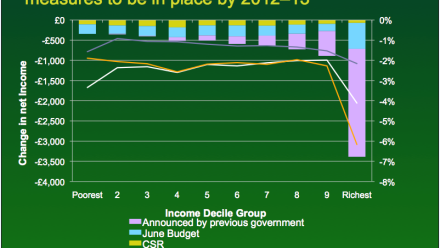
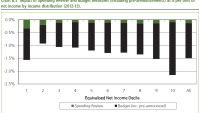
Paul Mason's review of the cuts for Newsnight last night (from 10:20 into the video here) was one of the most powerful critiques of Osborne from the left. His package majored on Osborne's decision to cut a further £11 billion from welfare and pensions, to soften the departmental cuts. Adopting a rather funereal tone, Mason declared that, "if you are poor, your life is about to change". He produced a decile graph, showing the poorest are hit second hardest. It foreshadowed this morning's Guardian cover: "Axe falls on the poor". Danny Alexander was fed to Paxo: "You said you would not balance your budget on the backs of the poor - when did you change your mind?" (Alexander performed very well - stunningly, even, given what he was doing only six months ago).

The Tory response to Osborne’s Spending Review

From our UK edition

George Osborne was well received by the 1922 committee of Tory backbenchers when he addressed them on the spending review earlier. There was much thumping of desks, the traditional sign of approval at meetings of the ‘22.   Talking to Tory MPs this afternoon, they are pretty happy with the package. They are glad that the money being taken out of the welfare budget means that the departmental cuts are less than expected. Overall, they think the package is politically sellable and has denied Labour that many targets.   One concern is about how local councils, including Conservative ones, might react to a 28 percent cut in their funding from central government.

Osborne blunts the axe – slightly

From our UK edition

As expected, the Chancellor announced reductions in public spending – though not quite as severe as indicated in the Emergency Budget last June.  Government expenditure will fall by 3.3 percent over four years rather than 3.6 percent as expected, leading George Osborne to state – correctly – that departmental budgets will be higher than those pencilled in by Labour – an outcome many may not regard as desirable.  In fact, Osborne will be spending 2 percent more in 2014/15 than Gordon Brown was in 2008/9. Departmental spending will fall 10 percent rather than 13 percent - largely paid for by more optimistic assumptions about savings on welfare and debt interest payments.  Capital spend was hit the hardest - being cut by 28 percent.

A long way to go

From our UK edition

George Osborne has probably done enough to ensure that the public finances are back on track and that the national debt will not run out of control.   He has, however, taken only the first step on the road to reducing the size of the state. The government will spend the same proportion of national income in 2015 as it did in 2007. In other words, the size of the state will be no smaller when David Cameron goes to the country than when Gordon Brown left the Treasury.   Much more could have been done and low-hanging fruit has been left on the tree. Child benefit should have been scrapped for 16-19 year olds. Universal payments to pensioners (winter-fuel allowance, free TV licences and free bus travel) and the aid budget have been left untouched or increased.

Doing things right, but in the wrong way

From our UK edition

In today’s spending review, George Osborne was absolutely right to hold the line on eliminating the structural deficit within one parliamentary term. In the Emergency Budget released earlier this year the coalition won fiscal credibility (and breathing space from international financial markets) by setting that goal. Failing to follow through on this goal at the first sign of difficulty would have damaged the government’s credibility and reputation in the eyes of international markets.   The Chancellor was also absolutely right to highlight the need for public service reform and to look to the welfare budget to provide some large and early savings.

Ten points about the Spending Review

From our UK edition

In the end, George Osborne didn't flinch. The Chancellor is a clever political operator – too clever, sometimes – but the result is a cuts package that has surprisingly broad popular support. And this has been achieved, in part, by including measures that strike the likes of me as economically unwise. So much of this budget was known in advance that we didn't find out much new today. The below points are my thoughts not on the overall package – which I strongly support – but the pieces of it that we learned today: 1) Total state spending is falling by 3.3 percent in real terms over the next four years, at a lower level than the 3.7 percent forecast in the Budget.

The chart that could cause trouble for the coalition

From our UK edition

Just as they did in the Budget, the coalition have produced a chart showing the impact of the Spending Review's tax, spend and benefit measures on different income groups (see above). In many respects, this is a noble effort: it's a good deal more transparency than Gordon Brown could ever manage in his Budgets. But it also sets a trap for the coalition. As we've pointed out before, these kinds of analyses don't account for measures that can't be quantified in terms of the money handed out to, or taken away from, the public. So policies that might improve the life chances of the least well-off, such as better schools or benefit reform, don't get a look in.

The departmental cuts

From our UK edition

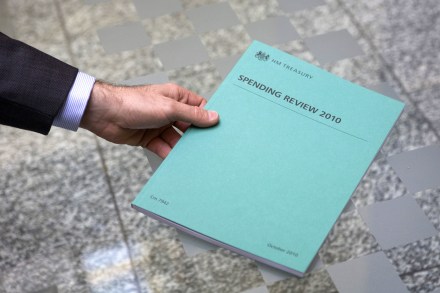
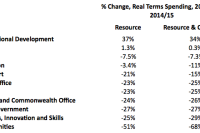
The Spending Review document is available here, but we've collected the cuts facing some of the main departments in the table below. This is not the complete picture of Osborne's announcements today: much of the action takes place in the separate social security budget, but we'll have more on that shortly.

Cameron’s warm-up act for Boy George

From our UK edition

Cameron was a mere warm-up man at PMQs today. With Osborne’s statement due at 12.30 the session felt like a friendly knock-up rather than the main fixture. Ed Miliband rose to thunderous cheers from his backbenches and he tried to capitalise on their support by opening up an ancient Tory wound – heartless attitudes to unemployment. Spotting Cameron chinwagging with Osborne instead of listening, Miliband chided the PM for not paying attention. ‘Well, it’s a novel concept,’ said Dave smoothly ‘but in this government the prime minister and the chancellor speak to each other.’   Ed’s problem was that the OBR has predicted rising employment for the next three years. Bad news for the opposition leader.

PMQs live blog | 20 October 2010

From our UK edition

QUICK VERDICT: More heat than light today, but Cameron easily got the better of Ed Miliband. Now to the Spending Review live blog. 1230: Cameron says that as cuts are made, the government will have to reform the way it does criminal justice. This is a prelude for the deep cuts that the Home Office and Justice department are expected to face in the spending review. 1228: The Lib Dem MP asks whether Cameron believes that better-off graduates should bear more for their university costs. Cameron says that he agrees on principle, and claims that "everyone in the House" wants the "same thing": a fair and well-funded university system. 1226: Cameron says that the spending review will contain answers on social housing - but hints that the results may be better than expected.

How we got here – and where we’re going

From our UK edition

With the Spending Review less than two hours away, I thought CoffeeHousers might like to be armed with a few graphs that set the scene. What follows is by no means the complete picture of the fiscal landscape, but these are certainly some of most prominent landmarks. First up, real terms spending (aka Total Managed Expenditure) from 1966 to 2015: So, yes, all the fuss is about that small dip at the end of the blue line – a dip, as it happens, of about four percent. But don't think that the fuss is entirely unwarranted. What the government is trying to do here is curb a trend of ever-increasing spending that has persisted over decades, and which rocketed during the New Labour years.

Exclusive: 1.5 million jobs to be created during the ‘cuts’

From our UK edition

Almost every newspaper today leads on the chilling figure of 500,000 jobs to go. This was taken from a briefing paper held by Danny Alexander – a “gaffe” says The Guardian. Indeed: it was top secret - to anyone without internet access. “The OBR’s Budget forecast was for a reduction in public sector workforce numbers to 490,000 by 2014/15”. Read the offending sentence. This was not private advice, but posted online (here) and this is what it said…   But hang on. The same forecasts predict that the number of jobs in the economy will rise – by 1.08 million over the same timeframe. So by the same forecasts, the economy will create three times as many jobs than the public sector is shedding.

The slog starts today

From our UK edition

Welcome to Stage Two of the government's life. The first stage was the Budget, which established the size of the fiscal mountain looming over the coalition. The third stage will be the difficult, four-year slog up to the top. But today – the Spending Review – is all about determining the route for that ascent. In just a few hours we will know when, where and why the pain will come. Don't forget to pack sandwiches. Of course, with this roadmap being drawn out in Westminster, we already know some of the details. This morning's papers major on the fact – snapped from Danny Alexander's hands yesterday – that almost 500,000 public sector jobs will be lost over the next four to five years. And then there are the actual departmental settlements.

On the eve of the cuts

From our UK edition

In economic terms, the role of the Comprehensive Spending Review is a fairly straightforward one: to set Departmental Expenditure Limits for every government department, and outline some of the policy measures that will be undertaken to keep spending within those limits.   Fraser Nelson has already ably summarised the real impact that the spending review will have on public expenditure, so I won’t go into that here. Suffice it to say that, yes, the cuts are significant but, no, they aren’t nearly as severe as the BBC would have us believe.    But just as interesting as the cold, hard numbers themselves is what they will tell us about the government’s wider agenda.

Generous settlements mean gigantic cuts elsewhere

From our UK edition

I hear that the Department of Transport’s settlement is another one that is not as bad as expected. The capital statement is, apparently, positively reasonable. George Osborne’s commitment to infrastructure spending has meant that a good number of transport projects have been saved. On rail fares, I hear they will indeed go up significantly. But not by as much as the doomsday 30 to 40 percent scenario reported in the Sunday papers. Nearly all the settlements we have heard about so far have been less bad than expected. There must be, given that Osborne is sticking to the cuts schedule set out in the budget, some departments that are going to have to absorb absolutely massive cuts.

What we know already

From our UK edition

At the Comprehensive Spending Review tomorrow, we will get a much clearer picture of how the Government plans to manage spending cuts.  There are a few things we already know, though: 1) The overall cuts will be modest.  As Fraser has pointed out, the overall cut in spending is small.  Spending is going down to around the level it was at in 2006-07.  It will remain several percentage points of GDP above the level at the start of the last decade. 2) Cut in some areas will be much sharper.  The higher bill for Government debt interest, the ringfencing of Health and International Development and the relatively soft deal for some other departments means quite drastic cuts in other areas.

The unavoidable cruelty of necessary cuts

From our UK edition

Even though the SDSR promises that it "will be used by units returning from Germany or retained for other purposes," the loss of RAF Kinloss will still be a body blow to Moray. For years, it has sustained hundreds of airforce families in Elgin, Forres and Nairn - mine amongst them. And I can picture the bakeries, shops and other small businesses that will be hit by losing so many clientele. About 6,000 jobs depend on the RAF up there: not just Kinloss but Lossiemouth, 15 miles away, whose future also looks bleak. Jet fuel for the Tornados in Lossie is sent via Inverness harbour, so it would mean job losses there. The downgrading of Kinloss, of course, means the end of Nimrods.