Uk politics

The Lords punish Cameron over policing

From our UK edition

In Number 10, they are already concerned that they are losing public support on crime and punishment. David Cameron is planning to give a speech on the subject that will, in the words of one senior coalition figure, ‘throw a lot of bones to his party’s right.’   But Cameron’s words will mean little if he can’t rescue the elected police commissioners policy from its defeat in the Lords last night. By introducing police commissioners who are accountable to the public, this policy will make the police concentrate on the crimes that have the greatest impact on peoples’ quality of life rather than form filling.

Garnering third party support

From our UK edition

Third party support is an important political asset. Nobody trusts politicians any longer (when did they ever?) and so it’s useful to draft in supposedly apolitical backers to support your plans. Yesterday’s PMQs was a case in point, with David Cameron and Ed Miliband competing for support from GPs. As Jim Pickard writes over on the FT blog, having 42 GPs on side is a little less impressive than having support from the Royal College of GPs, which has 42,000 members. So the PM is seen to have emerged from the exchange as the loser. Therein lies a problem for the government. Since the general election, the Tories seem to have become decidedly worse at garnering third party support for their policies. Before the poll they did excellently.

The Coffee House A-Z of the Coalition: T-Z

From our UK edition

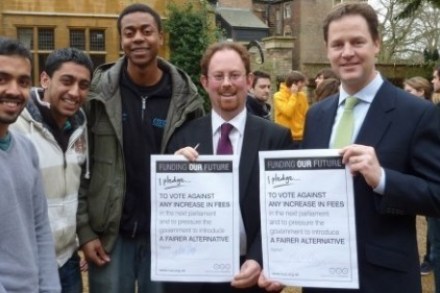
Here are letters T to Z in our A-Z guide the coalition's first year. A-F are here. G-M are here. And N-S are here. T is for Tuition fees "Broken promises, there have been too many in the last few years." So said Nick Clegg in a Liberal Democrat video during the last election campaign. It was favourite theme of his — and one that he deployed both during the TV debates and in signing a pledge to scrap tuition fees. This was to be a New Politics. Clegg was to be its champion. Shame it didn't quite work like that. The coalition agreement was damaging enough to Clegg's aura: it didn't guarantee that tuition fees wouldn't rise, only that the Lib Dems wouldn't have to vote for such a rise.

Cameron tells the ’22, the NHS pause is my idea not Clegg’s

From our UK edition

David Cameron was received in the usual desk-thumping way at the 1922 Committee. But what was striking about his appearance was his message that the NHS reform pause is his idea not Nick Clegg’s and that he won’t let the Lib Dems take credit for the coming changes. The robustness of this message took even Tory MPs by surprise. But I understand that Tory high command feels that Clegg’s decision to list the Tory policies he had blocked this morning means that they are allowed to make points like this. There were some hostile questions to Cameron but the general mood of the meeting was positive.

The Coffee House A-Z of the Coalition: N-S

From our UK edition

Here are letters N to S in our A-Z guide the coalition's first year. A-F are here. G-M are here. N is for No Nothing has frayed coalition relations quite like the AV referendum has. This was always going to be the case, but the viciousness it inspired has still been fairly shocking. Need we remind you of Chris Huhne's outburst in Cabinet last week? Or of George Osborne's stinging riposte? Even David Cameron seems to have relished taking it out on his coalition stablemates, trashing their pet policies with a vigour that would have been unthinkable only a few months ago. As Tim Montgomerie reveals in his exhaustive guide to the No campaign, Cameron's firmer stance coincided with a realisation of just what he was risking.

Exclusive: Gove’s free school policy gets Labour support, finally

From our UK edition

This week's Spectator reveals the rather tantalizing fact that Peter Hyman, Tony Blair's former director of strategy, is setting up a Free School in East London. This – I kid you not – is a very good thing. Newham School 21 will teach kids between the ages of 4 and 18 – an ambitious span of ages – and will open its gates in September 2012 if all goes to plan. Whatever you think about Blair, Hyman is a quietly impressive figure, coining the phrase "Education, Education, Education" and then leaving Downing Street in 2003 to become a teaching assistant. Now, as the deputy head of a school in Ealing, Hyman could not be better placed to start a "free school" and his plans have the blessing of those at the very highest levels of Labour politics, I'm told.

Lib Dem polarity

From our UK edition

For the Lib Dems this was the first day of the afterlife. Booted off the AV-train which was supposed to fast-track them to power, the minority party now looks politically homeless. Everyone in parliament makes jokes about them but the gags never raise a laugh. Pity intervenes. At today’s session Ed Miliband was haranguing Cameron for ‘dumping on’ his ministers as soon as their policies run into trouble when he broke off to indulge in a Lib Dem-kicking moment which he felt would cheer his troops. ‘And the poor deputy prime minister,’ chortled Miliband, ‘gets dumped on every day of the week!’ Sad laughter followed. No one’s heart was in it. Mocking Clegg is like throwing a wet sponge at a man with a fractured skull.

A mixed bag for the coalition at PMQs 

From our UK edition

So much for the de-Flashmaning project. At PMQs, a tetchy Cameron doled out his usual number of insults, comparing Ed Miliband to Eddie the Eagle Edwards. Frankly, I don’t think this really matters as long as Cameron appears to be in control of his temper, which isn’t always the case. But Ed Miliband definitely raised a chuckle when he told Cameron to ‘calm down, dear.’ But, perhaps, the most noticeable thing about today’s PMQs was the behaviour of the Liberal Democrats. Nick Clegg joined in with all the jeering at the Labour front bench, something which he very conspicuously didn’t do in the last few weeks. Chris Huhne happily chatted away to Michael Gove and two Lib Dem MPs asked patsy questions of the PM.

PMQs live blog | 11 May 2011

From our UK edition

VERDICT: An inconclusive sort of PMQs, where neither leader particularly triumphed, nor particularly sank. Ed Miliband was persistent, and more aggressive than usual, with his questions on the NHS — but failed, really, to properly discomfort the PM. Cameron dwelt lazily on the extra money going into the service, but it was enough to carry him through the session. Perhaps the most striking moment was when, during the backbench questions, Cameron pointed out that "[the Tories] were the only party at the last election to promise [real-terms spending increases for health]. If it wasn't for us, it wouldn't be happening." This is, I suspect, all part of the new drive to distinguish the two parties of government. But it will have jarred with some listening Lib Dems nonetheless.

Not so flash, Dave

From our UK edition

The papers report this morning that David Cameron has been urged by his aides to be more polite to his opponents at PMQs or risk playing into the Flashman stereotype of him as a cocky public school bully. Now, as with all advice about making PMQs a calmer affair (remember how Cameron pledged an end to Punch and Judy politics), this is easier said than done. The confrontational atmosphere of PMQs means that it is hard for those involved to resist a withering put down or to meet insult with insult. But if Cameron does learn to rein himself in, it will be a triumph for his new chief political strategist, Andrew Cooper.

The Coffee House A-Z of the Coalition: A-F

From our UK edition

The coalition is 1 today. Unfortunately, we can't serve jelly and ice cream over the internet — but we can write an A-Z to mark the first year of Cameron and Clegg's union. Below is the first part of that, covering the letters A to F. But, first, a little piece of political nostalgia for CoffeeHousers. A year ago today, this happened: And now for the A-Z… A is for Andrew Lansley Rap John Healey, make way for MC NxtGen. The Loughborough rapper may not be part of Her Majesty's Most Loyal Opposition, but his three-minute denunciation of the coalition's health reforms — video above — did the job better than most politicians ever could.

Today’s lesson for David Willetts

From our UK edition

What a knotty problem David Willetts has created for himself today. Speaking to the Guardian this morning, he floated an idea to help the universities make a bit of cash: they could, he suggested, sell extra places to students who were prepared to pay exaggerated fees up front. This isn't yet government policy, and the students needn't do the paying themselves (they could be sponsored by charities or employers, for instance), but the Guardian pounced nevertheless. "Extra places at university for rich students," blared its front page headline. Not a good look for the coalition, at a time when access to university is such a general concern. Not a good look for David Willetts, who might have avoided the pitfall before him.

Breaking Laws | 10 May 2011

From our UK edition

When David Laws resigned from government last year, his return was thought to be only a matter of time. Today, it is looking considerably more indefinite. Not only has Cameron been talking down the prospect of a reshuffle any time soon, but the Evening Standard is reporting that Laws has been found guilty of breaching six — six! — Commons rules related to his expense claims. No word, yet, on the details, or whether there will be any formal punishment for the former Chief Sec. But it doesn't look good for him, nor for his ministerial prospects in the short-term. Sky's Sophy Ridge tweets that certain Lib Dems are "still keen" to transfer Laws back to government "within weeks". Perhaps so — but I'd be surprised were they to pull it off.

The press becomes the story

From our UK edition

The power of the press has, almost from nowhere, become one of the defining leitmotifs of this Parliament. Only two years ago, the Telegraph exerted that power to (partially) clean out British politics, and won general acclaim in the process. But now, it seems, the media is more likely to have its actions attacked, or at least questioned and contained. Whether it is the Press Complaint Commissions's censure today for those clandestine Cable tapes, or the continuing hoo-hah over super-injunctions and their infraction, there is a question hanging unavoidably in the air: how much does the public have a right to know? This is a precarious political issue, not least because of the immediate problems it has thrust upon the coalition.

Cameron sets out the bounds of Lib Dem assertiveness

From our UK edition

Our coalition government was forged one year ago tomorrow — and we shall have more on that then. But the Sun has already marked the occasion by publishing an interview with David Cameron today. It is a wide-ranging sort of conversation, touching on everything from the Prime Minister's workload ("every day feels like a week") to the shelf life of the government ("five years"), although much of it is unsurprising. It does, however, contain one or two useful insights into how the coalition's game of give-and-take is going to operate from now on. First up, Cameron's insistence — contra Clegg — that the Lib Dems should not be portrayed as a "moderating influence" on his party.

The Dame departs

From our UK edition

Pauline Neville-Jones was a first. She was one of the first women in the Foreign Office to climb the department's male-dominated ladder, serving as Lord Tugendhat's chef de cabinet at the European Commission, obtaining the coveted post of Political Director and eventually becoming JIC Chairman. She led the British delegation at the Dayton Peace Accords and she probably thought she would be the first British National Security Adviser. But it was not to be. Her usefulness to the Prime Minister seems to have been mainly in opposition, where she could add a voice of knowledge to a Shadow Cabinet with very little governmental experience. The Tory Green Paper on National Security was all the more serious for her drafting it. But it was not always easy.

A leadership contest might be just what the Scottish Tories need

From our UK edition

That's it, the full house. Alex Salmond has seen off all three main opposition party leaders before the Scottish Parliament has even convened for the first time in this new session. Yesterday afternoon, Scottish Conservative leader Annabel Goldie joined her Labour and Liberal Democrat counterparts (Iain Gray and Tavish Scott) in standing down. The Conservatives did not do quite as badly as either of the other two opposition parties in the election – they went down two seats, from 17 to 15 – and many will see that as the reason Miss Goldie delayed her resignation for a few days, to work out of she could continue. But, in reality, Miss Goldie always seemed destined to resign after this Holyrood poll.

Credit where it’s due

From our UK edition

One of the worries of Tory modernisers about the coalition back in May last year was that the Tories would end up being seen as being responsible for all the tough but necessary stuff, eg deficit reduction, while the Lib Dems would claim the cuddly stuff, for example the pupil premium — a policy that was in both the Tory and Lib Dem manifestos.   David Willetts in a piece in the Telegraph today, taken from a speech he’s giving tonight, makes this point anew in the context of the new, frostier coalition relations: “This agenda is shared, so it would be a mistake to get into a game of identifying Liberal measures and Tory ones in a perpetual trade-off.