Uk politics

070, licensed to rebel

It's no surprise that 70 Tory MPs have formed a Eurosceptic group, as the Sunday Telegraph reveals today. They are the modernisers now. The new Tory intake are strikingly robust on all this: by and large, their idea of political balance is a picture of Thatcher on the wall and Jacques Delors on the dartboard. The impending boundary review and thinner-than-they-expected majorities mean they worry more about their constituency (and constituency associations) than the whips. But I'm told today that this rebellion isn't quite as fierce as it may seem. One Tory backbencher tells me the Tory whips have actually encouraged this group to call for renegotiation of the UK terms of EU membership.

This autumn, Europe could become the most important issue in British politics again

Europe will be one of the political issues of the autumn. The government expects another round of sovereign debt crises in the autumn and these will add urgency to the Merkel Sarkozy plan for ever closer fiscal union between the eurozone members. Nearly every Tory MP and minister I have spoken to is instinctively sceptical of the Franco-German strategy. But Cameron, Osborne and Hague believe that because the Eurozone members won’t accept the break-up of the currency union, Britain has to back further fiscal integration in the hope that it will make the euro work. (Cynically, one might add that their position also makes life easier within the coalition given the Lib Dem’s Europhile leanings.

Human rights wrangle

A set-to has broken out this morning over the Human Rights Act. David Cameron has declared that he is going to fight the Human Rights Act and its interpretation. Cameron writes: ‘The British people have fought and died for people’s rights to freedom and dignity but they did not fight so that people did not have to take full responsibility for their actions. So though it won’t be easy, though it will mean taking on parts of the establishment, I am determined we get a grip on the misrepresentation of human rights. We are looking at creating our own British Bill of Rights.

Blair on the riots

Tony Blair has dropped in to write an article on the social context to the recent riots. It’s insightful, especially as a testament of his failings in government. At the close of his premiership, he says, he’d realised that the acute social problems in Britain’s inner cities were “specific” and could not be solved with “conventional policy”. So much for ‘education, education, education’, Blair’s favoured solution was a mixture of early intervention on a family by family basis to militate against the “profoundly dysfunctional” upbringings these young people endure and a draconian response to antisocial behaviour. Alas, he was forced from office for before implementing the plan.

The war on Britain’s streets

Police in Birmingham have released this extraordinary footage of people firing shots at lines of police officers during the riots. As Iain Duncan Smith says in this week's magazine, the riots were a wake-up call. This video shows what looks like gangs, about three dozen of them in masks, not just trashing buildings but discharging firearms at unarmed police. The West Midlands chief constable, Chris Sims, released the footage this morning and said he believes there is a "concerted and organised attempt" to kill or injure police.

Starkey: the problem is the breakdown of national identity

Public Enemy Number One, the unlikely figure of Dr David Starkey, is back in the papers; this time writing in the Telegraph to meet the cacophonous heckles that followed his appearance on Newsnight. Starkey begins with a viperous assault on Ed Miliband’s view that his comments were “disgusting and outrageous”, pointing out that black educationalists Tony Sewell and Katharine Birbalsingh broadly agree with him. Starkey then goes on to restate his position. The summer of discontent has revealed the “different patterns of integration at the top and bottom of the social scale.

Tackling the far right

The English Defence League marches are heinous, but tolerated by the English authorities. Not so in my homeland, where the Scottish Defence League have been told by Edinburgh council that they cannot hold a march where they'd hoped to be joined by 200. Part of me welcomes this news: Scotland has its social ills (mainly sectarianism) but racial tension has never really flared. As Alex Salmond says, there are many colours in the tartan. Then again, banning the march may serve to give credibility and a cause to the crackpots who call themselves the Scottish Defence League. Their march would probably have been a tragicomic affair, and they'd have disappeared into the black hole of public ridicule. But a ban is just what these agitators want.

Pickles rebuffs calls for new taxes

Anyone looking for a good blast of common sense on a Saturday morning should read Eric Pickles’ interview in the Telegraph. In it, he responds to much of the kite-flying by the Liberal Democrat left in recent weeks. In an exchange that will have many of his Cabinet colleagues nodding along in agreement, Pickles criticises judicial activism and the chilling effect it is having on ministers: “You are constantly looking over your shoulder for judicial review … the electorate is being frustrated,” he says. “I could kind of expect to be reviewed on procedural matters, but to be reviewed on policy?” But, should judges not have some oversight of policy? “No,” he replies. “I’m a bit old-fashioned really.

From the archives – the great debt deceit

The news that the national debt is even larger than it appears ties a knot in the stomach, limiting, as it does, the state’s ability to cut taxes. Andrew Tyrie has called time on the PFI bonanza, but in many ways this intervention comes too late. Back during the financial tempests in the autumn of 2008, my colleagues Peter Hoskin and Fraser Nelson revealed the scale of Gordon Brown’s deceit over PFI. The great debt deceit, Fraser Nelson and Peter Hoskin, The Spectator, 20 September 2008 A few months before the general election which brought New Labour to power, Geoffrey Robinson had David Davis to dinner in his flat overlooking Hyde Park.

Cameron: Governments should provide enough prison places to satisfy the courts

The row over sentencing rioters has morphed into a row about prison numbers and safety. Cathy Newman has been issuing a steady stream of tweets all afternoon, revealing that the Ministry of Justice is concerned about overcrowding and safety in prisons and young offenders’ institutions: an internal memo discloses that 2 convicted rioters have been assaulted and hospitalised. This is not altogether surprising: prisons are not exactly renowned for offering new inmates a genteel welcome. Still, it provides ammunition for those who oppose the courts’ stern response to the riots. There is now a record 86,654 incarcerated people in Britain; compared to 85,253 people the week before.

The Mrs Bercow show

What, I suspect, would infuriate Sally Bercow most is if there was a complete media blackout over her appearance on ‘Celebrity’ Big Brother. As she made clear on entering the house, her whole aim is to annoy what she calls the ‘establishment.’ But at the risk of playing Bercow’s game, it’s worth debunking one argument that her defenders make. They say that she’s a person in her own right and so should be allowed to do what she wants, that her appearance should be defended on feminist grounds. But on the show, she’s not presenting herself as that. Instead, she’s there as the Speaker’s wife — that is her claim to fame.

Miss Lightwood suggests…

The press’s tendency to feature female students receiving their A-Level results rather than their male counterparts is coming in for a fair bit of ribbing today. The Guardian diary yesterday revealed quite how far some schools are prepared to go to get their pupils on the front page: “And yet eyebrows were raised at Diary HQ on receipt of an email from Badminton School, inviting Fleet Street to feature a selection of pupils on results morning who "speak extremely well and take a good picture". "I have a fabulous case study of a girl … who sadly lost her mother … and is now an active charity campaigner," reads the email from director of admissions and marketing Henrietta Lightwood.

Tobin’s folly

The Eurozone Tobin tax announced on Tuesday by Merkel and Sarkozy is intended to reduce market volatility. It could have the opposite effect, and, if introduced in Britain, could cripple Britain’s financial sector, a new report by the Adam Smith Institute says. Based on the example of the “pure” Tobin tax that was implemented in Sweden in the 1980s and a large number of studies looking at equity and foreign exchange markets, a clear relationship was revealed between increasing transaction costs and higher levels of volatility. Transaction volumes also decrease as business is driven to lower tax regimes. When Sweden introduced a levy of 0.

The annual A-levels helter-skelter

The Gap Year has been declared dead. It’s A-levels day today, and the annual scramble for university places has been intensified ahead of next year’s tuition fees rise. According to this morning’s Times (£), the last count had 669,956 pupils sprinting after 470,000 vacancies. An estimated 50,000 students with adequate grades will not enter higher education this year as many universities have raised entry requirements to manage increased demand. This means that competition during clearance will be even more stiff than usual, particularly as universities will offer many fewer clearing places according to various surveys. Needless to say, UCAS’ website appears to have collapsed under the weight of this unparalleled interest.

The Huhne story returns

The news that the Crown Prosecution Service has asked Essex Police to make further inquiries into the whole allegation that Chris Huhne asked his then wife to take speeding points for him in 2003 is a political embarrassment for the Energy and Climate Change Secretary. Huhne has always denied these allegations and nothing has been proved against him but the whole process is hardly reputation enhancing. (But it is worth noting that the CPS’s decision suggests that they currently don’t think there’s enough evidence to lay charges against anyone. Equally, they haven't thrown the whole file out). Huhne’s troubles are also causing a certain amount of coalition friction.

Recalcitrant police forces

Applications to be the next commissioner of the Metropolitan Police closed at noon today. But thanks to the Home Office and the police, the best candidate for the job — Bill Bratton — hasn’t been allowed to even apply. The energy which was put into barring him shows just how determined the police and the Home Office are to prevent any outside talent from being brought into the police. Number 10, though, maintains that it still wants to appoint outsiders to positions of authority in the police, even though it is now trying to claim that the commissioner of the Met was the wrong place to start this process. It was, apparently, too big a job to give to someone from outside the magic circle of chief constables.

EXCLUSIVE: IDS on British jobs

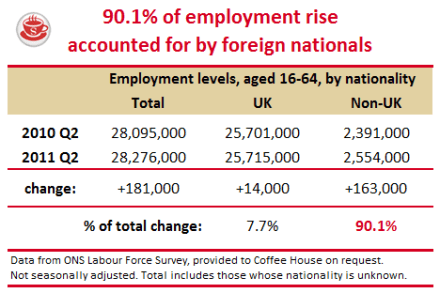
Last week, George Osborne boasted that Britain has the second-fastest job creation in the G7. In tomorrow's Spectator, we disclose official figures showing that 154 per cent of the employment increase can be accounted for by foreign-born workers. We on Coffee House have often questioned Labour's record: 99.9 per cent of the rise in employment was accounted for by foreign-born workers. The graphs for the Labour years and the coalition year are below:     The idea of 154 per cent is strange, so I will reproduce the raw figures below:     Now, no one outside Westminster expects the UK labour market to change the day a new government is elected, but what matters is that the problem still exists.

Riot sentencing row brews

David Cameron promised that looters would feel the full force of the law. Courts have been sitting round the clock holding defendants on remand and issuing stern sentences. This is causing disquiet in some circles. Lib Dem MPs complain that the government has overacted, incapable of resisting the temptation to take draconian decisions without adequate scrutiny. Tessa Munt told the Guardian that the government’s approach “smacks of headline grabbing by Conservatives, not calm, rational policy-making.” Lady Hamwee also told the paper that it would be a “great pity if what [the justice secretary] Ken Clarke has been doing – finding a better way of sentencing – was to be undone.

With an eye on 2015, Osborne is ramping up the growth agenda

30,000 new jobs by 2015: that is the glittering prediction made by the government as it announces the creation of more enterprise zones this morning. 11 zones* have been identified in total, tailored to foster the expansion of hi-tech manufacturing industries away from London and the M4 corridor. Enterprise zones certainly have their critics – notably the Work Foundation’s Andrew Sissons, who told the Today programme that they were merely an “expensive way of moving jobs around the country.” But the coalition is adamant that it has learnt from past mistakes, insisting that the policy will rebalance the economy and rejuvenate regions that have been “left behind”.