Uk politics

Labour tries to make its mark

Global events may soon relegate Labour conference to the News in Brief sections of newspapers, especially as it appears that G20 finance ministers are preparing for Greece to default and for contagion to spread to other parts of the Eurozone. So, the Labour leader has wasted no time as Labour conference opens. In interviews with the Observer and the Sunday Mirror, he revives his tactic of presenting himself as an insurgent, the man to "rip up the rulebook”. He makes a pledge or two: the headline grabbing idea is a cap tuition fees at £6,000 per year, paid for by reversing a planned corporation tax cut on the hated banks.

Searching for an alternative

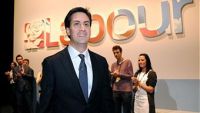
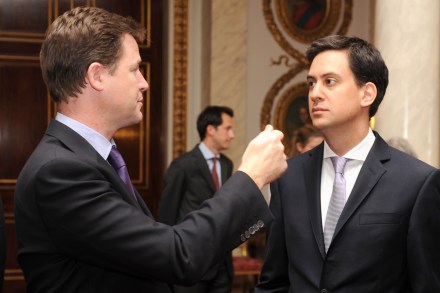
The Labour conference has started badly for Ed Miliband, with David Blunkett criticising the party for allowing the Tories to define the national economic debate. Blunkett was concurring with shadow foreign secretary Douglas Alexander’s view that the Tories had been successful in “framing a public language that made more sense of the economic crisis”. To be fair to Miliband, he made the same point in his recent interview with the New Statesman, but he is yet to provide a coherent or credible alternative to the government’s policies. So, inquiring eyes turn on Ed Balls (and today’s Mail relates another alleged tale of his part in our economic downfall). The shadow chancellor has written an article on economic policy for the Guardian.

Hard Labour

The sense of unreality that hangs over party conference seems particularly heightened this year. As events outside roll on at a dramatic pace, the conferences try to proceed as normal. A new law on stalking may be necessary but it is small beer compared to the economic crisis gripping the Western world at the moment. Ed Miliband’s challenge in the next few days is two-fold. First, he has to work to restore Labour’s economic credibility—something that will be made even harder by today’s allegations about the role of his shadow Chancellor in the last government. Second, he has to show that the party gets the seriousness of this moment. Miliband, who travelled up on the train with his wife and children earlier today, is running into a headwind of bad polls.

Osborne’s dire warning

This morning’s headlines are apocalyptic: “Global economy on the brink”, “Six weeks to save the Euro”, “Collective action needed now”. The unifying theme is the lack of leadership in the Eurozone: someone must grasp the nettle, say external politicians and commentators. Meanwhile, Charles Moore points out, with typical understatement, that Europe is leaderless by nature: no one is in charge and that is its tragedy. Moore doesn't mention the European President, who could, conceivably, offer direction and insist on fiscal discipline; but Herbert Van Rompuy is yet to meet that challenge. You wonder if someone of Tony Blair’s international standing might have succeeded where Van Rompuy has so far failed.

Read my lips: no new tax cuts

There are still rumours in Westminster that David Cameron will cut taxes to stimulate the economy, but the speech he gave to the Canadian parliament on Thursday rather scotches this idea. Here’s what jumped out at me 1) No Obama-style deficit-financed tax cuts, please, we’re British. "The economic situation is much more dangerous and the solution for most countries can not be simply to borrow more. Because if the government doesn’t have the room to borrow more in order to cut taxes or increase spending, people and markets start worrying about whether a government can actually pay back its debt. And when this happens confidence ebbs away and interest rates will rise, hitting people with mortgages, and hitting companies that want to borrow to invest.

Is Osborne ready for the next crisis?

There is a strange pre-Lehman feeling in the air right now: the idea that something awful is going to happen, but no one knows what or when. This is laden with political ramifications. The problem for the Tories last time was not that George Osborne had been caught aboard HMS Deripaska. The greater problem was that a crash had arrived and the Shadow Chancellor had nothing to say. Brown, at least, seemed to have an agenda, and the Tory poll lead was reduced to one vulnerable point. I admire Osborne, but he can do far better in making the case for the government’s economic strategy. If there is a second crash, he’ll need all his skills to convey confidence – to sound as if he knows what he’s talking about.

Texting times

After the education email furore earlier this week, discussions are underway in ministerial offices about private emails: are they subject to the freedom of information act? The answer is probably yes, which may not be what the government wants to hear. But the problems that this will cause are nothing compared to what might happen next, when attention moves on to text messages. Whitehall buzzes with texts: Ministers text SpAds; SpAds text journalists; journalists text ministers, and so on. Often the messages are short and inconsequential, but not always. There is the potential for even greater embarrassment than exists with emails.

Ed of many colours

Philip Collins has an essential column in this morning's Times (£), as a prelude to the Labour party conference. His theme is the many colours of Ed Miliband: he has been Red Ed, Blue Ed, Purple Ed, Green Ed and doubtless there will soon be Yellow Ed. Miliband has to be just one colour. Collins writes: 'Take a bit of green, a bit of red, a bit of blue, a bit of yellow and a bit of purple, mix them all up in a big splodge and what do you get? You get Brown.' The spectre of Brown evidently looms large in the minds of men like Collins, for whom the New Labour cap still fits (£).

Corporatism, comms and civil servants

David Cameron renewed his calls for global action for growth last night and it seems that the work begins at home. The Times reports (£) that 50 of Britain’s largest companies will be given direct access to ministers and officials. Corporate bodies will be designated an “account director”, who, despite what that title might suggest, is a cabinet minister rather than a junior advertising exec. The scheme is not yet finalised, but it seems that the labour will be divided thus: ‘Vince Cable, the Business Secretary, will act as what officials are calling “an account director” to Britain’s oil and gas giants Shell, BP and BG.

From the archives: Ridley was right

                                      In July 1990, Nicholas Ridley told Dominic Lawson that monetary union was "all a German racket designed to take over the whole of Europe". He was immediately forced to resign from the Cabinet. In this week's magazine, which hits newsstands today, Lawson says that Nicholas Ridley was right (subscribers click here). Here, in full, is the article that ended his career: Saying the unsayable about the Germans, Dominic Lawson, 14 July 1990 It is said, or it ought to have been said, that every Conservative Cabinet minister dreams of dictating a leader to the Daily Telegraph.

Ed’s opportunity

Ed Miliband is the man to rip up the rulebook. He uses the phrase half a dozen times in an interview with the New Statesman. Ever since the phone hacking saga climaxed in July, Miliband has been busy posing as an insurgent against the Establishment; the politician who refused to fawn to Rupert Murdoch. His version of events is utterly specious: he was happily quaffing News International’s champagne at the beginning of the summer. But that is immaterial. Miliband has recognised an opportunity to redefine his faltering leadership. Despite his stern rhetoric, Miliband says very little about policy to the Statesman beyond promises of a VAT cut and a few other baubles. A separate interview with Progress is equally devoid of concrete policies.

In this week’s Spectator: The great euro swindle

Very rarely in political history has any faction or movement enjoyed such a complete and crushing victory as the Conservative Eurosceptics. The field is theirs. They were not merely right about the single currency, the greatest economic issue of our age — they were right for the right reasons. They foresaw with lucid, prophetic accuracy exactly how and why the euro would bring with it financial devastation and social collapse. Meanwhile the pro-Europeans find themselves in the same situation as appeasers in 1940, or communists after the fall of the Berlin Wall. They are utterly busted. Let’s examine the case of the Financial Times, which claims to be Britain’s premier economic publication. About 25 years ago something went very wrong with the FT.

Battling it out over Brown’s legacy

Gordon Brown is back in the news this morning, or rather his legacy of debt is (an issue examined in depth by Pete and Fraser in 2008). The disastrous £12.7 billion NHS computer project is to be scrapped and, more important than that, the Telegraph reports that the care budgets at 60 hospitals are being squeezed by the costs of repaying PFI contracts totalling more than £5.4 billion. Andrew Lansley has taken to the airwaves to explain that Labour left the NHS with an “enormous legacy of debt”; he was keen to point out that no hospitals were built under PFI before 1997, so that there was no doubt where blame should be apportioned.

The Lib Dem conference closes

As the Liberal Democrat leadership leaves Birmingham, it is a contented bunch. Their conference has gone as well as could be expected. There were no embarrassing defeats for the leadership and no gaffes by any of their ministers. But conference was yet another reminder of how much of a gap there is between where those around Clegg want to take the party and where the activist base wants to go. When I asked one of Clegg’s allies about this discrepancy, he told me that the important thing to remember was that the membership, who elect the leader, take a different view from the activists. As evidence of this, he cited how activists’ darling Simon Hughes actually came third in the 2006 leadership race and how Clegg managed to squeak past Huhne in 2007.

How’s Clegg doing?

When Nick Clegg speaks today, he can - as usual - rely on a good deal of support from those in the hall. According to YouGov, current Lib Dem supporters support him by a 2-to-1 margin. That's stronger approval than Miliband gets from Labour voters, although nowhere near the popularity David Cameron enjoys with his own party: 93 per cent of Tories say the Prime Minister's doing a good job. Among the population as a whole, though, there's no doubt Clegg is unpopular. But he does at least appear to have stopped the rot - both in his personal ratings and his party's. As the graph below shows, the majority of the Lib Dems' poll decline - from the 24 per cent they won in May 2010 to their trough around 10 per cent - occured in the first few months after the election.

Clegg’s chance to lead by example

Nick Clegg will deliver his keynote speech to the Liberal Democrat conference later this afternoon. It has been substantially trailed this morning, despite competing for airtime with Nick Robinson's story about the injection of an extra £5 billion of capital spending into the economy. Similarly to Monday's Q&A with activists, Clegg is expected to defend the government's deficit reduction plan and insist that Britain can resist dire global economic trends. It remains to be seen whether Clegg will concentrate on the rest of the government's programme, especially its radical public service reforms. There is some concern in pro-government circles that he will not.