Uk politics

Salmond’s bonnie boat

From our UK edition

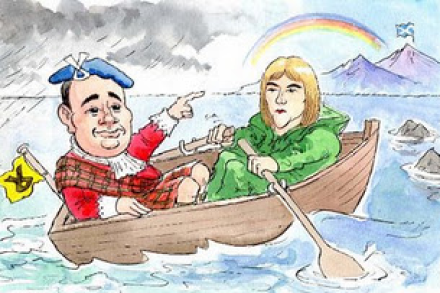
Meanwhile, Alex Salmond's journey is going depressingly well. The SNP conference starts in Inverness on Thursday and a ComRes poll today suggests 39 per cent are in favour of independence, against 38 per cent against the idea. Not a freak: a poll last month by TNS-BMRB produced the same results. Hardly an overwhelming endorsement, but a reminder that the unionists are in trouble in Scotland. The Scottish Tories are in so much trouble that one leadership candidate is suggesting the party renames itself because its official title strikes so many as oxymoronic. For all his Scottish lineage, David Cameron leaves Scots cold – as the general election demonstrated.
Labour failing to regain economic credibility

From our UK edition

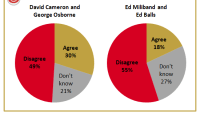
Labour may have a narrow leads in the polls, but they continue to lag behind the Tories on the public's number one issue: the economy. Today's ComRes poll finds that just 18 per cent trust Eds Miliband and Balls "to make the right decisions about the economy", compared to 30 per cent for Cameron and Osborne. Worse, the two Eds don't even have the confidence of the majority of Labour voters: only 48 per cent trust them on the economy. YouGov also find Labour behind when it comes to the economy. 30 per cent think the Conservatives would handle it best, while just 26 per cent think Labour would. And that's despite the fact that 58 per cent of the public think the Coalition is managing the economy badly.

How will Greening deal with the airports issue?

From our UK edition

One Cabinet minister fretted to me yesterday about the implications of Justine Greening’s appointment as Secretary of State for Transport. Their worry was not Greening’s position on the Tory ideological spectrum but her views on aviation. This minister worried that Greening, who helped lead the opposition to a third runway at Heathrow, would be against any expansion in airport capacity. In recent months, opinion has been shifting at the top of the Tory party on the airports issue. People were increasingly coming round to the view that there was need for an extra airport or at least an extra runway somewhere close to the capital.

What will Osborne’s offer to the IMF amount to?

From our UK edition

George Osborne's allies may be filtering across government, but what of the man himself? He was at a meeting of G20 finance ministers in Paris yesterday, and trying to maintain a difficult balance over the imploding eurozone. In part, our Chancellor was firm about Europe's troubles — the area, he said, "remains the epicentre of the world's current economic problems," and he urged its leaders to come up with something "quite impressive" at next weekend's European Council meeting. But he also tried to sound understanding — the UK, he suggested, would consider shuffling more cash into the IMF's bailout account. The offer of more funding for the IMF was arresting — but it's uncertain what it will come to, or whether it will come to anything at all.

Cameron’s party management problems

From our UK edition

Parliamentary party management is, perhaps, the subtlest of the political arts. It is, obviously, particularly difficult in coalition. But the Cameroons are still scoring a ‘must do better’ grade on this work. The mini reshuffle was fairly neatly executed. But it has, almost inevitably, left behind some bruised feelings. Part of the problem is that the Whips’ office is, to borrow a phrase, neither Sandhurst nor a proper careers’ department. Ministers and MPs are all too often left to guess at why they have been passed over for promotion. There is also a tendency for people to be rapidly promoted and then fall out of favour almost as suddenly.

The future’s bright for the right

From our UK edition

There’s much gnashing of teeth about the future of the right today following Liam Fox’s resignation. I think this is misplaced. Fox was a passionate advocate of a certain strand of Conservative thinking. But his appeal and relevance was always going to be limited by his tendency to believe that it was, in political terms, always 1987. The future of the right now, as Matthew Parris says (£), rests on the 2010 intake. They are, generally speaking, an impressive bunch. At Tory party conference, I chaired an event on the future of the party with four of its most able members.

Liam Fox, the morning after

From our UK edition

It is as you'd think: a sea of news coverage and commentary about Liam Fox's departure. Some of its currents are merciless, such as the Mirror's front cover. Some are more circumspect, such as an excellent pair of articles by The Spectator's own Matthew Parris (£) and Charles Moore. But, on the whole, there is a strange absence of finality about this story. A Defence Secretary has resigned – and rightly so, I think – but we still cannot be completely sure why. Maybe it is just the "appearance of impropreity," as Philip Stephens puts it, that killed this Fox. Or maybe there is something more poisonous waiting to emerge in the next few days. The dots are still being connected, the knots of Adam Werritty's business dealings still being untangled.

The new Tory generation

From our UK edition

The final reshuffle moves have now been announced. Chloe Smith, the winner of the Norwich North by-election, moves from the Whips office to become economic secretary to the Treasury. Expect Smith to, in time, do a lot of media. Greg Hands, Obsorne’s PPS moves into her slot as a whip. From this position, he’ll be able to continue running the parliamentary side of George Osborne’s highly effective political operation. Sajid Javid moves from being PPS to John Hayes to being PPS to the Chancellor. I suspect that Smith’s promotion will be seen by those Tories who held frontbench positions in opposition but missed out on jobs in government because of coalition as evidence that their chances of promotion are effectively gone.

Greening’s rapid promotion

From our UK edition

David Cameron has sent the Cabinet’s safest pair of hands to the Ministry of Defence. Philip Hammond, a robust Euro-sceptic with a belief in firm fiscal management, will bring calm and stability to the department. He’s also the Cabinet minister most likely to be able to sort out the longstanding problems of defence contracts going hugely over budget. As a close political ally of George Osborne, Hammond will be well placed to win extra funding for the department in the, sadly increasingly unlikely, event of the public finances having been put back on a sound footing by the end of the parliament. Hammond is followed at Transport by Justine Greening. Greening voted for Fox in the 2005 leadership election.

Hammond fills Fox’s shoes

From our UK edition

It's official: Philip Hammond is the new Defence Secretary and it’s a wise choice. The tough work: making the cuts, axing Nimrod, leaving the east coast undefended etc.: has been done. I doubt Cameron would have been able to get that little lot past his party as easily had it not been done by Liam Fox. Now, the task is implementation. It requires mastery of detail and a sharp eye for financial irregularities, and Philip Hammond is the man for that. As Osborne's number two in Opposition, he will, like Des Browne, approach defence from the perspective of fiscal management. The future of Trident is less assured: Hammond will not threaten to quit over its abolition (as Fox quietly did in Opposition).

Fox unlikely to cause trouble for Cameron

From our UK edition

As soon as the news about G3's funding of Adam Werritty emerged, it became clear that Liam Fox was going to have to go. Downing Street had no desire to be seen to be pushing this Thatcherite out of the Cabinet, but its test has always been that Werritty could not have been receiving money from companies with any interest in defence. Once that line was crossed, Fox was always going to have to go. I suspect that the former Defence Secretary will not be a problem for Cameron on the backbenches. Fox values loyalty highly and his friends appreciate how the Prime Minister didn't push Fox at the first opportunity. Also, Fox's standing as a politician has been severely diminished by the events of the past ten days.

Fox resigns, Cameron responds

From our UK edition

Liam Fox has just resigned as Defence Secretary. Here is his resignation letter to the Prime Minister in full: Dear David, As you know, I have always placed a great deal of importance on accountability and responsibility. As I said in the House of Commons on Monday, I mistakenly allowed the distinction between my personal interest and my Government activities to become blurred. The consequences of this have become clearer in recent days. I am very sorry for this. I have also repeatedly said that the national interest must always come before personal interest. I now have to hold myself to my own standard.

Few think Fox can survive

From our UK edition

I understand, from a Cabinet Office source, that Sue Grey, the civil servant who interviewed Adam Werritty on Tuesday, was completely baffled by Werritty's explanation of how his funding arrangements work. This is yet another sign that events are beginning to move rapidly against Liam Fox. The Times' front page story this morning has led to a significant fall away in support for Fox among Tory MPs. There is also considerable nervousness in Tory circles about what tomorrow's papers are expected to bring. All this makes it increasingly hard to find people who expect the Defence Secretary to survive. Indeed, several people who have been defending Fox in the media say that they feel that they can no longer do so.

The pathology of the politician | 14 October 2011

From our UK edition

With ministers behaving particularly oddly, we thought CoffeeHousers would enjoy Matthew Parris' Spectator column from May, in which he explains the weirdness that afflicts politicians. Politicians are not normal people. They are weird. It isn’t politics that has made them weird: it’s their weirdness that has impelled them into politics. Whenever another high-profile minister teeters or falls, the mistake everyone makes is to ask what it is about the nature of their job, the environment they work in and the hours they work, that has made them take such stupid risks. This is the wrong question. We should ask a different one: what is it about these men and women that has attracted them to politics?

Ministers behaving oddly

From our UK edition

It’s a rum deal being a Global Networker. This morning’s Times reports (£) that Adam Werritty has received nearly £200,000 in donations from clients who appear to have employed Werritty to lobby Liam Fox on ideological issues such as Israel, the Special Relationship and Euroscepticism; although why anyone thought it necessary to lobby Fox, who is a resolute neo-Conservative and Atlanticist, on these matters is something of a mystery. Meanwhile, the Telegraph reveals that Fox and Werritty enjoyed a $500-a-head dinner with American military figures in Washington, which the Ministry of Defence has not disclosed (perhaps because no British official attended the dinner).

Lansley’s historic debacle

From our UK edition

I've just come back from a Health Service Journal conference of medics, where all manner of subjects came up. One audience member asked what historical event stood comparison to Lansley's mishandling of the Health Bill. What else has caused so much controversy, to such little purpose? No one knew. Many of those present — senior doctors, NHS executives, etc — knew Lansley, and everyone seemed to agree that he is a policy wonk fatally miscast as Health Secretary. Politics is about making and winning arguments; whereas Lansley wanted to work on details so complex that, even now, almost no one in government can explain what is being done.

The Fox story rumbles on

From our UK edition

It has been a relatively quiet day on the Liam Fox front today. It now seems that the report into this whole affair will not be ready until next week; Adam Werritty has not yet had a second interview with Cabinet Office. For his part, Fox has looked more confident today and by all accounts was impressively calm as he sat on the front bench today. Interestingly, one ministerial ally of Doctor Fox feels that last night’s report by Nick Robinson was more damaging for the defence secretary than most people have realised. His fear is that having people pay Werritty to push a specific agenda, even if it was ideological not commercial, is deeply problematic and makes it more likely that Sir Gus O'Donnell’s report into the whole matter will not be sympathetic to Fox.

How Lansley won over the Lords

From our UK edition

As Ben Brogan wrote this week, the House of Lords is threatening to become one of the biggest obstacles to the coalition’s reform agenda. But the way in which the Health and Social Care Bill was steered through its second reading in the upper house does provide a model for how even the trickiest votes can be won. Andrew Lansley’s much derided operation got this one right. It realised months ago that the crucial thing was to stop the crossbenchers voting against the bill en masse. So, the health minister in the Lords, Earl Howe, and Lansley’s long-serving aide Jenny Jackson have been on a cup of tea offensive for the last few months, seeking to explain the bill to any crossbencher who would listen.