Uk politics

The trouble with the NHS’s working week

From our UK edition

If you like your literature gloomy, then, at first, there may not be much to interest you in the latest Dr Foster Hospital Guide. A double-page diagram, across pages 10 and 11, is mostly about the positive trends of the past ten years: declining mortality rates and waiting times, that sort of thing. The only particularly sour note sounds out from the timeline at the bottom of the spread, which notes the creation of that big, galumphing NHS computer system in 2002, and then its abolition this year for not ‘achieving objectives’.   But keep pressing on, because there is much to be concerned about in the pages that follow — particularly in the second chapter, entitled ‘Reducing mortality at nights and weekends’.


Tobin tactics

From our UK edition

The biggest bone of contention between the UK and its EU allies these days is the ‘Tobin tax’, the idea of levying a tax on financial transactions. To the UK this is folly. Unless it is levied globally, a tax will force business to move elsewhere. And there is a greater chance of Silvio Berlusconi being elected ECB chief than the Tobin tax being levied globally.   Based on the experiences of Sweden in the 1990s, the tax will achieve none of what its proponents believe it will — and at a considerable cost to Britain's and Europe's economy, as companies look to list elsewhere to avoid it. As Ryan Bourne from CPS points out, even the European Commission found that the tax may hurt the economy. The EC thought it could reduce Europe's GDP by up to 1.

Why infrastructure isn’t a magic tonic for the economy

From our UK edition

Growth plans are a high growth industry — with every day bringing yet another set of ideas, from one quarter or another, for how the government can fix the economy. And one suggestion pops up quite frequently in all these plans: bring forward spending on infrastructure. This is often presented as a simple thing to do, with few (if any) downsides. But how realistic is this? We know that infrastructure is important for growth. Economic texts generally suggest that the ‘multiplier effect’ (when government spending leads to more private spending later on) from is higher for infrastructure spending than for spending in other areas, such as health and welfare. We also know that the UK’s infrastructure needs to improve.

The shape of the Budget battleground

From our UK edition

There are still two days and a couple of hours to go until George Osborne's Pre-Budget Report — but, already, we have a good idea of what will be said. The emphasis, beyond just plain ol' jobs and growth, will be on combatting youth unemployment; helping smaller businesses; and relaxing the squeeze on middle-income folk. Most of the measures either announced or suggested so far — from the Youth Contract to the credit easing scheme to the suspension of January's fuel duty rise — fall into one of those compartments. Whether they'll work or not is a different matter entirely.      As for Labour's response, they're already making it — and I doubt anything in the actual Budget document, or the growth review, will change it much.

How can Cameron protect our interests in Europe in the short term?

From our UK edition

Chatting to people in Brussels last week, I couldn't help feeling that David Cameron's EU problem is one of timing. The PM will probably be able to piece together a repatriation package that includes measures such as a withdrawal from the over-implemented Working Time Directive and a reduction in the EU budget. But none of this is likely to be enough for his party. Indeed, I suspect the budget won't be finalised until two minutes to midnight during the Lithuanian EU Presidency in 2013. Add to this the Tobin Tax, where there seems to be little leeway for the British government. Barosso, Merkel and Sarkozy are determined to introduce it, and even a Eurozone-only tax will harm the City.

Cameron cross-questioned

From our UK edition

A quick post just to add the Guardian's interview with David Cameron to your Saturday reading list. It takes the unusual approach of fielding questions to the PM from a range of ‘public figures’ — and, although many of those questions reduce down to ‘why aren't you giving more money to X?’, the results are still generally engaging and occasionally insightful. And so we learn, after an enquiry by The Spectator's own Toby Young, that Cameron doesn't keep a diary. And we also have the PM justifiying his stance on Europe to Nigel Farage; skipping over a question about what he may or may not have inhaled during his time at Eton; claiming that ‘not everything [Gordon Brown] did was wrong’; and more besides.

Wrestling over cuts

From our UK edition

Britain's economic debate has been reduced to WWE-style wrestling, where two figures adopt semi-comic personas and have at each other for the entertainment of the crowd — while not doing any real fighting at all. So it is with Osborne and Balls. Rhetorically, they are poles apart; one championing cuts, the other spending. But you'll notice that neither quantifies the cuts. That's because Osborne is simply enacting an only-slightly-souped-up version of Darling's plan and the real difference between the two parties is tiny. This was the point of last night's Newsnight, where David Grossman filed a report (in which yours truly was interviewed) about the great pretend fight between two parties whose plans only differ by less than 1 per cent a year.

Without growth, Osborne’s best-laid schemes will go awry

From our UK edition

Strikes, Olympic boycotts and obesity league tables — it's a dreary set of newspaper front covers this morning. But none of them are quite so dreary as the Telegraph's, which speaks of ‘The return of recession’. According to their story, the OECD has told ministers that its latest set of forecasts, released on Monday, will have the UK economy shrinking for the first six months of next year. They're not the first forecasting organisation to suggest a double-dip — going by the Treasury's overview of indpendent forecasts, Schroders Investment Management have economic ‘growth’ at -0.4 per cent in 2012 — but they are the most prominent so far. Shudder ye might. Of course, one forecast does not make a recession by itself.

A Clegg-up for young workers?

From our UK edition

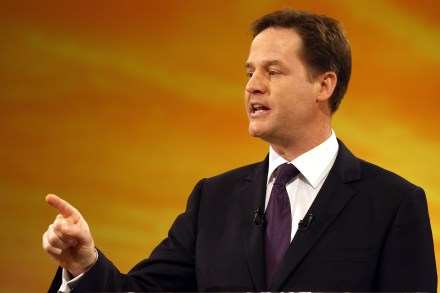
There was a time when Nick Clegg was the most agile and persistent defender of the coalition's deficit reduction programme. But now — although he's still got it in him — he is more often wheeled out to announce some spending wheeze or other. A couple of weeks ago, it was the next instalment of the government's regional growth fund. Today, it's a £1 billion scheme, spread out over three years, to encourage companies to take on young people. This latest scheme is one of those that looks very neat on paper. Put aside questions about how it will be funded, and what we have is a plan whereby £2,275 will be paid to companies for each young recruit they bring on. It means that, in effect, the state will cover half of the youth minimum wage for a six-month period.

An open letter to Chris Huhne

From our UK edition

Earlier this year, the former head of the civil service, Lord Turnbull, wrote a pamphlet on climate change entitled The Really Inconvenient Truth or “It Ain't Necessarily So”. It was praised by Nigel Lawson, writing its foreword, as a ‘dispassionate but devastating critique’ of global warming alarmism — and it is a critique that Chris Huhne saw fit to respond to earlier this week, in a letter to the ennobled pair. Well, now they've responded in turn, via the open letter below, and we thought CoffeeHousers might care to see it: Dear Secretary of State, We are pleased that you have decided that a public response to growing criticism of your climate policies is now required.

How much are we paying towards next week’s strike?

From our UK edition

Next week, millions of public sector workers will go on strike over proposed changes to their pensions. And yet, even after the reforms, those pensions will still be far more generous than most taxpayers working in the private sector — who will pick up the bill — can expect. It's going to be hard to convince people of the ‘fairness’ of paying more into public sector pensions than they do into their own. The unions will do their best though. And the real irony is in how their campaigns are funded. Guess who is paying for unions to organise strikes that will disrupt the public services that taxpayers pay for? Yep — taxpayers. The unions enjoy £32.

We cannot forget the riots, nor ignore their causes

From our UK edition

If I’d said that an MP had accused the Church of England of being too obsessed with gay marriage and women priests — and not worried enough about how God can keep young boys out of harm’s way — you’d probably imagine that a Tory had gone nuts. But this is the David Lammy, Labour MP for Tottenham, who has gave an interview to our Books Blog. In it, he elaborates on the theme of his new book: that his colleagues are so keen to help single mothers that they’ve lost sight of what really helps working class boys. Amongst the contributing factors, he mentions two things that may cast him out as a heretic in Labour’s secular religion: fathers, and God.   Lammy’s book, Out of the Ashes, was released yesterday. On Monday.

Breaking down those record immigration figures

From our UK edition

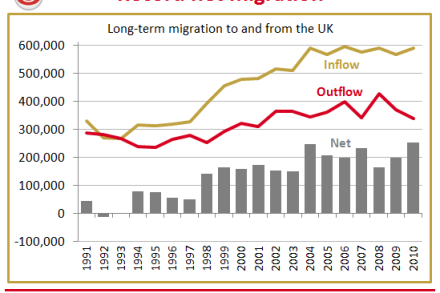
New immigration stats out today show that 2010 set a new record for net migration into the UK. The figure hit 252,000 – a 27 per cent increase on 2009 and 7,000 higher than the previous record in 2004:   As this graph shows, the number of immigrants moving to the UK has actually been fairly constant – at around 580,000 – since 2004 (when the 'accession eight' countries in eastern Europe joined the EU). But the number of people leaving the country has dropped off significantly in the past couple of years – from 427,000 in 2008 to 339,000 last year, hence the increase in net migration. So, as Gillian Duffy might ask, where are they flocking from? Here's where the 591,000 people who migrated to the UK last year came from: And why do they come?

Miliband’s opportunity in the economic debate

From our UK edition

Political debate is going to be dominated by the economy between now and the autumn statement. Ed Miliband is trying to use this moment to persuade the public that the Coalition's economic policies have failed. By contrast, the Tories want to highlight how much deeper trouble the country would be in if it did not have the confidence of the bond markets. The Tories hope that this 'stay close to nurse for fear of something worse' approach will eventually deliver an election victory for them in 2015, given how hard Labour is finding it to regain credibility on the economy. As Ben Brogan wrote the other day, this strategy worked for them in 1992 — the campaign on which both Cameron and Hilton cut their political teeth.

From the archives: ‘Britain is no longer racist’

From our UK edition

In Brixton this morning, Nick Clegg delivered a speech on race equality. He said 'There is another front in the war on race inequality that is too often neglected: economic opportunity... It simply cannot be right that that we still live in a society where, if you are from an ethnic minority, you face unfair hurdles when you strive for success.' As a counterpoint to the Deputy Prime Minister's remarks, here is Samir Shah's Spectator cover piece from 2009: Race is not an issue in the UK anymore, Samir Shah, 7 October 2009 I first arrived in this country from Bombay in January 1960. Harold Macmillan had yet to make his Winds of Change blowing through Africa speech. Coronation Street hadn’t appeared on our television screens.

Cameron: ‘We have to end the sicknote culture’

From our UK edition

The Prime Minister has backed the proposal for a new independent service to sign workers' long-term sicknotes, instead of GPs. The plan, which Pete wrote about at the weekend, is aimed at ensuring that people on sick pay or sickness-related benefits really are too ill to work. Cameron describes how it would work in today's Mail: 'The independent service would be free to all employers from four weeks of sickness absence, with the option for employers to pay for it earlier. It would provide an in-depth assessment of an individual's physical and mental function. So if they're unable to work, they’ll be helped – but if they are fit, they'll be identified and supported back into the workplace.

Paying for justice

From our UK edition

To British ministers, the role that the International Criminal Court played over Libya was key – it made clear that Colonel Gaddafi's actions were unacceptable and would be subject to international law. Tory MP Dominic Raab even wrote a piece in The Times about the need for Libyans to rely on the ICC in The Hague, rather than seek retribution and revenge against Gaddafi and his loyalists. And it wasn't only the British government. German Chancellor Angela Merkel stated that the Libyan leader Muammar Gaddafi should be tried by the ICC: 'Gaddafi should have a trial according to the law, something he never did with his opponents,' Merkel said when asked by the weekly Bild am Sonntag whether she was in favour of such a trial.

Ed looks more dead than deadly

From our UK edition

If Roman Abramovich owned the Labour party, Ed Miliband would be toast by now. The floundering opposition leader gave the sort of inept, predictable and ill-organised performance at PMQs that would get a manager sacked in the Premiership. It scarcely helps that Mr Miliband seems to prepare for these sessions like a deluded psychic. He and his team of prophets at Labour HQ clearly believe they can foretell what the prime minster will say and how best to smash his answers to pieces. Referring to the rise in unemployment, Mr Miliband began by attacking the PM for scrapping the Future Jobs Fund in March. He boasted, rather weirdly, that ‘under Labour, youth unemployment never reached 1 million.

In PMQs, a preview of next week’s battles

From our UK edition

Today's PMQs was a preview of the debate we'll be having after next week's autumn statement. Miliband, struggling with a bit of a cold, tried to pin the economy's problems on Cameron. The Prime Minister's retort was 'who would want to put the people responsible for the current mess back in charge'. It was a simple message and one that carried him through the session. The other feature of today's joust was also a preview of next week: a tussle over the strikes. Cameron said strikes were the 'height of irresponsibility'. He also made sympathetic noises when Tory MPs asked about imposing minimum thresholds for strike ballots.

Opening Europe

From our UK edition

It is an article of British faith that further liberalisation of Europe's market is a worthwhile goal. But few people realise the boost the UK economy would actually get from the finalisation of the EU's internal market – especially implementation of the Services Directive, creating an integrated market for energy, modernising public procurement rules and liberalising the digital market. Implementation of the Services Directive alone would add 1.5 per cent of GDP to the EU as a whole in the next nine years, according to European Commission calculations. As the UK has one of the strongest services sectors, this will have direct benefits here.