Uk politics

Dave and Ed strike each other

From our UK edition

It was a real blood and thunder PMQs today. This was the politics of the viscera; whose side are you on stuff.   Ed Miliband chose to start on the strikes. David Cameron ripped into him from the off, calling him ‘irresponsible, left-wing and weak.’ Miliband came back with an attack about how he wasn’t going to demonise dinner ladies who earn less in a year than George Osborne’s annual skiing holiday costs, though he flubbed the line slightly.   The Tory benches were in full cry, and throughout the session Cameron kept coming back for another swing at Miliband and the union link.

Picketing Parliament

From our UK edition

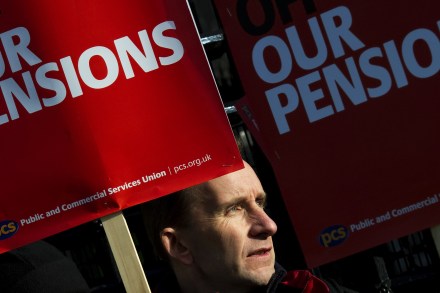
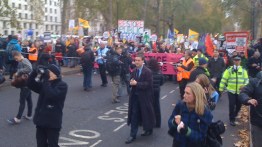
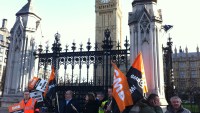
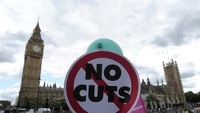
By way of Spectating, I thought I'd take a quick stroll along Westminster's picket lines. And, to be honest, there isn't a huge amount to see, as yet. The groups of around five or six industrial actioneers outside some departments trump the small pile of placards outside the Treasury. There are about thirty to forty people picketing Parliament itself. The photo I shot hastily on my iPhone, above, should give you the sense of it. The striking workers I spoke with, however, were bullish about people turning up later in the day, especially with the march that's happening this afternoon — as well as for the strike's general progress in the rest of London and beyond. An organiser for Met staff reckoned on about 70 per cent turnout from his cohort.

A day of disruption

From our UK edition

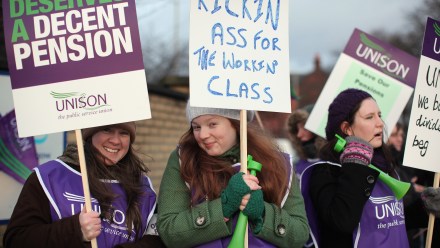
Another testing day for the government, as we shift from the autumn statement to a national strike. It will certainly be more noticeable than the industrial action in June. Some 2 million public sector workers will be involved. According to the schools minister Nick Gibb, around 75 per cent of state schools will be closed. And on top of that, airport queues will lengthen; non-emergency operations will be cancelled; and today's parliamentary proceedings will go untranscribed. The government's attitude towards the unions — or, rather, union bosses — appears to have been hardening. The brothers will not have liked yesterday's forecast that 710,000 jobs will be shed from the public sector by 2017. And they will not have liked George Osborne's rhetoric either.

Osborne plays a tough hand well

From our UK edition

Today was always going to be a difficult day for the Chancellor. The figures from the OBR were always going to dominate the headlines and the restrictions of coalition meant that there couldn’t be as much as the Tories would have liked on the supply side. It was striking that the loudest Tory cheer of Osborne’s statement came when he reiterated his opposition to an EU-imposed financial transactions tax. But the silver lining for Osborne and co is that Labour still lack economic credibility. It is hard for Labour to savage Osborne for borrowing more than he said he would — which he is to the tune of £158 billion — and then say that they would borrow even more than that.

Osborne has made the right choice — but it’s not without its costs

From our UK edition

Today, George Osborne had a choice. Growth prospects have evaporated, and tax revenues along with it. Should he reopen the 2010 Spending Review and cut the spending totals? Or stick with those totals, and finance this with extra debt? He chose the latter. And I think, on balance, he was right to do so. Credibility is the most valuable currency in this eurozone crisis, and Osborne said it was a fixed five-year plan. He chose more debt over less certainty, and it looks today like the markets believe he chose correctly.  But all this comes at a cost. The government will now run deficits higher than those which Labour proposed. Certainly, had Labour been confronted by evaporating growth it may have had to choose even lower spending or even higher borrowing.

Growth has upset Osborne’s plans — and it’s likely to get worse

From our UK edition

The real story, as everyone expected, wasn't in the Pre-Budget Report ‘Green Book’ — but in the supplementary document produced by the Office for Budgetary Responsibility. Growth forecasts have taken a dive. And while that is both unsurprising and not all that revealing, it carries grim implications for so much else. I mean, just look at the graphs we produced in our last post: forecasts for debt, unemployment and borrowing are all up. It is not a pretty picture. But despite the dreariness of it all, I suspect that the numbers are far too optimistic.

The Autumn Statement: What you need to know

From our UK edition

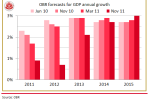
We've been posting some of these charts on Twitter, but here they are, collected, for CoffeeHousers. You can expect more as we mine deeper into the OBR's supplementary document. Do shout out, also, if you spot anything yourself. 1. Weaker growth — except for a very optimistic figure for 2015 2. Higher debt — both in real terms and as percentage of GDP   3. Osborne borrowing more than he'd hoped 4. More persistent — and deeper — ILO unemployment 5.

Your Autumn Statement check-list

From our UK edition

I very much doubt today’s Pre-Budget Report will be memorable; a shame, given the circumstances. The supplementary Office for Budget Responsibility document will be more interesting — and relevant to people’s lives — than the Budget itself. Sure, everyone focuses their attention on the Red Book (or Green Book, as it is for the PBR) and GDP projections. But even GDP isn’t really useful. You can manipulate GDP by printing money, or by borrowing money. Gets you nowhere. GDP is only useful insofar as it’s a proxy for national prosperity. And thanks to the OBR we’ll have other, more useful metrics today. Here's my guide to them:   1. Net debt: up or down? How much will national debt rise by? It’s due to hit £1.

Osborne has a few cards up his sleeve, but no aces

From our UK edition

In some ways, George Osborne will always be haunted by his 2007 Tory conference speech. That speech and the reaction to his commitment to raise all estates worth less than £1 million out of inheritance tax contributed to Gordon Brown not calling an early election. It has a claim to be one of the most important speeches in modern British politics — it is certainly the one that saved the Cameron project. But it has also created an expectation that Osborne has a set of aces up his sleeve every time he stands up to give a big speech. Tomorrow’s speech won’t see the Chancellor pull out any unexpected trumps.

Sifting through the rubble from the riots

From our UK edition

Not many folk are aware of it, but there is an official riots inquiry and it has delivered its interim report today. Its conclusions are pretty clichéd and not really worth studying; David Lammy’s book is infinitely more instructive and readable. But it does produce a few figures about the rioters — or, I should say, those arrested mainly because they didn’t think to cover their face. I looked at this for my Telegraph column last week. Here’s my summary of today's report:   1. Broken Britain. Some 46 per cent of those arrested live in the lowest ‘decile’. These guys are not working class, but welfare class.

Preparing for the strike

From our UK edition

Wednesday’s strike is going to be big — unlike the one in June, which I suspect most people didn’t really notice. You’re not going to be able to miss this one as 90 per cent plus of schools shut — compared to a third in June — and it takes half a day for anyone coming to Britain to pass through passport control. Michael Gove’s speech this morning is being widely seen as the government taking a more confrontational attitude to the strike. But I think that’s only half the story. What Gove was trying to do was appeal to the union membership while attacking those union leaders who really don’t want a deal.

Those gloomy OECD projections in full

From our UK edition

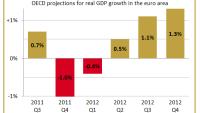
Thanks to the tremors along Westminster's grapevine, we already knew that today's OECD Economic Outlook would make for pretty dreary reading. But now that the report is actually out, we can see the organisation's numbers for ourselves. The headline point appears to be that the eurozone is in, or is facing, ‘mild recession’. Or to put it in graphic form: And the current situation isn't look particularly encouraging for the UK either. The first heading in the section on us reads ‘The economy is weakening sharply’. And a subsequent pair of graphs predicts, first, that we'll experience a mild recession of our own across the next two quarters, and then that unemployment will keep on rising to a peak in 2013.

The trouble with the NHS’s working week

From our UK edition

If you like your literature gloomy, then, at first, there may not be much to interest you in the latest Dr Foster Hospital Guide. A double-page diagram, across pages 10 and 11, is mostly about the positive trends of the past ten years: declining mortality rates and waiting times, that sort of thing. The only particularly sour note sounds out from the timeline at the bottom of the spread, which notes the creation of that big, galumphing NHS computer system in 2002, and then its abolition this year for not ‘achieving objectives’.   But keep pressing on, because there is much to be concerned about in the pages that follow — particularly in the second chapter, entitled ‘Reducing mortality at nights and weekends’.

Tobin tactics

From our UK edition

The biggest bone of contention between the UK and its EU allies these days is the ‘Tobin tax’, the idea of levying a tax on financial transactions. To the UK this is folly. Unless it is levied globally, a tax will force business to move elsewhere. And there is a greater chance of Silvio Berlusconi being elected ECB chief than the Tobin tax being levied globally.   Based on the experiences of Sweden in the 1990s, the tax will achieve none of what its proponents believe it will — and at a considerable cost to Britain's and Europe's economy, as companies look to list elsewhere to avoid it. As Ryan Bourne from CPS points out, even the European Commission found that the tax may hurt the economy. The EC thought it could reduce Europe's GDP by up to 1.

Why infrastructure isn’t a magic tonic for the economy

From our UK edition

Growth plans are a high growth industry — with every day bringing yet another set of ideas, from one quarter or another, for how the government can fix the economy. And one suggestion pops up quite frequently in all these plans: bring forward spending on infrastructure. This is often presented as a simple thing to do, with few (if any) downsides. But how realistic is this? We know that infrastructure is important for growth. Economic texts generally suggest that the ‘multiplier effect’ (when government spending leads to more private spending later on) from is higher for infrastructure spending than for spending in other areas, such as health and welfare. We also know that the UK’s infrastructure needs to improve.

The shape of the Budget battleground

From our UK edition

There are still two days and a couple of hours to go until George Osborne's Pre-Budget Report — but, already, we have a good idea of what will be said. The emphasis, beyond just plain ol' jobs and growth, will be on combatting youth unemployment; helping smaller businesses; and relaxing the squeeze on middle-income folk. Most of the measures either announced or suggested so far — from the Youth Contract to the credit easing scheme to the suspension of January's fuel duty rise — fall into one of those compartments. Whether they'll work or not is a different matter entirely.      As for Labour's response, they're already making it — and I doubt anything in the actual Budget document, or the growth review, will change it much.

How can Cameron protect our interests in Europe in the short term?

From our UK edition

Chatting to people in Brussels last week, I couldn't help feeling that David Cameron's EU problem is one of timing. The PM will probably be able to piece together a repatriation package that includes measures such as a withdrawal from the over-implemented Working Time Directive and a reduction in the EU budget. But none of this is likely to be enough for his party. Indeed, I suspect the budget won't be finalised until two minutes to midnight during the Lithuanian EU Presidency in 2013. Add to this the Tobin Tax, where there seems to be little leeway for the British government. Barosso, Merkel and Sarkozy are determined to introduce it, and even a Eurozone-only tax will harm the City.

Cameron cross-questioned

From our UK edition

A quick post just to add the Guardian's interview with David Cameron to your Saturday reading list. It takes the unusual approach of fielding questions to the PM from a range of ‘public figures’ — and, although many of those questions reduce down to ‘why aren't you giving more money to X?’, the results are still generally engaging and occasionally insightful. And so we learn, after an enquiry by The Spectator's own Toby Young, that Cameron doesn't keep a diary. And we also have the PM justifiying his stance on Europe to Nigel Farage; skipping over a question about what he may or may not have inhaled during his time at Eton; claiming that ‘not everything [Gordon Brown] did was wrong’; and more besides.