Uk politics

Labour reach out to the Lib Dems (again)

From our UK edition

Others have already been there, but it's still worth noting Douglas Alexander's article for the lastest issue of the New Statesman. Much of it, it's true, is a predictable attack on David Cameron's recent activity in Brussels. But slightly more surprising is the fact that, rather than criticising the coalition in toto, Alexander saves his ire for the Tories and reaches out to the Lib Dems. Here's the relevant passage: ‘The roots of what happened on the night of Thursday 8 December lie deep in Cameron's failure to modernise the Tory party. Just because he puts party interest before the national interest, there is no reason others should do the same.

Was the PM reasonable?

From our UK edition

As the effects of last week's European Council become clear, debate about the rights and wrongs of David Cameron's diplomacy hinge on one question: were his demands ‘reasonable and modestly expressed’, as a source in No 10 put it to me? Everyone knows that there were chronic failures in the run-up to the meeting itself. I laid a few of them out in an earlier post, but, basically, they amount to a failure of prioritisation: the UK eroded the goodwill it needed by fighting tooth-and-nail on every issue beforehand, thereby blocking things that other EU states care about but which are not important, except symbolically, to the British. International — and especially European — cooperation is about give-and-take. It cannot just be take.

Inflation down, but the squeeze goes on

From our UK edition

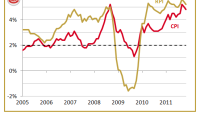
Has Mervyn King's downwards trend in inflation, promised for over a year now, finally arrived? After all, going by today's figures, inflation has now dropped for two months running. CPI inflation is at 4.8 per cent, and RPI is at 5.2 per cent. What's more, we can expect them to fall even further once the effect the VAT rise is removed in January: But I wouldn't get too excited just yet, CoffeeHousers. Sure, most forecasters have inflation going down from here into the foreseeable future — but, don't forgot, we're still being subjected to pretty high inflation, with CPI over double its target level. And, crucially, even by the OBR's forecasts, inflation is set to outpace wages until at least the end of next year.

Where we are now

From our UK edition

Reading through the paper's this morning, it's even clearer that we didn't learn much from that marathon Europe debate yesterday. But here are my thoughts, anyway, on where it leaves us: 1) Ed Miliband lacked credibility from the outset. As Malcolm Rifkind put it, he’s had three days to work out whether he’d have signed that Treaty or not — and he still can’t make his mind up. God knows Cameron is vulnerable on this, but he won’t be hurt being attacked for indecision by a man who still cant make any decisions. 2) Clegg’s misjudgment, cont? First, Clegg backed Cameron after the veto. Now, he says he disagrees with Cameron.

Whatever Chris Huhne says, Durban hasn’t changed anything

From our UK edition

This morning the Department of Energy and Climate Change (DECC) told us that the climate summit in Durban, which concluded over the weekend, has been ‘heralded a success’. As they say, the ‘talks resulted in a decision to adopt the second commitment period of the Kyoto Protocol next year in return for a roadmap to a global legal agreement covering all parties for the first time’. Should anyone be heralding that as some kind of step forward? Was I wrong to be sceptical last week? As it happens, the various parties were actually trying to secure that ‘global legal agreement’, covering all of them, two years ago in Copenhagen — not just talking about securing it in the future.

Good news from Brussels

From our UK edition

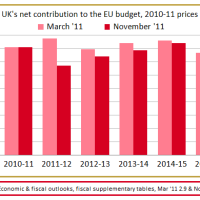
While the debate over Europe rumbles on, it's worth highlighting one bright spot in the OBR's recent document of doom which has largely slipped past Westminster's radar: by their forecasts, we will pay the EU £2 billion less this year than we were expecting to in March. Instead of the £9 billion 'net contribution to the EU budget' forecast for 2011-12 nine months ago, the OBR now estimates it'll be £6.9 billion. That represents a 17 per cent real terms cut on the £8.1 billion we paid last year, instead of an 8 per cent increase: Why the reduction? The OBR gives a few reasons:  By themselves, each of these factors means just a few hundred million less sent to the EU.

Your three-point guide to today’s RBS report

From our UK edition

After months of delay, and much hounding by The Spectator's Select Committee Chairman of the Year, Andrew Tyrie, the Financial Services Authority has finally released its report into the wheezing collapse of RBS in 2008. At 452 pages it is a behemoth of a document, and too much for me to have fully digested yet. But a few points stand out at first glance: 1) Don't blame us, blame Gordon. The Tories are making much of the fact that only three politicians are mentioned in the report: Tony Blair, Gordon Brown and, most relevantly, Ed Balls. And they're not mentioned in a particularly flattering context, either. All three are quoted to partially justify the FSA's regulatory approach in the run-up to the RBS debacle.

Expect today’s eurosceptic celebrations to be muted

From our UK edition

The real Tory celebration of David Cameron's veto will be on Wednesday. Then, behind closed doors, Cameron will address the 1922 Committee of Tory backbenchers. With no Lib Dems present, the Tories will be able to thump the desks and be rude about the EU without worrying about what their coalition partners might think. But in the chamber today, Tory MPs are being urged to be calm and forensic. The whips keep pointing out to ambitious MPs that a question on what Labour's position is would be most helpful. Eurosceptics, though, should be in good cheer today even if Cameron's statement is more downbeat than they would like.

The new premium on Lib Dem policies

From our UK edition

Could it be an accident of timing that the government, in the shape of Sarah Teather, is announcing an expansion of the pupil premium today? Or is it part of a careful response to David Cameron's adventures in Euroland? In any case, the Lib Dem-devised scheme to help the poorest pupils will be extended in 2012-13, so that both the amount given to each pupil and the number of pupils eligible are increased. What's not clear yet is whether this was planned all along, or whether it's because of some previously unforeseen slack in the existing £1.25 billion budget for next year. The pupil premium has, for instance, already been increased for this financial year because fewer children registered for free school meals than expected.

Cameron’s winning the popularity contest over Europe

From our UK edition

It's no surprise that David Cameron's actions in Brussels last week appear to be popular with the voting public, but it is significant nonetheless. The Times is carrying a Populus poll today (£) which suggests just how difficult Labour and the Lib Dems will find it to recapture ground over the Continent. 57 per cent of respondents say that ‘David Cameron was right to exercise Britain's veto’, against only 14 per cent who believe he was wrong to do so. And it turns out that 49 per cent of the folk who voted Lib Dem at the last election support the PM too. With one particular exception (which we shall get on to below), most of the poll's other findings will both hearten and embolden the blue half of the coalition.

The government’s Sarkozy problem (and other euro dilemmas)

From our UK edition

This week’s European Council meeting has been analysed by diplomats and commentators alike, but a number of issues have not been brought out as clearly as they need to be. The first is that Britain will now achieve political advantage, at the cost of economic setback, if the euro collapses. Although the government insists both that it is still wedded to the success of the euro and that it will not be isolated in Europe now or in the future, the simple fact is that eurofailure will ensure that efforts to organise among the 26, rather than the full 27, will finish. The economic costs would be considerable — possibly 10 percent of Britain’s GDP — but it would help Britain back into the centre of European decision-making.

The coalition’s latest anxiety attack

From our UK edition

It is starting to feel like the build-up to the AV referendum again, if not worse. No longer the casual bonhomie of the coalition's early days, but a great show of mutual distrust and loathing between the Lib Dems and Tories. There was Nick Clegg's interview on the Marr Show earlier, of course, which James has already blogged about. There are rumours that Vince Cable is set to quit. And there is also Paddy Ashdown's caustic article in the Observer, which he has followed by attacking, Major style, the Tory ‘bastards’ on Sky this morning. For their part, many of those ‘bastards’ are looking on at the Lib Dems' pain with glee, eager to make it worse. Some of this is probably choreographed.

Clegg blames the Tory Eurosceptics

From our UK edition

Nick Clegg has just given a quite astonishing interview to Andrew Marr in which he accused David Cameron of being incapable of getting a good deal for Britain because of pressures from within the Conservative parliamentary party. When Marr asked him if things would have been different if Lib Dems had been in Brussels, Clegg said they would have been because he is ‘not under the same constraints from my parliamentary party.’ Clegg described Cameron as being trapped between the ‘intransigence’ of the French and Eurosceptics in the Conservative party. Intriguingly, the deputy Prime Minister blamed the French for there being no negotiation about the British asks.

Ten myths about Cameron’s EU veto

From our UK edition

The EU veto that Cameron pulled in the early hours of Thursday morning has been widely misunderstood on all sides. Here are the 10 most common myths: 1. Because of Cameron’s veto, Britain lost a seat at the negotiating table. Not true. The UK was never itself going to take part in the Merkozy pact (and potentially be subject to EU sanctions), and therefore not in the monthly, parallel EU meetings that will begin in January, either. Even if he had approved the Treaty changes, Cameron still would not have had a seat at the table. Wider political challenges aside, the veto didn’t change anything structurally in terms of UK influence. 2. Cameron’s veto created a two-tier Europe.

The sort of influence we can live without

From our UK edition

David Cameron’s decision, in the wee hours of Friday morning, to make clear that he would veto the proposed treaty change will have many far-reaching effects. One is that other European leaders know that Cameron is prepared to follow through on a threat to veto. As Charles Moore says in The Telegraph today, the dynamic that has existed throughout this country’s participation in the European project — that “Britain huffs and puffs, but always agrees in the end” — has now changed. This morning, those close to the Tory leadership were pointing out that a Cameron threat to, for example, veto the budget next year will be taken far more seriously than it would have been previously.

Britain and isolation

From our UK edition

The word ‘isolation’ is used a lot in today's newspapers, as if Cameron walking away from the ongoing EU implosion were a self-evident disaster. Pick up the Guardian and you see Britain cast as a leper, a status conferred on her thanks to a tragic miscalculation by a Prime Minister whose sole aim was to assuage his swivel-eyed Tory MPs and get back on Bill Cash's Christmas card list. Orwell would have great fun with the language that accompanies the Euro project: trying to suck up to its tiny elite is seen as a country being outward looking. A PM more focused on the people who sent him to office is seen as a parochialist. Spend too much time in SW1 and you may come to believe this yourself.

What Cameron can do next

From our UK edition

What now? That’s the question. This morning it looks not like 17 versus 10, but like 1 versus 26, which is a cold and lonely place for Britain to be. But it is also the right place to be. David Cameron asked for a little and got less. He had to act as he did and will reap the benefit electorally and among his MPs. Labour’s position is not just politically weak, but also unrealistic: it has been clear for weeks it was not possible to run a ‘periphery strategy’ as the 10 states outside the Euro have different incentives to Britain and different long-term aims. And the idea that the last Labour government had better links to the continent is laughable.

A dozen questions for after the Brussels summit

From our UK edition

Cameron will be depicted in tomorrow's press as either a Tory Boudicca or an Essex Bulldog (© Tristram Hunt), depending on your point of view. I suspect the truth is somewhere in between. Cameron did not go in swinging a handbag, although it will suit No10 to make out that he did. But Labour's caricature of him storming off and wasting the veto certainly doesn't ring true to me. An EU27 deal was never likely, and EU17 deal always was. Cameron, on their account, just seems to be being blamed for what was going to happen all along. In any case, we are still trying to assemble the pieces of last night's drama, work out the demands and counter-demands, and see what sort of picture they produce. I'm still not sure.

Cameron on top — for now

From our UK edition

Looking at the British political scene today, David Cameron is in a very strong position. His own party has rarely been happier with him. His coalition partners, despite being the most pro-European party in British politics, are standing by his decision to use the veto. What Liberal Democrats keep stressing is that the British government was not actually asking for that much and that Sarkozy’s behaviour left Cameron with little option but to wield the veto.   Labour are in good spirits today. But they don’t have an answer to the question of what they would have done in the early hours of this morning. Instead, they are saying that they wouldn’t have started from here — hardly a persuasive position.