Uk politics

The Home Office still hasn’t cleared up its border issues

From our UK edition

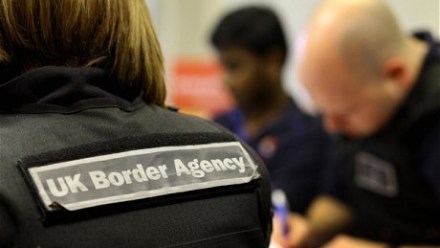
Remember Theresa May's border skirmish against Brodie Clark back in November? This morning the Home Affairs Select Committee published their report into the whole affair. Ideally it would have cleared up some of the confusions over who was responsible for waiving various security checks at our borders last summer, and whether they were right to do so — but it doesn't really manage it. This is not really the fault of the committee: some of the crucial questions they put to the Home Office remain unanswered, and key documents have not been released to them.

Boris’ poll lead evaporates

From our UK edition

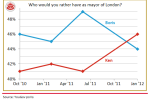
It looks like the May's election for Mayor of London will be a close run thing. A new poll today from YouGov has Ken Livingstone two points ahead of Boris Johnson – a big turnaround from the eight point lead Boris had in June: Ken shouldn't be popping any champagne corks yet, of course. His lead is well within the poll's margin of error, and there's three and a half months to go before election day. But he's certainly looking more likely to topple Boris than he did seven months ago. So why the change? YouGov's Peter Kellner has a good article on the poll's details here, but two key points jump out from the numbers: 1. Labour voters are getting behind Ken.

Miliband’s proximity problem

From our UK edition

Ed Miliband is on unusually assertive form this morning. His observation in the FT that ‘my speech to Labour’s annual conference was not — I think it is fair to say — universally well-received’ is not, I think, intended self-deprecatingly, but rather self-congratulatory, as though he were the only politician calling for a ‘responsible capitalism’ at the time. And he's repeated that suggestion elsewhere: in a short statement for Which?, and in a Labour briefing document — entitled Who is he trying to kid? — that has been filtered around the crowd at David Cameron's speech. Ed is trying to crash Dave's party, and bring it crashing down. Like I say, he's being unusually assertive.

Lansley’s health problems return

From our UK edition

Another day, another exercise in obstructionism from the unions. Only this time it's not Ed Miliband that they're complaining about. It's Andrew Lansley and the government's health reforms. The Royal College of Nursing and the Royal College of Midwives have said that the entire Health Bill should be dropped. They have shifted, as they put it rather dramatically, to ‘outright opposition’. Which must be annoying for Lansley, given how he took time to ‘pause, listen and engage’ last summer, and adjusted his Bill accordingly. That whole process was meant to anaethetise this sort of disagreement, but the tensions clearly persist and could indeed get worse from here.

Boris puts on a performance for the 1922 Committee

From our UK edition

Boris Johnson was very well behaved this evening when he appeared before the 1922 Committee of Tory MPs. He stayed off the topics of Europe and tax and instead confined his remarks to London, saying that he wanted the capital to be an example of ‘cost-cutting, one nation Conservatism’. Those MPs inside the room say the performance was classic Boris, as one put it ‘he left no erogenous zone unstroked’.   Afterwards, Mark Reckless, a north Kent MP, asked the Mayor a sceptical question about his plan for a new airport in Kent. In the questions, I understand that Boris also took the chance to express his support for Rebecca Harris’s daylight saving times bill.   Interestingly, the turn-out for Boris was decent but not massive.

Cameron’s fight over the Falklands

From our UK edition

Thirty years on from the Falklands War, and the hostility between Britain and Argentina persists. And it was that hostility that delivered the most striking moment of PMQs earlier. Not only did David Cameron, at the insistence of Andrew Rosindell, describe the Argentinian attitude towards the Islands as ‘far more like colonialism’ than that of the British, but he also confirmed that the National Security Council yesterday discussed the simmering situation in the south Atlantic. As he put it himself, he wants to send out a ‘strong message’ to Argentina, after the recent sabre-rattling actions of their President, Cristina Kirchner — which Daniel has blogged about here.

Why the government shouldn’t be confident that employment’s rising

From our UK edition

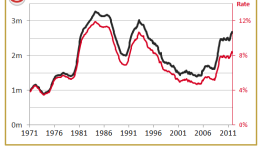
No two ways about it: today’s employment figures are difficult for the coalition. The unemployment figure’s up for the seventh month in a row, and now stands at 2.68 million — the highest since 1994. And the unemployment rate — up to 8.4 per cent — is at its highest since 1995. It doesn't look like getting better anytime soon, either: unemployment's predicted to carry on rising at least until the end of the year, possibly matching the three million peak of the early ‘90s. In its defence, the government claims that employment is rising too. Today's figure of 29.1 million in employment is about 150,000 higher than it was at the general election. That may seem odd — how come unemployment's up when more people are employed?

The lesson from today’s PMQs? Unemployment makes Cameron uncomfortable

From our UK edition

What’s the point of Ed Miliband? Does the Opposition leader have any purpose in life other than to provide ritual entertainment for the Tory wrecking crew at PMQs? Having spent the New Year listening to lethal attacks from his dearest supporters, Mr Miliband has now seen his leadership shrivel to a pair of policy statements which rival each other in desperation and barminess. The first, outlined by Liam Byrne this morning, is a fantasy tax on banking, ‘to create 100,000 jobs’. The second is Labour’s new position on the government’s austerity programme. This would baffle the dippiest and trippiest resident of Alice in Wonderland. We hate the cuts. We back the cuts. We oppose the cuts. We endorse the cuts. We accept the cuts.

What Boris Island tells us about Cameron

From our UK edition

He already has his bikes and his buses, but might Boris get his island too? Today's Telegraph reports that David Cameron is going to announce a consultation into building a new airport in the Thames estuary, as was first proposed by the London Mayor. The PM will wait until that consultation is over before making a final decision, but he's said to be 'provisionally supportive' of the plan at the moment. Nick Clegg, by the sounds of it, is more provisionally negative. Even the very prospect of Boris Island is a triumph for the Mayor, and not least because Cameron and George Osborne were previously opposed to it. It also says much about the more general shift in attitude of those Tories in government.

The new politics of leaning on business

From our UK edition

Ed Miliband the consumer champion, the saviour of the squeezed classes. That, more or less, is how the Labour leader has always sought to sell himself — but this morning the sales pitch goes into overdrive. He has an interview with the Daily Telegraph in which he attacks 'Rip-off Britain'. Not the TV show, mind, but those companies that hammer their customers with extra costs and hidden charges. Excessive savings fees, car-parking charges, airline levies, bank charges, consumer helpline costs and energy bills; all these should come to an end, says Miliband. And he has a few measures for achieving that. What strikes me, when reading the interview, is how this fits into a trend of politicians leaning on businesses to make them curb certain excesses.

Miliband tells the unions ‘tough’

From our UK edition

Ed Miliband has just done a TV clip full of the kind of quotes that politicians love using. In an interview with Nick Robinson (above), the Labour leader declared that ‘I’m leading this party and making the difficult decisions. And if people don't like it, I’m afraid it's tough, because that is the way I’ve got to lead this party’. It seems that Miliband has decided to pivot off the attack on him by the Unite and GMB unions, to use them to try and show the electorate that he’s his own man and is fiscally credible. The worry among some Labour supporters is that Unite, Labour’s biggest financial backer, walks away from the party in disgust at its support for the public sector pay freeze.

Inflation at 4.2 per cent is nothing to cheer

From our UK edition

Are today’s inflation figures cause for celebration? The Consumer Price Index rose a mere 4.2 per cent in the year to December, down from 4.8 per cent in November. So, yes, a sharp drop — but only a statistical boffin could describe this as good news. Sure, a similar drop can be expected when the VAT rise drops out of the comparison figures next month. But the prices confronting British shoppers are still rising at twice the supposed inflation target, and will keep rising above this target for months to come. The following graph shows the trajectory we can expect for CPI and RPI over the next few years: The misery that inflation inflicts on the public is, of course, mitigated by pay rises.

What will Miliband do now?

From our UK edition

The Labour leader Ed Miliband has been determined not to define himself by picking fights against his own side. He didn’t want to do a Blair or a Cameron and triangulate his way to power. Rather, his model was, in one respect, Thatcher. His team were struck by how she managed to move the political centre from opposition. But Miliband now finds his own side picking fights against him. As Pete blogged earlier, Unite’s Len McCluskey has launched an intemperate attack on him in The Guardian. McCluskey claims that Miliband’s recognition that Labour’s starting point has to be that the cuts will be reality by 2015 has ‘undermined his leadership’.

Labour disunited

From our UK edition

Labour MPs didn't pick Ed Miliband as Labour leader; they preferred his brother. Labour members didn't pick Ed Miliband as Labour leader; they preferred his brother too. It was the union bloc that delivered the crown unto Ed — spearheaded by the votes, support and influence of the country's largest trade union, Unite. Which is what makes Len McCluskey's article for the Guardian today so dangerous for the Labour leader. McCluskey, you'll remember, is the head of Unite — and he's not happy with how things are going now that Miliband has closed the ground, rhetorically at least, between his party's fiscal stance and the coalition's.

A joke too far?

From our UK edition

Tom Harris lost his job as Labour's ‘Twitter tsar’ today after uploading this Salmond-themed Downfall video onto YouTube.

Clegg versus vested interests (and the Tories)

From our UK edition

‘Another week, another speech about the evils of capitalism.’ So joked Nick Clegg at the start of his speech to Mansion House earlier, and there was some truth in this particular jest. All three parties are jostling to be seen as the harbingers of a new economy at the moment — one that doesn't reward failure; that benefits everyone ‘fairly’; that won't seize up as the old one did; that etc, etc. Ed Miliband sketched out his rather insipid vision for this economy last week; David Cameron will hope to do a better job later this week. Today, though, was the Deputy Prime Minister's turn. So what did Clegg say?