Uk politics

The Tory 2015 message: times are tough, but they’d be worse under Labour

From our UK edition

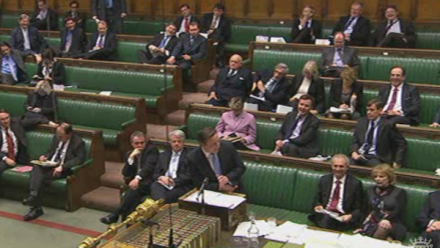
Today's PMQs was not, as James says, a tricky one for David Cameron. He had some good jokes and embarrassing gossip to poke Ed Miliband with, even though the Labour leader chose to attack on the thorny issue of living standards. The key to the next election will be whether voters feel their lives have improved under the Coalition far more than it is about the latest ONS release on GDP. And the key challenge for the Coalition is to be clear that though things won't be rosy - as Miliband pointed out, the squeeze on living standards will still be taking place when polling day arrives - they would be worse under Labour.

PMQs: Ed Miliband fails to bowl Cameron out

From our UK edition

I suspect that David Cameron was in a better mood at the end of PMQs than at the start. He sailed through the session with relative ease. Ed Miliband went on living standards, his specialist subject, but his delivery was oddly flat. It was as if he was giving Cameron throw-downs in the nets rather than trying to bowl him out. Cameron, who has been bested on the joke front these past few weeks, also had the better one liners. He gleefully read out an email from the Labour press office inviting people to a Miliband speech on the economy but warning there was no new policy in it. Labour, though, are claiming that they’re grateful for the plug for the speech.

Eastleigh by-election parties fight over policy they both support

From our UK edition

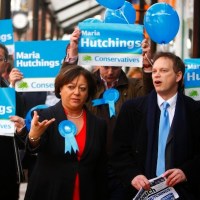
Alarming news reaches this blog from the Eastleigh by-election, where the battle has descended into a catfight about a policy the two main parties support at national level. How unusual for parties to detach themselves from their own policies when a prize seat is in sight: this time round it's the Lib Dems and Tories fighting over a development of new homes in the area on greenfield land. The Lib Dem leaflets promoting Mike Thornton say 'residents are angry with the Conservatives for putting green fields under threat from big builders'. The Tories backing Maria Hutchings point out that Thornton and his Lib Dem colleagues on the council voted in favour of the local plan for Eastleigh, which includes provisions for up to 4,700 new homes on greenfield land.

Adultery and the same-sex marriage bill

From our UK edition

Nadine Dorries said during the debate on same sex marriage last week that 'This bill in no way makes a requirement of faithfulness from same-sex couples. In fact, it does the opposite'. Her rather surprising claim stems from the government's plans to maintain the current definition of adultery in the equal marriage bill. Although not defined in statute, case law defines adultery as sexual intercourse between persons of the opposite sex. So while a heterosexual man can be divorced on the basis of unfaithfulness with another woman, a homosexual man could not on the basis of unfaithfulness with another man. The definition of adultery has caused legislators a collective headache as they have tried to adapt current marriage legislation so that it is capable of extending to same sex couples.

The government’s work experience scheme isn’t headed for the plug hole

From our UK edition

Depending on which paper you read this morning, the government's work experience scheme is either heading for the plug hole or going from strength to strength. The Guardian has an editorial praising Cait Reilly, the geology graduate who fought the workfare scheme she found herself on, The Telegraph says workfare can 'still do the job for Britain', and The Sun carries a bullish piece by Iain Duncan Smith on why the scheme is not 'slave labour'. The problem is that everyone has managed to interpret yesterday's Court of Appeal judgement as favouring their own view of the scheme. Reilly emerged yesterday with her lawyer to claim victory, but the Work and Pensions department seemed relatively unperturbed, too.

Lib Dems and Labour concerned by Tory Leveson Royal Charter plans

From our UK edition

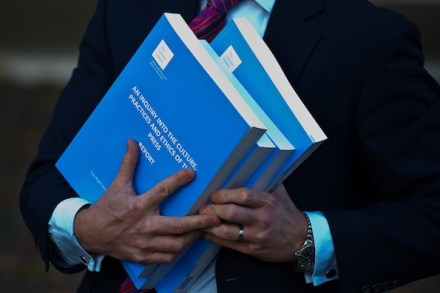
Does the Royal Charter, published by the Conservative party this afternoon, take politicians any further away from meddling with press regulation? The charter is the Tory answer to the statutory underpinning recommended by Lord Leveson, and the party is keen to stress that it 'does not require statute and enables the principles of Leveson to be fulfilled without legislation'. But is this plan any better? Well, the charter, which you can read here, can only be unpicked or changed if the leaders of all three parties confirm they agree with this and if the change gets the support of at least two thirds of MPs. It also needs the support of all those involved in the cross-party talks. So what do they think?

Nick Clegg: I spent months making the case for an EU budget cut

From our UK edition

Deputy Prime Minister's Questions is rarely an uplifting experience: more like watching some hapless chap stuck in a room full of his ex-girlfriends, all pointing angrily at him, like the wedding reception scene in Four Weddings and a Funeral. Somehow Peter Bone either manages to get his name on the Order Paper or to tag along at the end of another question to bring up one of the more painful rows in the Coalition relationship, the boundary reforms, or when he's in a really good mood, what the DPM would do if David Cameron were run over by a bus. He did so again today, even though the Tories have already lost the boundaries vote. Zac Goldsmith was moodily grumbling, too, because the promised Recall Bill still wasn't making its way onto the books. Others were less kind.

Secret justice bill unites senior Tory and Lib Dem MPs

From our UK edition

Last week ministers managed to rewrite some of the protections in the controversial Justice and Security Bill while it was being scrutinised in committee: this week backbenchers MPs are starting to hit back. I reported in late January that Andrew Tyrie was considering amending the legislation, and that a group of Tory MPs was minded to support him. He has now tabled a series of changes for the report stage of the Bill in the Commons, with the support of Liberal Democrat deputy leader Simon Hughes. Tyrie's proposals involve creating an elected chair of the Intelligence and Security Committee who is an MP, which is one of the recommendations in his CPS paper on the Bill. These proposals relate to part I of the Bill, which is perhaps the less controversial section of the legislation.

Cross-party consensus on Leveson tested with Royal Charter plan

From our UK edition

The Conservatives publish their plans for a Royal Charter to underpin regulation of the press today. Although the cross-party talks have been more successful than most imagined, with no rows or public posturing, today is the day when that consensus is tested. There's also another test on the way for the three parties, which is the return of the Defamation Bill to the Commons towards the end of February or start of March. This Bill was amended last week by peers - including Tories - to include low-cost arbitration for members of a press regulator, overseen by a 'recognition commission' and a statutory requirement for pre-notification.

Planning Minister: Govt must be tough on new migrants to protect housing from more pressure

From our UK edition

MPs' concerns about how many Bulgarian and Romanian migrants might come to this country when transitional controls are lifted aren't going away any time soon, by the looks of things. There were six questions on the order paper from Conservative MPs about the matter at Home Office questions yesterday, for starters. But I've also spoken to a minister who is uneasy about the impact that the end of the controls will have on his own sector.

Briefing: What is the government doing to inheritance tax?

From our UK edition

The Death Tax has risen again. The government estimates that its proposals for social care funding will cost the Treasury £1 billion a year. That will be met through a combination of not compensating government departments for the higher National Insurance contributions they will have to pay under the new single-tier state pension and freezing the level at which inheritance tax kicks in at £325,000 until 2019 - the source of the 'death tax' accusations today. Freezing the inheritance tax threshold The inheritance tax threshold (or ‘nil-rate band’) is the amount of an estate that is not taxed. It rose in both cash- and real-terms throughout the Labour years, but in 2009 Alistair Darling decided to freeze it at £325,000 for 2010-11.

Barwell wins bill battle against mental health discrimination

From our UK edition

Gavin Barwell's bill to end discrimination against those suffering from mental illnesses received its third reading in the House of Lords this afternoon, which means it is just a small hop, skip and jump from becoming an Act of Parliament. The legislation will end automatic blocks on those receiving regular treatment for any mental health disorder from sitting on a jury and from continuing to work as a company director, as well as repealing the section of the Mental Health Act 1983 which automatically removes an MP from their seat if they have been sectioned for more than six months.

Tory poll weaknesses show why an Eastleigh win is so important

From our UK edition

The latest ICM poll for The Guardian is interesting because it highlights the weakness in both the Tory and Labour positions. The Tories are 12 points behind on 29, doing appallingly with women voters—trailing Labour 25-51, and haven’t managed to halt UKIP’s momentum. But Labour’s position is not as strong as the headline figures suggest. A plurality of voters still places the blame for the economic slowdown on Labour’s ‘unsustainable spending’. Polls in mid-term do not tell us that much. But the more bad news they bring for the Tories, the grimmer the mood on their benches will become. This is one of the things which makes Eastleigh so important for Cameron.

A long overdue counterblast to the Left’s thinking on Islamists

From our UK edition

A three year open sore within the human rights community will be closed this evening when Gita Sahgal officially launches her new organisation, the Centre for Secular Space, at Toynbee Hall. Sahgal will also be launching the group’s first report, ‘Double Bind: The Muslim Right, the Anglo-American Left, and Universal Human Rights’ highlighting the ongoing scandal of the left’s promiscuous embrace of radical Islamists. The story of Gita Sahgal has been covered before but is worth revisiting. A lifelong human rights activist, Sahgal worked on issues relating to women’s rights, religious extremism, and racism before heading up the Gender Unit at Amnesty International.

Social care reforms: clever politics, bad government

From our UK edition

Judge a Government on its priorities.  And then its priorities within priorities.  Amidst the clamour for rapid and credible deficit reduction, the dawning reality that green shoots won’t sprout unaided, Iain Duncan Smith’s welfare reform and Michael Gove’s education revolution, social care did make the hastily compiled Coalition to-do list. But a Government’s Parliamentary programme is a game of two halves, and within weeks of Andrew Dilnot’s radical report in 2011, it became clear that any such reform would be a second half priority. Today, after months of cross-party Whitehall wrangling and internal Coalition debate, the Health Secretary proudly unveils the Government’s offer.

Social care reforms: the good and bad news

From our UK edition

Jeremy Hunt is unveiling the government's long-awaited reforms to the funding of social care today. This is the next announcement in the government's mid-term review series, and while it addresses a serious issue, it's probably the biggest disappointment to date, and not just because it doesn't match the ambition of the reforms proposed by Andrew Dilnot. The good news is that no-one will have to pay more than £75,000 for the costs of their social care: that is the personal help, washing, and clothing, but not the cost of accommodation or food.

Ed Davey sounds more enthusiastic about Nick Clegg than Nick Clegg himself

From our UK edition

It took a while for Nick Clegg to confirm that he would stay with his party to 2015, but today his colleague Ed Davey did him a favour (or perhaps not) and confirmed on his behalf that Clegg would stay not just through the next election, but would lead his party into the 2020 election. He told Andrew Neil on the Sunday Politics: 'I'm really very supportive of what Nick has been doing, I think he's the best leader we've ever had and I think he's going to lead the party not just into the next election but into the one after that.' Ed Davey is obviously trying to fend off accusations that he's abandoning the club sandwiches and aiming for the leadership himself, but he managed to make himself sound more enthusiastic about Clegg as leader than Clegg himself.