Uk politics

Philip Hammond: Britain can do better than a blank sheet of paper or the Lib Dems

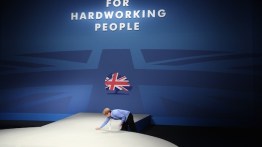
listen to ‘Hammond: ‘A Conservative government will never send our forces in to battle without the right kit’’ on Audioboo Philip Hammond’s speech to the Conservative conference was accompanied by the set of circumstances that most ministers have bad dreams about after eating too much cheese. First he was interrupted by two men in military clothing, shouting about defence cuts and fusiliers. ‘I’ll come and talk to you later, let me finish my speech,’ the Defence Secretary said, hopefully. The man didn’t stop, and was escorted from the floor, followed by a cloud of journalists scribbling away and enthusiastic photographers. Then the giant screens behind Hammond that were beaming two

Grant Shapps: Britain can do better than a Labour government

Manchester Central is a beautiful, cavernous conference venue. But it also seems to be acting as a bit of an atmosphere sink today. When Grant Shapps bounded onto the conference stage after the party’s tribute to Baroness Thatcher, he might have expected that his speech, which was full of the sort of fare that Tory grassroots love – attacks on Labour and the trade unions and a reminder that Abu Qatada no longer haunts these shores – would have gone down to uproarious applause. But though delegates clearly liked his speech, they never really warmed up. If this continues through the week, it won’t help diminish the impression that political

How strong can the Tory tax attack be?

One of the key dividing lines in 2015 will be over what sort of action each of the parties proposes to take over filling the financial black hole. The choice is between tax rises and spending cuts, and the Tories were first out of the blocks to make clear that they want to focus on spending cuts, specifically shaving more money from the welfare bill, as part of their election offer. James first revealed this in his Mail on Sunday column in June, and then George Osborne ruled out tax rises at a press gallery lunch the following month. At the time, he said: ‘I think this can be delivered

Conservative conference: Sunday fringe guide

Every morning throughout party conference season, we’ll be providing our pick of the fringe events on Coffee House. The Tories’ annual bash kicks off today in Manchester with plenty of cabinet ministers and interesting figures popping up, mostly later in the day. Here’s our selection of the must-attend fringes: Title Key speaker(s) Time Location How To Win The Next Election Owen Paterson, Andrew Mitchell, Tim Montgomerie 14:00 Midland Hotel, Alexandra A Boot Camp: Designing a truly digital government Francis Maude 17:00 Rylands Room, Novotel Centre The Big Transport Interview Patrick McLoughlin, Stephen Hammond 17:00 Manchester Central, Central 4 The Implications Of Independence For The Energy Sector Michael Fallon, Lord Strathclyde 17:30 Midland Hotel, Stanley Suite

We haven’t heard the last of the mansion tax

In Manchester this week, there’ll be much talk from the Tories about how they are gunning for a majority. But in private, many senior Tories will admit that being the largest party in another hung parliament is a more realistic aim. As Matthew d’Ancona reveals in the Telegraph this morning, there has been talk—albeit brief– between the principals about a second coalition. Matt also reminds us how, if it had not been for Cameron’s intervention, a mansion tax would have been imposed by the coalition. I suspect that if there is to be another coalition, the Liberal Democrats would insist on some kind of mansion tax. It has come for

David Cameron unveils £1,000 marriage tax allowance

That the Conservatives were going to announce a marriage tax allowance at their party conference had to be one of the worst kept secrets in Westminster since the date of the last general election. So they’ve managed to go one better than the £750 allowance proposed by their 2010 manifesto with David Cameron announcing in the Daily Mail tomorrow that people will be able to transfer £1,000 of their personal tax allowance to their spouse or civil partner. Cameron has written in the Mail about his personal belief in marriage, adding: ‘When I ran for the leadership of my party back in 2005, I said that I wanted to do

The Boris Johnson guide to making headlines

Boris Johnson sure knows how to make the front pages. His interview in the latest FT Weekend Magazine — with the cover quote ‘for the first time in years, I wished I was in Westminster’ — is a prime example of his strategy. He wants to remain in the public consciousness without revealing anything new. He’s done it several times before, often in similar ways: 1. After a period of inactivity, give an interview which appears revelatory Boris flits in and out of the spotlight, particularly when he’s busy trying to run London. Then suddenly, he appears front and centre with ‘news’. In the FT’s interview, he says ‘during the

David Cameron ducks a debate with Alex Salmond. This makes sense but is still depressing.

A novice poker player quickly learns – or had better quickly learn – that strength often connotes weakness and weakness is a reliable indicator of strength. But as the stakes increase and the level of play becomes more sophisticated such elementary tells can be misleading. They are false friends in the land of the double and triple bluff. So a novice poker player might conclude that David Cameron’s refusal to debate against Alex Salmond is a sign of weakness. A slightly more experienced player would think this weakness too obvious to be true and conclude that Cameron is holding better cards than he is indicating. And it is true: with

‘North-south railway’: the new Tory brand for HS2

When Lord Howell described parts of the North East of England as ‘desolate’ (or did he mean the North West?), he was talking about shale gas exploitation, but he could have more accurately applied the term to the map of Tory support in the region. The urban north hasn’t supported the party since the late 1980s. Seats like Manchester Withington, Newcastle Central and Nottingham North (that last is not in the North, of course, but another example of the urban problem) were once Conservative, but now it’s hard to imagine them ever being safe blue seats again. The Tories can win without the urban North, but as their electoral map

Why the Tories need to reunite the Right

One of the most important things about British politics right now is that the left is united and the right is divided. The combination of the Liberal Democrats going into coalition with the Tories and Ed Miliband’s leadership of the Labour party has seen left-wingers who moved from Labour to the Liberal Democrats during the Blair years go back to Labour. At the same time, Ukip has started eating into the Tory core vote. Combine this with constituency boundaries that hugely favour Labour and it becomes evident that Labour can win with nowhere near 40 percent of the vote. If the Tories are to stop this happening, they need to

Being a ‘National Treasure’ appears to be a license to talk rot

Take, for instance, the curious case of Sir David Attenborough. The poor booby is another neo-Malthusian. Which is another reminder that expertise in one area is no guarantee of good sense in another. As I wrote in The Scotsman this week: Attenborough is a supporter of Population Matters, a creepy outfit who have previously suggested Britain’s optimum population lies around the 20 million mark. Let’s rewind the clock to 1850 then. Like other Malthusians, Population Matters is coy about how it proposes to reduce Britain’s population to this “sustainable” level. Emulating China’s one-child policy may be tempting, but will not reverse the terrifying tide of prosperity and population growth now threatening our

Why should 16 year olds get the vote? They don’t pay tax.

No doubt it will happen, because the Tories will not dare oppose it, but is there any conceivable good reason why 16-year-olds should have the vote, as first Alex Salmond, then the Liberals, and this week Ed Miliband have promised? The argument is that giving people the vote makes them feel empowered. But the sad fact about human nature is that once you have won a right, you quickly take it for granted. I am part of the first generation to have had the vote at 18 rather than 21. We were quite pleased by this, but less interested than our parents’ generation. Our children’s generation is astonishingly uninterested. If

Rod Liddle: Under New Labour, it really was the loony left

There is a little vignette in the first volume of Alastair Campbell’s diaries that makes it abundantly clear that, at the time, we were being governed by people who were mentally ill. It is yet another furious, bitter, gut-churning row involving Campbell, Tony Blair and Peter Mandelson and concludes with Mandelson stamping his little feet and screaming: ‘I am sick of being rubbished and undermined! I hate it! And I want out.’ The cause of this dispute was not whether or not Labour should nationalise the top 200 companies and secure for the workers by hand or by brain the full fruits of their industry. Don’t be silly. It was

Ed Miliband’s second conference message: ‘bring it on’

If you’re looking for two phrases to summarise this year’s Labour conference, they’d be ‘Britain can do better than this’ (in case you missed its fleeting reference in Ed Miliband’s speech) and ‘bring it on’. Ed Miliband has decided that even though he doesn’t poll above his party like Cameron, or have a history of impressing in broadcast and question-and-answer performances like Nick Clegg, he can still enter a presidential-style 2015 election without fear. Yesterday he told delegates that he would ‘relish’ a battle about character and leadership, today he told his conference during a question-and-answer session that he wanted TV election debates in 2015, saying: ‘It’s time for David

The three groups helping Miliband drive his conference message home

The Labour party held a briefing this morning for party campaigners on how they can follow up Ed’s speech on the doorstep. Activists had arrived at conference hoping for a simple message that they can sell to a voter in a dressing gown with their arms crossed and a sceptical expression on their face, and now they’ve got one: frozen energy bills. They were told that campaigning on energy bills wasn’t just something they can use on the doorstep this weekend, but a major digital and ground war campaign that is going to go on for months. The idea is to demand that David Cameron freeze bills now, using petitions.

Ed warns energy firms: don’t reinforce perception you are the problem

Following the announcement of his plan to tackle rising energy prices — and the accompanying backlash — Ed Miliband has fired a warning shot at energy providers this morning, suggesting unless they get on board with his proposals, they will be seen as part of the problem, not the solution, by their customers. Here is the full text of his letter: ‘In recent years we have discussed the need to rebuild public trust in the energy market many times. I think we all agree on the importance of that objective if we are to build a market that both delivers for consumers and underpins the investment in future clean energy

Tessa Jowell: Ed should expose himself to many people

The Labour party recently reached a stage where the only person in the entire country not giving Ed Miliband advice about how to lead was Ed Miliband himself. That has died down now, especially after another crowd-pleasing conference speech. But this evening Tessa Jowell offered a little bit more in the way of help. She told a fringe after her leader’s speech that the party’s job was now to take today’s policy announcements to the country, saying: ‘I think Ed should just go on travelling around the country, exposing himself to many people.’ Crikey! But didn’t the leader vow to keep his kit firmly on if he became Prime Minister

Jack Dromey: Labour let Thatcher become the champion of aspiration

When Margaret Thatcher passed away and the broadcasters, newspapers, and casual drinkers in pubs picked over what her legacy really was, one of the key policies mentioned – and praised – time and time again by those from all sides of the political spectrum was the Right to Buy. It was an iconic housing policy that helped people who would never have had a chance of making it onto the housing ladder realise the dream of owning their own property. It was an empowering policy (the detail, of course, is slightly more complicated: the way the policy was designed led to a reduction in the overall size of the social

Ed Miliband: You Are The Quiet Bat People And I Am On Your Side

Ronald Reagan once quipped that  “The nine most terrifying words in the English language are, ‘I’m from the government and I’m here to help.” As was so often the case the Great Communicator was only half-joking. He knew government had important jobs to do, jobs only government could do. What was needed was a rebalancing. Government had become too invasive. It needed pruning. (Never mind that not much pruning took place; the rhetoric and the positioning was what mattered.) I didn’t watch Ed Miliband’s speech to the Labour party conference this afternoon but no-one, I think, would say he possesses a Reaganesque delivery. But he was in Brighton to tell