Uk politics

Ten ways the Tories have helped small businesses

From our UK edition

New year is the time when we reflect on the year gone by and look forward to the year ahead. For small businesses, it is no different. 2013 was the year when small business really started motoring again, after Labour’s Great Recession. But there is more to do. Because although our recovery is real, it is still fragile. As a Government we have to go on making life easier for small business. Conservatives value small business because of the ethos they embody of hard work and reward for effort. They matter because of the jobs and prosperity they create, and the opportunity they create for people to rise and achieve their dreams. Small businesses allow people to get on in life and have a better, more secure future. And of course they are crucial to our country's future too.

Romanian and Bulgarian migration – What next?

From our UK edition

So there was no great rush of arrivals from Romania and Bulgaria on day one – nor was there ever likely to be. The numbers will build steadily as they did from Poland in 2004. How many is another question. The key difference with Poland is that other countries, notably Germany, France, The Netherlands and Austria will be opening their labour markets at the same time; other members have already done so. The other major difference is that about a million, mainly Romanians, have already gone to Spain and a similar number to Italy. In Spain unemployment is now about 25% and youth unemployment is just over 50%; the same figures for Italy are 12% and 33%.

Coffee Shots: Keith Vaz personally welcomes Bulgarian and Romanian migrants to the UK

From our UK edition

Ministers have spent the past 12 months in an almighty flap about how to stem a feared flood of Bulgarian and Romanian migrants once transitional controls on their freedom of movement lift. They've announced and re-announced measures on benefit tourism, housing and access to public services. But while they've been tinkering with these measures which may or may not make any difference to the number of people who do pitch up, they've managed to forget one very effective measure indeed. If only David Cameron had exclusively revealed to the worried press months ago that the best way of deterring an influx would be to deploy Home Affairs Committee chair Keith Vaz to personally patrol the UK border.

Video: David Cameron’s New Year message for 2014

From our UK edition

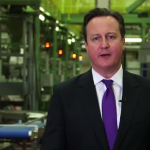
David Cameron's New Year message (and his accompanying Times op-ed) is an upbeat call to stick with the Tories to get the job done. He writes of his desire to 'turn Britain into the flagship post-Great Recession success story. A country that is on the rise'. And in his video message he focuses on the signs that the country is already rising. Downing Street is keen to stress that this message is no Blair/Brown-style relaunch of the government with a shiny new logo and a plan. It is the Prime Minister trying to encourage optimism about Britain's best days lying ahead of it, but that 'recovery is real, but it’s also fragile'.

Don’t blame climate change for flood damage, blame David Cameron

From our UK edition

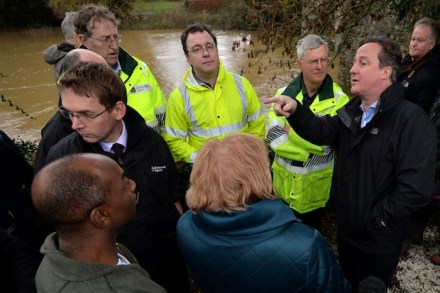
I’m sure the families clearing up after the Christmas and New Year floods have neither the time nor inclination to wonder if the floods were caused by climate change or not. Nevertheless the question has come up, as it inevitably seems to every time there is an extreme weather event nowadays. So, let’s look at the facts. Met Office data shows that four out of the five wettest years on record have been since year 2000. Official reports have repeatedly warned that the risk of flooding is becoming worse because of global warming. The Department for the Environment Food and Rural Affairs (Defra) Climate Change Risk Assessment warns 'floods and coastal erosion are already serious risks in the UK, and they are projected to increase as a result of climate change'.

Nick Clegg’s confusing New Year warning

From our UK edition

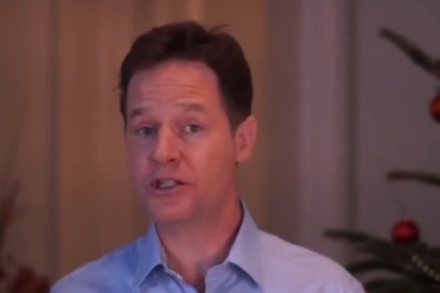
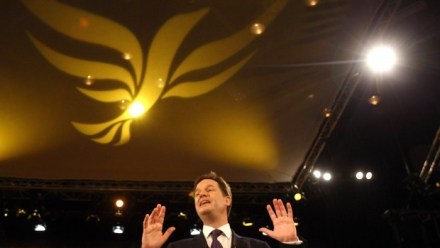
In the autumn Nick Clegg annoyed some in the Labour party by telling his conference that 'Labour would wreck the recovery' and that 'the Conservatives would give us the wrong kind of recovery'. Some senior figures such as Lord Adonis said it suggested Clegg was predisposed to partnership with the Tories as wrecking is so much worse than a tendency to veer off in the wrong direction. But in his New Year message Clegg turns on all the parties, warning voters that a vote for anyone other than the Liberal Democrats in the European elections would wreck the recovery too. He says: 'In May you are going to choose who represents you in the European Union. Two of the parties on offer could help lead Britain out of Europe, the surest way to throw our recovery away.

Six moments that hardened up the Tories in 2013

From our UK edition

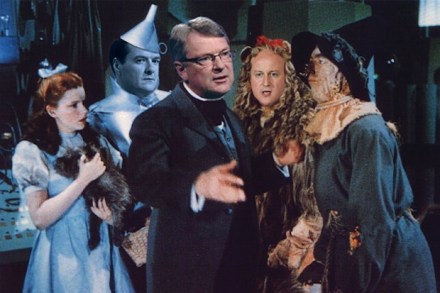
For the Conservative party, 2013 has been the year of Lynton Crosby. Just over a year ago, the Wizard of Oz was appointed David Cameron’s chief election strategist. Now he’s full-time. His brief is to make sure the Tories in government have a clear message – something that eluded them in the 2010 campaign. And to see that the message is articulated in deeds, not words. In April, the Prime Minister described his own strategy by using a quote from the late Keith Joseph: ‘the right thing to do is to address the things people care about; to fix yourself firmly in what Keith Joseph called the “common ground” of politics’. As opposed to the middle ground of Westminster. Here’s the six top incursions into this middle ground. 1.

Tories take Spectator advice and offer Boris a campaigning role

From our UK edition

The Sun on Sunday's story this morning that senior Tories have opened talks with Boris Johnson about a campaigning role for the Mayor follows some advice offered by James Forsyth in the pages of this magazine back in May. In his politics column, James argued that Boris needed a role in the 2015 campaign to reach voters who might otherwise be turned off by the Tories: 'Persuading the public that Labour can’t be trusted with office again is necessary but not sufficient. To achieve victory, the Tories must connect with the electorate in a way that they are currently not. That means Cameron finding a role for Boris; he’d be well suited to being the chief Cameron surrogate. 'Those around Cameron fret about whether Boris can be trusted or not.

SNP turns to God for help with independence referendum

From our UK edition

It turns out that Alex Salmond needn't worry too much about the re-emergence of that pesky row about advice on an independent Scotland's membership of the European Union. He's got arguments that are far more powerful than all that to convince Scots of the value of independence. In the latest issue of Idea, a magazine produced by the Evangelical Alliance, two Christian MSPs set out their arguments in favour of and against independence. Both accept that there isn't one Christian position on the subject, but the SNP MSP for Glasgow Shettleston John Mason does suggest that the Bible might have some wisdom on the matter - and it's from as far back as the book of Genesis. He writes: 'But does the Bible have nothing to say on all this?

Chris Grayling plays Scrooge

From our UK edition

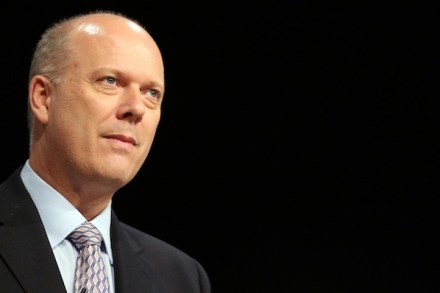
Chris Grayling is a nasty piece of work, isn't he? To wit: [N]ew rules, which forbid prisoners from receiving any items in the post unless there are exceptional circumstances, were introduced in November as part of the government’s changes to the Incentives and Earned Privileges (IEP) scheme. Under the rules, families are prevented from sending in basic items of stationery such as cards, paper or pens to help people in prison keep in touch with their friends and families and wish them a happy Christmas. They are also prevented from sending books and magazines or additional warm clothes and underwear to the prison.

Vince Cable in last minute bid to be Christmas Grinch

From our UK edition

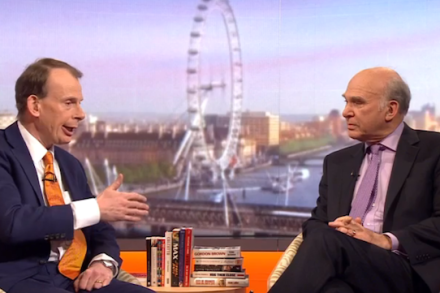
While Anna Soubry's short joke about Nigel Farage on Marr has been causing the biggest row, it was actually Vince Cable's interview earlier in the programme that was clearly intended to annoy. The Business Secretary has been quite quiet of late, particularly after a rather humiliating conference season. But today he went much, much further than his boss Nick Clegg in differentiating the Lib Dems from the Tories. While he repeatedly referred to his leader's work in blocking the 75,000 proposed by Theresa May in a leaked Home Office document, Cable repeated his fears about the Help to Buy scheme and, significantly, warned that cuts to public services were endangering 'the social fabric'.

David Cameron talks nonsense about vetoing future EU enlargement

From our UK edition

Fair's fair. Ed Miliband might be a fish-faced ninny but that doesn't let David Cameron off the hook. And not just because he's trailing a fish-faced ninny in the polls. No, the Prime Minister can be a terrible poltroon himself. Witness his witless suggestion today that the United Kingdom might veto future EU enlargement unless something is done to  thwart "vast migrations" of people. It is a silly thing to say for a number of reasons and the first of those is that Cameron is in no position to make any such suggestion. He cannot bind future British governments and since there is no immediate prospect of any country being accepted into the EU club it's not likely to be a decision he will ever have to make anyway.

Tea at 22: Michael Fallon on jobs, Europe and Ukip

From our UK edition

In the latest episode of Tea at 22, I interviewed Conservative business and energy minister Michael Fallon on his work in two Whitehall departments, Tory EU policy, and the party's approach to Ukip. Fallon was the Spectator's Minister of the Year for 2013. He had some very interesting points about how the Business department in particular might look different under a Tory majority government, suggesting that the Lib Dems had held the Tories back in getting more young people into work.

Rushing to judgement on the ‘crack cocaine of gambling’

From our UK edition

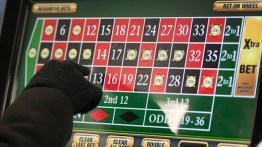
Ed Miliband’s pledge to crack down on the ‘crack cocaine of gambling’  is a significant moment in the extraordinary moral panic over fixed-odds betting terminals (FOBTs). Earlier this year, the Department for Culture, Media and Sport found that there was very little data to back up the anecdotal evidence of the anti-FOBT brigade and so decided to commission some research. This process will take 18 months and a decision about stakes and prizes will be made once there is some evidence to study. This eminently reasonable, evidence-based approach has naturally been howled down by the anti-gambling lobby whose campaign has thus far relied on anecdotes and, at best, half-truths.

The so-called “crack cocaine of gambling” is a myth. Trust Ed Miliband to believe in it.

From our UK edition

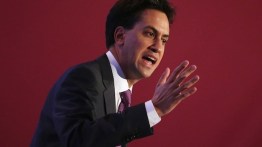
The puritan, as devotees of Baltimore's finest know, is greatly exercised by the fear that someone, somewhere, might be enjoying themselves. Ed Miliband is a puritan. And a hopeless, nagging, fish-faced puritan at that. A ninny, in other words. The Labour leader has a rare gift. He knows, you see, how you should spend your money. What's more, if you fail to spend your cash in the proper Miliband-approved manner he thinks he should be - nay is! - entitled to coerce you into changing your miserable behaviour. Of course he is not alone in that. Many politicians are far too free and easy in these matters. But there is a special teeth-grinding awfulness to the way in which Miliband seeks to coerce this fine country's citizens that never fails to annoy me.

Will ignoring FOBTs be enough?

From our UK edition

When he spoke to the 1922 Committee on Wednesday, David Cameron told MPs that the Conservative attack on Labour must not involve fighting the party on its own territory. He named payday loans as one of the issues that Ed Miliband and co want to create an 'evil Tories' narrative on. But another one that Miliband is currently focusing on is fixed-odds betting terminals, or FOBTs. The Labour leader has announced today that a Labour government would give councils the power to ban or cut the number of FOBTs in their areas. Visiting Kilburn today, Miliband said: 'Currently there is almost nothing that can be done to stop the spread of FOBTs. Laws passed restricting betting shops to a maximum of four of these betting machines has meant more betting shops in clusters, sometimes open from 7.

In praise of Eric Joyce

From our UK edition

Yes, Eric Joyce, the MP for Falkirk until the next election, has issues. Yes, his copy book is well blotted. He has a conviction for assault which scarcely reflects splendidly upon him (even if many members of the public themselves wouldn't mind sticking-the-heid on any number of MPs) and in his dozen or so years in Westminster he has made energetic use of his parliamentary allowances. Yes, yes, yes. But I have some time for almost anyone declared "unfit to stand for the Labour party". It's a kind of character reference. Moreover and despite his troubles, Joyce possesses many of the qualities we should desire in our parliamentary representatives. Chief of these, intelligence and an independent spirit. He may be mistaken on many issues but that's not the point.

PM pushes for stricter immigration controls in Brussels

From our UK edition

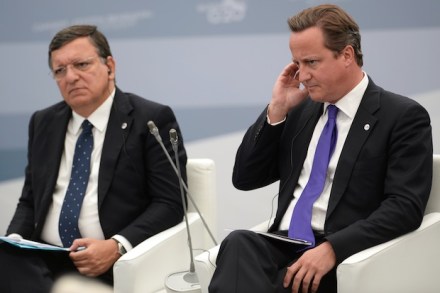
The Prime Minister is in Brussels today, trying to drum up support for stricter immigration controls on new countries joining the European Union. How much traction this gains will tell us a great deal about how successful his overall renegotiation of Britain's relationship with the EU might be. David Cameron's supporters argue that the tide of ideas is clearly turning in his direction in Europe, and that he has clocked up a number of achievements already in persuading other leaders to think what he's thinking, especially that cut he managed to achieve in the EU Budget. They also hope that the work MPs from the Fresh Start Project have been doing in parliaments across the EU to make the case for reform will pay off as politicians in other countries press their leaders for reform too.

Tories try to adapt their food bank message

From our UK edition

There was a food bank debate yesterday in the House of Commons. We all know that, but what few people can tell you is what was said. Instead, there is a furious debate raging about whether the Tories were laughing at poor people not having enough money for food, or whether Labour MPs were laughing too. I'll leave that to other people to tussle over, suffice to say that it wasn't the most edifying debate I've watched, mainly because as with all arguments in Westminster over food banks, both sides were jeering one another and making ugly accusations about each other too.