Uk politics

David Cameron insists Tory campaign has ‘the most positive vision there could possibly be’

From our UK edition

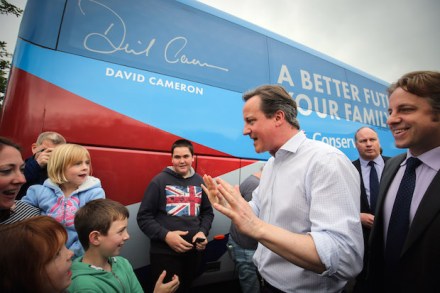
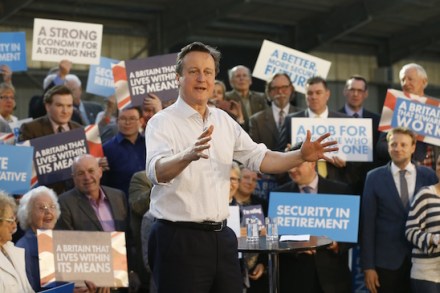
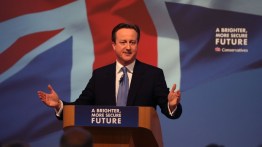
There’s nothing wrong with negative campaigning in an election. If you think your opponents would damage the country, then you should point it out. What’s wrong with negative campaigning is when it’s the only sort of campaigning you’re doing, or when the balance appears to be tipping in its favour in terms of your key messages and big attention-seeking posters. The Tories are currently facing accusations that they are doing too much negative campaigning, and so today David Cameron tried to defend that campaign when he appeared on Sky's Murnaghan programme.

Miliband avoids the Scottish question

From our UK edition

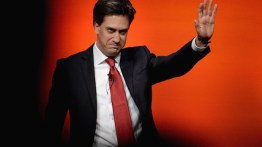
On the Andrew Marr show this morning, Ed Miliband fended off questions about any post-election deal with the Scottish National Party. He had two lines of defence. First, he said he wasn’t going to pre-empt the election result and that he was fighting to win the election everywhere including Scotland. Second, he was adamant that ‘I’m not doing deals with the Scottish National Party’. But there was no explanation of how he would pilot legislation through the Commons without their support. listen to ‘Ed Miliband on the Andrew Marr Show’ on audioBoom When it came to the economy, Miliband refused to admit that the last Labour government spent too much, saying the financial crisis had caused the deficit not the other way round.

The Greek crisis is back, and this time it’s more serious than before

From our UK edition

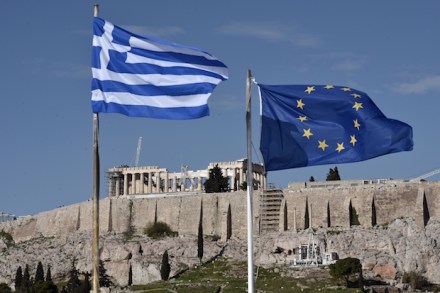
Amidst the hullabaloo of the general election campaign, one thing that has generally gone unnoticed in Britain’s political discourse is the worsening Greek situation. You now have European finance ministers openly talking about the possibility of a Greek default. What has changed is that there is now no goodwill and very little trust between Greece and the rest of the Eurozone. The rest of the Eurozone think that the Greeks are obfuscating and not providing the details needed. While the Syriza-led Greek government feel that the rest of the Eurozone is not providing them with the political cover they need to make a deal. They feel that the Eurozone’s insistence that Athens runs a Budget surplus even before debt repayments have been taken into account is unreasonable.

Ed Miliband thinks Libya’s failure is so obvious he’s barely mentioned it until now

From our UK edition

With less than two weeks until polling day, it’s nice to see that Ed Miliband has discovered foreign policy as an important issue worth discussing. The Labour leader will attack the Tories today on a failure of post-conflict planning for Libya which has contributed to the migrant crisis in the Mediterranean. The Conservatives have decided to get very cross about this, claiming that the overnight briefing on this included Labour spinners saying the Tory party was responsible for the deaths. They have decided to make this about Miliband’s fitness to be Prime Minister.

Jim Murphy rallies Labour activists in Edinburgh

From our UK edition

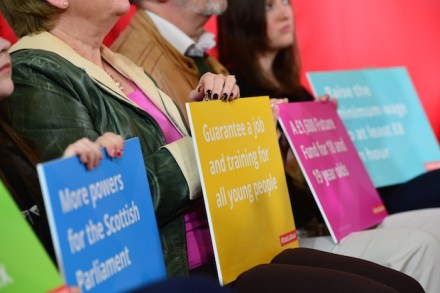
Jim Murphy held a street rally in Edinburgh today. Given many of the election events from the main parties have been behind closed doors, the Scottish Labour leader deserves credit for pitching up right outside the Scottish National Gallery and standing for about an hour in a space where real genuine members of the public were walking.  He was, of course, protected by a rubber ring of activists wearing T-shirts with key Scottish Labour pledges on it, such as ending exploitative zero hours contracts and lowering tuition fees. They had placards with #toriesout splashed across them. And given the rally was secret and only advertised to the media before it happened, there wasn’t much of an opportunity for real genuine members of the public to plan to pop by and ask questions.

The polls could decide the fate of the Lib Dems

From our UK edition

A Lib Dem West Country MP told me at the start of the year that he thought his party would keep his seat if the Tories were broadly ahead in the national polls on polling day but lose it if they were level or behind. His thinking was that if it looked like Cameron was going to continue as Prime Minister his constituents would both feel it was safe to vote for a local champion and would want some protection against the Tories cutting public services too far. But if the Tories were behind, he feared that these swing voters would feel that they had to vote Tory to try and stop Labour. This is what makes the current polls particularly concerning for the Lib Dems. If they don’t move, then they could face a bigger squeeze than expected in their Tory facing seats.

The other kingmaker

From our UK edition

Nigel Dodds, the Democratic Unionist Party leader at Westminster, is reflecting drolly on his party’s recent popularity: ‘I certainly think that the last year or two has been remarkable in the number of new friends we have encountered, people who are very keen to have a cup of tea or chat to you or whatever. I don’t put it all down to our natural charm.’ As pre-election talk of political pacts thickens — with both Conservatives and Labour angling for support — former House of Commons wallflowers have found their dance cards increasingly full. Which of the main parties might feel like a more natural ally? I ask.

Exclusive: Ukip slams ‘terrible’ ComRes poll of ten ‘target seats’

From our UK edition

The Ukip fox may have entered the Westminster henhouse but how many more chickens will it kill? ComRes has released a new poll revealing that Ukip is trailing in third place in ‘ten Conservative-held seats which Ukip have targeted’. Across the polled seats, the Tories are on 39 per cent, Labour on 28 and Ukip trailing on 21. While the latter party's vote share has increased by 15 per cent since 2010, ComRes's findings suggests they will struggle to win thanks to the collapse in the Liberal Democrat vote. According to the poll, a quarter of Lib Dem voters in these seats say they will now back Labour and 21 per cent will back the Tories. But Ukip is not happy at all with this poll, with party source describing it as a 'terrible way of doing the poll'.

Tired Tories call for ‘pizzazz’ in election campaign

From our UK edition

Are the Tories having a bad campaign? It certainly doesn’t seem to be as slick and upbeat as some had expected. Many Tories had expected the polls to stay right where they are until polling day, but others had assumed that there would at least be some signs of a public panic about Ed Miliband by now. Instead, normally gloomy Labour types say their leader is becoming less of a problem on the doorstep. That’s damning with faint praise, still, but the Tories had assumed things would be getting worse for Labour now, not better. The Tories I’ve spoken to over the past couple of days talk of the need to ‘hold our nerve’, which suggests a risk of getting nervous but certainly not outright panic.

David Cameron: Andrew Marr was talking ‘bollocks’ about foxhunting

From our UK edition

So both the BBC and Andrew Marr have admitted to misquoting David Cameron as having said that foxhunting was his favourite sport. But what did Cameron himself think of Marr’s self-described ‘cock up’? Well, The Spectator caught up with the Tory leader earlier today and asked him about it – and here’s his answer: ‘The old mental filing system, you’re going ‘drrrrrr’ through, and thinking… but I knew the article because I wrote it myself… I just thought maybe there’s something else. You never know, something might have been written by someone else. So I thought it was bollocks. And it was bollocks.’ Was there perhaps a spot of truth in it?

Cautious Miliband doesn’t want to talk about borrowing

From our UK edition

Labour is proposing to balance the current not the overall budget. This is presumably because they think that borrowing to spend money on capital projects is a sensible policy. But you wouldn’t have known that from watching Ed Miliband on BBC1 just now. In response to questions from Evan Davis, Miliband was determined not to say that Labour would borrow to invest. In a highly disciplined performance, Miliband would also not engage with Davis’ questions about inequality and whether it was a good thing if everyone got richer even if the gap between rich and poor widened. Indeed, Miliband was so cautious that you began to wonder if he’s started to think that this is now his election to lose.

Why are all the manifestos so rubbish?

From our UK edition

So all the manifestos are now out for voters to pore over. Given the amount of fuss the parties have made about these documents, you’d think they might outsell Fifty Shades of Grey. Sadly the reality is that these verbose tomes are less bonkbuster and more borebuster: they’re not written for voters to read, only for sad politicos who are paid to pore over them for fine details. They are getting longer and longer as the years go on, yet politicians don’t seem to be doing a better job at impressing voters, or indeed winning elections. The Tory 2015 manifesto has 82 pages and 34,000 words, up from 28,000 in 2010. Nick Clegg may end up with only 30 MPs after the election, but he inflicted 157 pages of promises and 36,000 words on the electorate.

Labour’s gamble for SNP support

From our UK edition

The SNP launches its manifesto today in Edinburgh. Nicola Sturgeon will be arguing that the policies in the document are for the benefit of the whole of the United Kingdom, which is a way of reassuring former no-voters who might back the SNP, and also of appealing to the left wing faction of the Labour party. Scottish Labour will be claiming that many of those policies such as voting for lower tuition fees in England are in fact a theft from their own party's ideas, and that the SNP is in fact using Labour as a think tank for its own manifesto. But what is also interesting is how the party that is scrutinising Sturgeon’s claims today could end up working with her parliamentary colleagues from May.

John Major to enter the electoral fray this week

From our UK edition

David Cameron’s inner circle are always keen to talk up the parallels between this campaign and 1992. This week, the winner of that election will enter the fray on their behalf. As I report in the Mail on Sunday, John Major will give a speech warning of the dangers to the Union itself if the United Kingdom ends up with a Labour government propped up by the SNP. The Tories hope that Major’s intervention will elevate this point above the usual party political knockabout. They also believe that a former Prime Minister speaking out will make voters pay attention; they were much struck by how much coverage Tony Blair’s speech on the dangers of an EU referendum received a few weeks back. That the Tories have asked Major to get involved is telling.

Angela Eagle: Labour would speak to other parties to get a Queen’s Speech through

From our UK edition

On the Sunday Politics just now, Angela Eagle shifted Labour’s position on what it would do in the event of a hung parliament. Previously, Labour has insisted that if it was a minority government it would simply propose a Queen’s Speech and dare the other parties, and in particular the SNP to vote it down. listen to ‘Angela Eagle: we'd speak to any party to get a Queen's speech through’ on audioBoom But Eagle told Andrew Neil that in the event of a hung parliament Labour 'would speak to any party that has got representation in the House of Commons in order to try to build a majority for a Queen's Speech that the country desperately needs'. What makes Eagle’s comments so significant is that she is the shadow Leader of the House of Commons.

Feisty Cameron warns English voters of the ‘frightening prospect’ of the SNP propping up a Labour government

From our UK edition

David Cameron has just delivered his feistiest performance of the election campaign yet. In a combative interview with Andrew Marr, the Tory leader repeatedly described the prospect of a Labour government propped up by the SNP as ‘frightening’, telling English voters that the SNP wouldn’t ‘care’ about them and their needs. He implicitly warned that SNP MPs supporting a Labour government would result in less money for English constituencies. He had been given this opening by Nicola Sturgeon, who in her interview had made clear how the SNP would use the fixed term parliament act to give them maximum influence on a Labour government.

The coming battle for legitimacy

From our UK edition

Jonathan Freedland has written a compelling column on the challenge that Ed Miliband will face to establish his legitimacy if he becomes Prime Minister despite Labour not having won the most seats or votes. But I suspect that whoever becomes the government after May the 8th will have difficulty in persuading everyone that they have a right to govern. The Tory-Liberal Democrat coalition could claim that 59 per cent of voters had backed its constituent parts. It also had a comfortable majority in the House of Commons with 364 out of 650 seats. Now, unless something dramatic happens, no governing combination is likely to have anything like that kind of support this time round.

No. That poll didn’t put Ed ahead in the Prime Minister stakes.

From our UK edition

An hour and a half watching Ed Miliband debate four people who are not going to be Prime Minister. That is the ordeal you had to go through in order to be qualified to answer Survation’s post-debate poll, which included the ‘sensational’ result that respondents preferred Ed Miliband to David Cameron by 45% to 40%. The figure set some even seasoned commentators agog at Ed’s miraculous turnaround on the preferred Prime Minister stakes, following years of languishing twenty or so points behind the Conservative leader. Everyone should hold their horses. People who watch debates are, at the best of times, the electorally aware and highly partisan, largely tuning in to have their prejudices confirmed.

Iain Duncan Smith is right about zero hours contracts – he’s just far too late

From our UK edition

Into each day, outrage must fall. Today Iain Duncan Smith has performed the service of upsetting everyone by telling Sky News that zero-hours contracts should be rebranded ‘flexible-hours contracts’. The Work and Pensions Secretary said: ‘I think, with respect, the media and others have got this completely wrong, the flexible-hours contracts I’m talking about which are named ‘zero-hours contracts’, they are taking by people who want that flexibility. The reality is what we’ve had from Labour is a series of scare stories about these.