Treasury

Your guide to Osborne's fiscal rules

George Osborne’s two fiscal rules have been around since his very first Budget, delivered almost two years ago, so they’re hardly news. But they do underpin much of what he’s done since, including last week’s statement, so they’re also worth knowing about. Fraser touched on ome of the detail in a post last weekend, but here’s a supplementary guide for CoffeeHousers: 1) The deficit rule. This is the one that seems to cause the most confusion, perhaps because it has often been simplified — wrongly — as something like ‘eliminate the deficit by the end of this Parliament’. Fact is, the ‘end of this Parliament’ doesn’t come into it. And as for ‘eliminating

Osborne opens the door to dynamic costings

George Osborne’s announcement that the Treasury is going to start looking at the dynamic effect of tax changes is significant. The aim, I understand, is for them to gather data on this which could then be used to work out the costs of various tax and spending changes. This would mean that most tax cuts would, in the Budget Red Book, cost the government less. The decision, though, about what system to use is no longer in the Treasury’s hands. The independent Office for Budget Responsibility now does all forecasts and policy costings so the decision on what model to use ultimately rests with them. Osborne made this announcement in

The borrowing behind Osborne's Budget

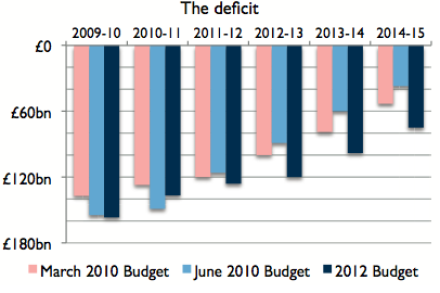
Will George Osborne’s refusal to look again at high levels of state spending become the greatest risk to Britain’s economic stability? There have been plenty of rude comments about the Chancellor’s supposed tactical ineptitude in the weekend press, but he has still managed to keep on borrowing and have almost no one notice. Osborne’s iron commitment is to spending, and a programme of cuts which total just under 1 per cent a year. His commitment to deficit reduction is flexible, as his three Budgets have demonstrated: Osborne spent the election campaign berating Labour for its lack of ambition in halving the deficit in four years. He’s now doing it in

Osborne needs to speed up

Will the Budget make a difference? Nowadays, we have a quick and easy guide: Box 3.1 from the Office for Budget Responsibility — otherwise known as the ‘blind bit of difference’ test. Sure, Budgets can make your hot takeaway lunch 20 per cent more expensive and your cigarettes cost £7.50 a packet, but the question, in a recession, is whether any stardust can be found between its pages. Whether it will be do anything for jobs, the deficit or economic growth. The Budget nowadays is handed to the OBR in advance of publication and assessed for its impact on the economy. The verdict: speeding up the corporation tax cut (another welcome move, and brave

Balls goes on the attack against 45p

Ed Balls committed Labour to voting against the reduction in the 50p rate at his post-Budget briefing. But he wouldn’t say whether or not Labour would pledge to restore it in their manifesto; sticking to the classic opposition line that all decisions on tax will be made in the manifesto and not before. Balls, though, was on typically pugilistic form; few politicians relish a scrap as much as he does. The Labour leadership clearly view the abolition of the 50p rate as a major political opening for them. Balls went out of his way to attack the HMRC report that Osborne used to justify the move. He mockingly declared that

Behind Osborne's 50p tax change

How significant was this Budget? On an economic level, not very. There’s no discernible impact on growth: all of the main forecasts have more or less stayed the same since the Autumn Statement. Borrowing is the tiniest bit lower, mainly thanks to a £23 billion accountancy trick with Royal Mail pensions. And even many of the policies announced today will barely rouse the Exchequer’s attention. That cut in the top rate of income tax to 45p? It will mean only £100 million a year less in direct revenues. That stamp duty increase for properties worth over £2 million? It will net only £300 million a year. The overall effect is

The Cost of Living Like This

Brother Jones and Fraser and Pete have already given you some of the useful charts from today’s budget. But the truth of this budget can be summarised quite simply: Everyone Pays More. Here’s the proof, culled from the Red Book: Conservative Home say this shoots Ed Miliband’s fox, proving that the rich will pay more as a consequence of this budget. Up to a point. In pure cash terms, the total impact of the budget may be greater on the wealthiest 10%; in proportional terms it seems to hit those on lower incomes rather harder. Again, however, note this: George Osborne appears to have delivered a tax-raising budget. If Britain

Let the Tax Competition Games Begin!

It is not right to say that this is the last United Kingdom budget. Far from it. Nevertheless, the times they be changing. Due to an unfortunate coincidence of parliamentary timing (though doubtless some will see a conspiracy in this) the Scotland Bill will be agreed today. It will, naturally, be lost amidst the budget brouhaha but it is a significant moment nevertheless. The SNP have made their peace with the coalition, recognising that the Calman Commission’s recommendations, imperfect though they may be, are another step towards a more independent future. Significantly, the Scotland Bill accepts the proposition that it is perfectly feasible, and perhaps even proper, for the different

More advance snippets from the Budget

The big Budget news tonight is that the personal allowance will rise to £9,205. This is a larger increase than expected and, intriguingly, will be paid for — in part — by a couple of billion more of spending cuts. So, the Lib Dems see considerable progress on their main budget priority, raising the income tax threshold to £10,000, but this will be partially funded by something Tory MPs have been calling for, more spending cuts. It also appears that the coalition will further increase the pace of its corporation tax cuts as well as introducing a new higher rate of stamp duty for £2 million plus houses. There’ll also

Has Osborne learnt the right lessons from Adam Smith?

According to Rachel Sylvester in The Times (£) today, George Osborne’s love of soaking the rich — from the non-dom levy to the tycoon tax – stems from the importance he puts on the ‘empathy’ described in Adam Smith’s Theory of Moral Sentiments. If so, he’d better start re-reading his Adam Smith. Certainly, the Chancellor is familiar with Smith’s other great book, The Wealth of Nations (1776). He wrote an introduction to a recent edition of it. That book is a passionate call for free trade and for open and competitive markets, and a stinging critique of the mutual back-scratching between businesspeople and politicians — what today we would call

The Trouble with George: Politics & Economics Do Not Always Mix

Today’s top Westminster read is James Kirkup’s article on the Treasury smart set. It builds a good foundation from which to argue that for all David Cameron and George Osbourne dislike being compared to Tony Blair and Gordon Brown, there remain good grounds for making that kind of comparison. And already we can see, as James says, some daylight between Numbers 10 and 11. Perhaps we should not make too much of this. Cameron and Osborne remain exceedingly close. Even if most Prime Ministers lose patience with thier Chancellors their relationship is not bound to end acrimoniously. Nevertheless, they begin from a position less propitious than that which faced Blair

Support for scrapping the 50p rate grows, but why?

Will Wednesday’s Budget herald the end of the 50p tax rate? It’s looking increasingly likely, with today’s Telegraph claiming that Osborne will replace it with a top rate of 45 per cent. Leaving the economic arguments aside, the consensus is that this will prove an unpopular move that could damage the Tories. Tim Montogmerie tweets that ‘if the post-Budget headlines are about 50p then Tories have a political problem’. The New Statesman’s George Eaton writes that it ‘would do more to retoxify the Tory brand than any other measure’. But how dangerous a move is it? Certainly, scrapping the 50p rate doesn’t poll well. Yesterday’s YouGov poll found 60 per

Downing St plans to boost construction

In the last few months, there’s been a distinct change in the attitude of the Tories at the heart of government. They are now far more cognisant of just how difficult it is to drive change through the government machine. It is no longer just Steve Hilton and Michael Gove complaining about this, but Osborne and Cameron too. The Chancellor’s particular frustration at the moment is over the pace of planning reform. Osborne and his brains trust believe that simplifying the planning rules is one of the things that they could do to both give the economy a short term stimulus, by encouraging more construction, and improve its long term

Osborne makes his appeal to Britain's grafters

‘A Budget for Working People’. That’s the headline theme of this year’s Budget, says our former editor Matt d’Ancona in the Sunday Telegraph today. And his words are borne out by George Osborne’s interview with the Sun on Sunday. ‘We’ve got to help people into work, particularly young people,’ says the Chancellor, ‘We have to make this a competitive place in the world to set up in business and employ people.’ The measures being broadcast around this morning include a trial suspension of Sunday trading regulations, timed for during the Olypmic Games. At once, this is both an unsurprising and genuinely risky venture from Osborne. Unsurprising, because the votes of

The man behind the Budget

In today’s Telegraph, I profile Rupert Harrison, chief economic adviser to George Osborne and the man who’ll do more than anything else (including his boss) to shape next week’s Budget. In the British political system, special advisers are given very little attention — even though the best of them are more influential than the average Cabinet member. The Treasury’s vast power, assembled by Brown, is still there. That can’t be said for Osborne: he spends half his time in Downing St, and is sufficiently detached from the Budget process that he felt able to take a couple of days’ holiday in America last week to jump in the motorcade and

Osborne's economic and political reasons for local pay rates

George Osborne has just fired the first shot in the fight over the 2012 Budget. His decision to introduce local pay for the 160,000 civil servants coming off the public sector pay freeze is, as is often the case with Chancellor Osborne, both an economic and a political move. The economic case for local pay is straightforward. National pay rates mean that public sector workers are relatively underpaid in prosperous areas of the country and relatively overpaid in deprived areas. Pay that reflected local conditions would make for a more balanced economy, helping the private sector in those parts of the country where the public sector is currently dominant. But

Go on, George — scrap the 50p rate

Will George Osborne scrap the 50p tax in next week’s Budget? Whispers to this effect have been getting louder, and now the Guardian is saying that it will come back down to 40p, and it makes a lot of sense. As I argued in my Telegraph column a fortnight ago, this is the perfect time to do it. Axing the tax paid by 1 per cent of the population will be unpopular with the remaining 99 per cent, so if Osborne is going to take a political hit he should do so now. Anecdotal evidence of its harmfullness has been getting stronger: multinational companies saying they can’t persuade people to

The Bond Bubble's getting bigger

George Osborne is planning to launch a 100-year bond, says the FT — a sure sign that the Bond Bubble is getting even bigger. These devices are usually used by American universities: the California Institute of Technology issued one at 4.7 per cent, MIT did one at 5.6 per cent, and a few American companies have tried at 6 per cent. The Mexcians sold a billion bucks’ worth of century bonds a while ago at 6.1 per cent, so it would only be a matter of time before HM Treasury — a world leader in, ahem, novel debt vehicles — was going to do the same. The US Treasury Borrowing

Will Osborne accept the Lib Dem offer?

Try telling George Osborne that ‘tax doesn’t have to be taxing’ — I’m sure he’d laugh at the sentiment. The story this morning is that he has a grand, gritty choice to make ahead of the Budget: to tax income or to tax wealth. The Lib Dems have apparently agreed to relent on the 50p rate, but only if they get a mansion tax on properties worth over £2 million in return. The thinking is that, in the current political environment, the government must always be seen to be hitting the well-off in some way. So, will Osborne accept the offer? He and other Tories will certainly be tempted to