Trade war

Bessent’s private message reveals a Milei gamble

The first lesson for Treasury Secretary Scott Bessent is that digital photography has totally changed politics, as wiser practitioners have long since realized. You might have got away with reading private communications in public 30 years ago, but you can no longer do so. The second lesson is that if you build an administration on the promise that you will always serve the American interest, certain foreign policy decisions become difficult. Bessent has been caught reading a message on his phone from Agriculture Secretary Brooke Rollins expressing her anger at the Trump administration’s deal to establish a $20 billion loan facility with Argentina, or "the Argentine" as Rollins prefers still to call it.

Bessent

Deals, deals, deals vs China, China, China

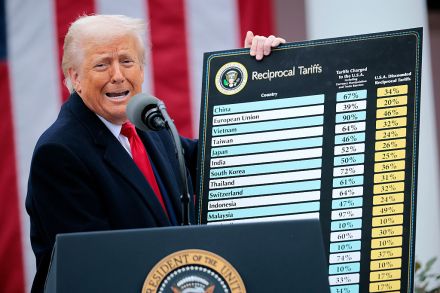
How was your Liberation Month? It’s been almost 30 days since Donald Trump stood in the Rose Garden of the White House and announced a shocking set of massive tariffs on the world. The event caused huge convulsions in the economic universe: trillions were wiped off the stock market and, under huge pressure, Trump did agree to a 90-day pause on reciprocal tariffs. After that he exempted electrical goods, though his standard 10 percent remains, and the heads of most financial analysts are still spinning trying to figure out what it all means. Yet for all the angst and the apoplexy, yesterday the S&P 500 index closed just 1 percent down from where it was at the beginning of the month.

How America can develop its own rare earth elements industry… safely

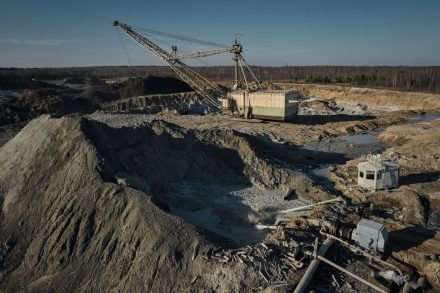
Give a country rare earth elements and it’ll have fighter jets, missiles and warships for a day. Force a country to extract and process its own rare earth elements and it’ll be safe from relying on countries run by unstable dictators forever.  Such is President Trump’s sensible line of thinking as he keeps up America's trade war with China. As China imposed export licensing restrictions on seven rare earth elements, or REEs, last week, Trump signed an Executive Order “launching an investigation into the national security risks posed by US reliance on imported processed critical minerals and their derivative products.” The administration is now pursuing a deal to procure REEs from Ukraine.

rare earth elements

China bans Boeing in targeted trade war shot

“If it ain’t Boeing, I ain’t going,” goes the old adage, championing the supposed superiority of the company’s planes on safety issues. If you are traveling in China in future that probably means that you won’t be going very far at all. The US aviation giant is emerging as one of the biggest losers of Donald Trump’s trade war. China has not merely applied punitive tariffs on the company’s planes; it has banned imports altogether. Even existing orders of planes appear to be affected by the ban. What’s more, the ban applies to Boeing itself rather than to general imports of US aircraft – it is personal. Boeing, already reeling from the crash of two 737 MAXs in Indonesia in 2018 and Egypt in 2019, lost $11.

Give Trump’s tariffs a shot

So the big question is: will it work? Will Trump’s protectionist policies, announced with some fanfare at a Rose Garden event at the White House yesterday, increase American prosperity? Or will they harm the economy?  Opinion on that matter is sharply divided. In one corner we have the free traders. They are wringing their hands and warning about higher prices, disruption of international trade and a trade war no one can win.  In the other corner are – what to call them? Most are not “anti-free traders” or “economic protectionists” (though some are).  Let’s call them “fair traders.” They like the idea of free trade – in theory. What they don’t like is the ethic of “free trade for thee but not for me.

Get ready for Trump’s ‘FAFO’ foreign policy

President Donald Trump posted an AI-picture of a gangster version of himself on Instagram at around 3 p.m. Sunday. Behind the fedora-clad figure, the text “FAFO” — short for “fuck around and find out” — appears alongside a smiling face.  What happened earlier that Sunday, and the machine-made picture that followed, tells us a lot about how Trump 2.0. will deal with the world.  After two planes carrying Colombian illegal aliens departed the United States this weekend, self-proclaimed humanist and former guerrilla fighter Gustavo Petro, Colombia’s president, refused to allow the plane to land. “I deny the entry of American planes carrying Colombian migrants into our territory,” Petro said on X.

There’s a long way to go before Trump can declare victory in his trade war

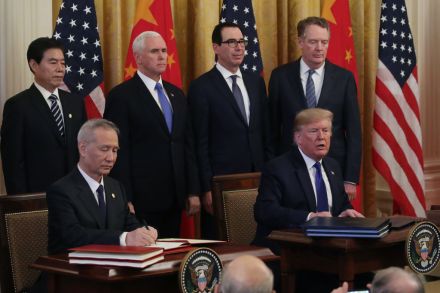
There is no shortage of quotes by Donald Trump that his opponents have tried to use against him — few of which have so far damaged him politically, still less embarrass the man himself. But there is one which really does have the potential to cause him harm in this year’s presidential election: his claim, in March 2018, that ‘trade wars are good, and easy to win’. That isn’t looking quite so clever now, two years later when the trade war that Trump started with China is still far from won. The deal signed today by Trump and Chinese vice premier Liu He brings a respite in hostilities, but there is a long way to go before the US can be claimed to have won, or even to have restored trade to what it was prior to 2018.

trade war

The Chinese trade deal is a Christmas gift to Xi

If Donald Trump wanted to deliver a seasonal gift to his ‘good friend’ Xi Jinping, the ‘Phase One’ trade deal reached this weekend fits the bill pretty well.  From the viewpoint of the Beijing leadership, it vindicates the Chinese refusal to budge during the long months of trade negotiations despite the threat of escalating duties. What has resulted is less the kind of overall trade agreement originally aimed at by the Trump administration and feared by China as interference in its economy —  and more of a purchase agreement accompanied by reduced tariffs.

xi

Trump’s Chinese tariffs are simply a scare tactic

Ever since Donald Trump began his trade war with China there have been two possibilities: firstly, that he intends tariffs to form a permanent feature of the landscape in relations between the US and China: a protectionist device designed to protect American jobs indefinitely; or secondly, that he sees his tariffs as a shock tactic devised to draw China into talks which it would otherwise be loathe to join, and with the ultimate aim of freeing up trade. The latest development, halving a set of tariffs which had been in place since September and canceling another set which had been due to come into place this week, points heavily to the latter.

chinese tariffs

Donald Trump’s one-front trade war

At 12:01 a.m. on Monday, President Donald Trump went a long way toward defusing a potential war – not with Iran, but Canada and Mexico, where Trump revoked tariffs he had imposed in the name of national security. Why the sudden bout of tariff reduction? The president is focusing on a one-front trade war with China. The restrictions began as two fronts of the same war. Trump imposed 25 percent tariffs on steel and 10 percent tariffs on aluminum imported from China last March. Then he extended those tariffs to the EU, Canada, and Mexico on June 1. But the president seems to have concluded that the US can no more fight a two-front war in trade than on the battlefield.

Donald Trump one-front trade war