Theatre

Brutal and brilliant portrait of Bette Davis and Joan Crawford

The Last Days of Liz Truss? is a one-woman show about the brief interregnum between Boris Johnson and Rishi Sunak. We first meet the future prime minister at a nursery school in Paisley where she orders the teachers to call her Elizabeth and not to use her first name, Mary. This establishes her combative, self-righteous nature and her utter dislike of authority. Truss is like the smell of gas indoors. Even a tiny amount is too much She left Oxford with a PPE degree and became a political activist while setting her sights firmly on parliament. (By researching the CVs of every sitting member, she had discovered that one in 30 of them held a degree in PPE from Oxford.) She was on her way.

Elton John’s The Devil Wears Prada is sumptuous but unmemorable

The Devil Wears Prada is a fairy tale about an aspiring female novelist, Andy, who receives a job offer from Runway, the nastiest and most influential fashion magazine in America. Miranda, the editor, is a Botoxed uber-bitch who doesn’t really want to hire Andy, but does anyway. And Andy doesn’t really want to work in fashion, but does anyway. Slightly odd. Visually, the show is a sumptuous treat that offers Olympic-standard costumes, set and lighting designs Andy is like Paul Pennyfeather in Decline and Fall, a bland but trustworthy cipher who bears witness to a fascinating world of excess and corruption. She’s barely a character, more a device. The best lines are delivered by others. Miranda (Vanessa Williams) specialises in toxic putdowns.

‘La Scala was maddening’: an interview with John Macfarlane, the finest set designer of his generation

Pantomime season is upon us, and unless your taste in colour runs no further than Smarties, there is no more magnificent spectacle on offer than Birmingham Royal Ballet’s production of The Nutcracker – performed so many hundred times since its première in 1990 that two years ago it disintegrated and required reconstruction. Its scenery and costumes are the work of John Macfarlane, a softly spoken Glaswegian who is ranked worldwide as one of the great stage designers of his generation. They demonstrate in abundance a quality that characterises all his work: a brooding chiaroscuro, in which nightmarishly surreal flickers of ruin and decay are shot through with gorgeous sensuality. There is no tinsel-pink prettiness. His Nutcracker has been inspired by the haunted imagination of E.T.

This Muslim playwright believes Yorkshire is headed for civil war

Expendable, at the Royal Court, is an urgent bulletin from the front line of the grooming gang scandal in the north of England. The setting is a kitchen in Yorkshire where Zara is trying to keep her family together after her son, Raheel, was outed as a rape suspect by a national newspaper. White thugs dump parcels of excrement on their porch and Zara cowers under the kitchen table, too scared to answer the door. The racists have mounted a mass demonstration, supported by the cops, which causes local bus services to be cancelled. Every Muslim in town is terrified of a white vigilante gang who recently targeted a blameless Yemeni pensioner and kicked him to death. It gets worse.

Wonderful comedy of manners: Kiln Theatre’s The Purists reviewed

A slice of the ghetto arrives at the Kiln Theatre in Kilburn. The Purists is set on the stoop of a crumbling block in Queens, New York, and the show declares its urban credentials as a boombox slams out a hip-hop rhythm and Mr Bugz, a DJ, enters, mike in hand. He urges the audience to commit arson and murder using a chant inspired by the theatre’s location. ‘Kill! Burn!’ he screams. ‘Kill! Burn!’ He invites the crowd to join in his riotous incantation. ‘Kill! Burn!’ they shout back with blood-curdling obedience. After this homicidal overture, the play settles down and turns into a surprisingly genteel comedy of manners. Mr Bugz makes friends with an Anglophile neighbour, Gerry Brinsler, who adores musical theatre and has a soft spot for her late Majesty.

Heart-warming but safe biographical drama: Going for Gold, at Park90, reviewed

Going for Gold is a biographical drama about a forgotten star of the 1970s. Frankie Lucas was a middleweight boxing champion, born on the Caribbean island of St Vincent, who won a gold medal at the Commonwealth Games in 1972. Although he lived in London he wasn’t picked for the England team and instead he wore the colours of his native land. He did them proud. Frankie Lucas seems to have spent 42 years sitting in a council flat, smoking weed and sulking The script, by Lisa Lintott, emphasises Lucas’s virtues and downplays his rackety personal life and his habit of smoking bales of cannabis on a regular basis.

A flop: The Curious Case of Benjamin Button, at Ambassadors Theatre, reviewed

The Curious Case of Benjamin Button carries a strap-line, ‘an unordinary musical’. Perhaps the word ‘extraordinary’ is simply too banal to capture the outstanding qualities of this unique show. The year is 1918 and a miraculous birth occurs in a remote Cornish fishing village. The newborn is not a baby but an adult pensioner, Benjamin, who emerges from the  womb wearing a three-piece suit, a pair of spectacles and a bowler hat. His shame-faced mother hastens away from the family home and takes a walk along the cliffs, which results in her death. Suicide, perhaps. And Benjamin’s angry father locks him in the attic and refuses to let him out. Benjamin escapes and visits the local pub where he enjoys a single pint of ale every Friday night for the next four years.

A riveting show crammed with the kind of risky gags rarely heard on stage these days

How To Survive Your Mother is a play based on a memoir by political dramatist Jonathan Maitland. He portrays himself in the show, and he muses on the wisdom of turning his manipulative, devious, sex-mad mother into a dramatic heroine. In the end, he’s swayed by ‘Edinburgh derangement syndrome’ as he calls it. ‘You’re diagnosed with terminal cancer and you think: “Great, there’s a show in this.”’ Maitland’s account of his rackety childhood is crammed with risky gags rarely heard on stage these days His mother, Bru, was a Jewish refugee from Haifa who posed as a Frenchwoman with Spanish roots to protect herself from the anti-Semitic bigotry. Her self-taught skills included seduction, bribery and fake suicide attempts.

Is Coogan’s Dr Strangelove as good as Sellers’s? Of course not

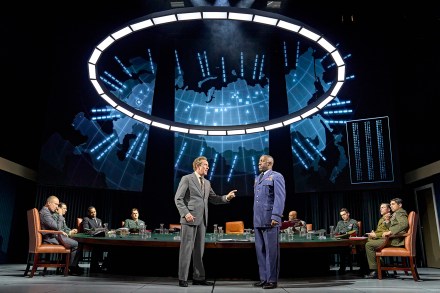
Stanley Kubrick’s surreal movie Dr Strangelove is a response to the fear of nuclear annihilation which obsessed every citizen in the western world from the end of the Cuban missile crisis in 1962 until the fall of the Berlin Wall in 1989. The play’s co-adaptors, Sean Foley and Armando Iannucci, are old enough to recall that fear – but they’ve omitted any sense of collective anxiety from their adaptation. It’s a just a larky tribute to the movie, like a sketch show. Daft not disturbing. It turns out Dr Strangelove is like Father Christmas – more potent as a mythical abstraction than as a reality The story starts with an insane American, General Ripper, ordering a squadron of B-52s to nuke Russia before the communists can overwhelm the United States.

How is Arnold Wesker’s Roots, which resembles an Archers episode, considered a classic?

The Almeida wants to examine the ‘Angry Young Man’ phenomenon of the 1950s but the term ‘man’ seems to create difficulties so the phrase ‘Angry and Young’ is being used instead. It’s strange to encounter a theatre that’s scared of words. The opening play, Roots, by Arnold Wesker, looks at the conflict between town and country in 1950s Norfolk. Beatie, in her early twenties, returns from London and announces to her warm-hearted but unsophisticated family that her boyfriend, Comrade Ronnie, wants to meet them. He’s a pastry chef who supports a Marxist revolution and Beatie is eager to fight for everything he believes in.

Familiar scenarios: Our Evenings, by Alan Hollinghurst, reviewed

There’s a certain pattern to an Alan Hollinghurst novel. A young gay man goes to Oxford. He’s middle class and riddled with suburban self-consciousness – a kind of complicated awareness of his non-posh failings and resulting subtle superiority. He meets another young man – possibly gay – who is posh. An intricate dance ensues of social slip-ups and huge townhouses in Notting Hill, bags of money and country piles. It’s a formula which can be transposed between Edwardian drawing rooms and 1980s parties with only the slightest changes. Sometimes our protagonist is the aristocrat himself; sometimes he even went to Cambridge. He’s always cultured – interested in poetry, theatre and Henry James. Hollinghurst’s fiction was, for a period, radical.

Are you Beatles or Stones?

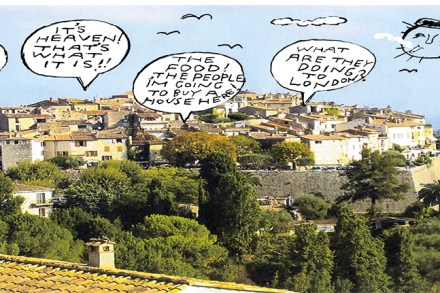
You find me in the south of France, holed up in that inn of near perfection called La Colombe d’Or in St Paul de Vence. I escape here twice a year and marvel at how little has changed since the 1950s, when it was Mecca for artists of all types, painters such as Chagall and Picasso (Matisse was an early fan between the wars) and stars of stage and screen, Brigitte Bardot, Yves Montand, Simone Signoret, all looking breathtakingly cool, smoking of course. One can still catch a glimpse of the fabulous Dame Joan C and her husband Percy sipping ice cold glasses of rosé. It is a place where the living is easy but civilised – not something one can say about London these days. Oh London, what have we done to you? ‘To be tired of London…’ Hmm, sorry Dr J, but that is no longer true.

Faultless visuals – shame about the play: the National’s Coriolanus reviewed

Weird play, Coriolanus. It’s like a playground fight that spills out into the street and has to be resolved by someone’s mum. The hero is a Roman general whose enemies conspire to banish him so he takes revenge by joining forces with a foreign power and laying siege to Rome. Coriolanus’s mother shows up on the battlefield and begs him to drop his vendetta and come back home. Later he dies but without delivering a big speech. The Roman soldiers have plastic swords that go ‘clack’ rather than metal ones that go ‘ching’ The key difficulty is that Coriolanus’s tragic flaw, a lack of ambition, is really a virtue. He’s far too noble for his own good and his disdain for power makes him annoying rather than admirable.

The show belongs to Jonathan Slinger and Ben Whishaw: Waiting for Godot reviewed

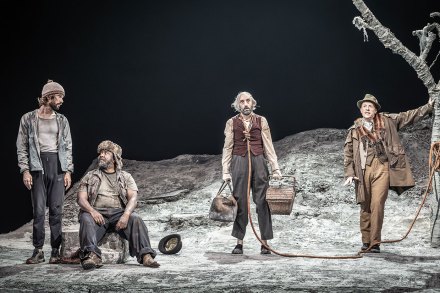
Waiting for Godot is a church service for suicidal unbelievers. Those who attend the rite on a regular basis find themselves wondering how boring it will be this time. A bit boring, of course, but there are laughs to be had in James Macdonald’s production. The set resembles a Gazan bombsite with a tree-stump stranded in a pit of ashen rubble. Didi is played as a goofy English toff by Ben Whishaw who supplied the voice of Paddington in the movies. The bear is back.

A massive, joyous, sensational hit: Why Am I So Single? reviewed

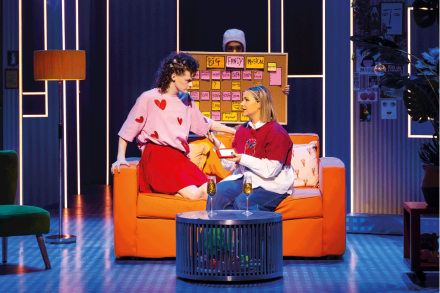
Why Am I So Single? opens with two actors on stage impersonating the play’s writers Toby Marlow and Lucy Moss. You may not recognise the names but you’ve probably heard of their smash-hit, Six, which re-imagined the tragic wives of Henry VIII as glamorous pop divas. This follow-up show is a spoof of vintage musicals and it’s deliberately knowing and self-referential. That’s why the authors are played by members of the cast, and they start with a few disparaging quips about Mamma Mia! and other West End fare. They even call the audience at the Garrick ‘riff-raff’, which seems a little charmless.

The rise of soapy, dead-safe drama: The Band Back Together reviewed

The Band Back Together is a newish play, written and directed by Barney Norris, which succeeds wildly on its own terms. It delivers a low-energy slice of feelgood nostalgia involving three musicians who reunite in their hometown of Salisbury. The action consists of talk and songs, more talk, more songs, some cider-drinking and a surprise ending to convince the audience that it was worth the wait. The play was commissioned by Farnham Maltings, an arts centre in Surrey, whose aim is to ‘bring artists, makers and communities together’ and it feels a bit am-dram. The script has no conflict, suspense or uncertainty. No harrowing emotions or life-changing experiences. It’s just a pipe-and-slippers get-together involving three has-beens who once shared a stage as musicians.

Letters: A cautionary lesson for England’s schools

Lessons to learn Sir: Your leading article ‘Requires improvement’ (7 September) rightly raised concerns that a curriculum review in England might reverse the excellent progress in schools following the Gove reforms. Fortunately, there are two very good examples of what happens when you replace rigour and the acquisition of knowledge with left-wing dogma and woolly thinking. The introduction of the Curriculum for Excellence in Scotland has led to a dramatic fall in standards in Scottish education and a resultant collapse in its Pisa [Programme for International Student Assessment] ranking. Last year Wales recorded its lowest-ever Pisa ranking.

What’s gone wrong at the National Theatre?

Now we have a Labour government, it would be nice to feel repertory will return to the National Theatre. It used to be possible to come to London for a week and see six plays. Audiences loved it. New writing spoke to old in ways which enriched both. Today, you’re more likely to see Ibsen, O’Neill, Molière and Marlowe in the West End. What happened to the library of world drama? The new practice is to offer only a couple of straight runs, sometimes first-rate. So there’s nothing to stop any random producer saying: ‘Hey, the Lyttelton seems to be empty this autumn, can I hire it to do one of my shows?’ Shaw and Granville Barker wanted to assert that theatre was art, not commerce. The model was European, not American.

Dazzling: Stoppard’s The Real Thing, at the Old Vic, reviewed

The Real Thing at the Old Vic is a puzzling beast. And well worth seeing. Director Max Webster sets the action in a vast sitting room painted electric blue with a white sofa in the centre. A lovely use of empty space. But the preview trailer on the theatre’s website shows the actors seated in a scruffy bomb site where they discuss similarities between Tom Stoppard’s 1982 play and the lyrics of Taylor Swift. Perhaps the Old Vic hopes to attract a younger audience, but this show will appeal most to Stoppard’s lifelong fans. The play marks a major shift in his development. The exuberant and frothy cleverness of his earlier work has acquired emotional weight and a tougher outer shell. There’s a lot of jealousy and anger smouldering beneath the surface.

The unstoppable rise of stage amplification

Recent acquisition of some insanely expensive hearing aids aimed at helping me out in cacophonous restaurants has set me thinking about the extent that modern life allows us to filter our intake of noise. This is big business. As sirens wail and Marvel blockbusters and rock concerts crash through legal decibel levels, controlling sound levels has become an increasingly sophisticated operation, abetted by everything from silicone pastilles and the volume-control knob to the wireless earbud.