Theatre

Aversion therapy

From our UK edition

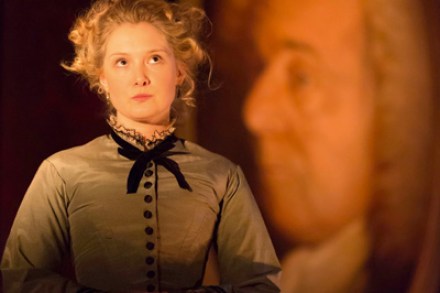
It’s been a while, I have to say, but last week I saw a show that thrilled me to the core. Trelawny of the Wells, the Donmar’s latest offering, is a tribute to the theatre written by actor-turned-writer Arthur Wing Pinero. A simple set-up. Gorgeous young luvvie, Rose Trelawny, has forsaken the greasepaint to marry a greaseball called Arthur Gower. He’s loaded. Rosie’s actor chums treat her to a farewell bash complete with antique gags, tuneless ditties, snatches from half-remembered dramas and long-winded orations consisting entirely of in-jokes. (You’ll have spotted that this is not the show that thrilled me to the core.

Transatlantic traffic

From our UK edition

There has been a lot of discussion recently, prompted by the start of President Obama’s second term, about the ‘Special Relationship’ between the United Kingdom and the United States. What seems to have been overlooked in the analysis of politics, economics and diplomatic relations is that the strongest and most culturally important link between the two countries is their shared passion for theatre. For all the razzle-dazzle of Broadway, the London of Elizabeth II remains, as it has since the rule of Elizabeth I, the world capital of the stage. Transferring from London to New York is a huge buzz for British actors, but it is a chance to sample the delights of Manhattan rather than a cultural pilgrimage.

Bloomberg will buy the Financial Times — but only if it jettisons The Economist

From our UK edition

How much would you stump up for the Economist? Most of us would draw the line at a fiver, but I’m told that Mike Bloomberg, mayor of New York, is drawing the line at £300 million. Bloomberg is busy relocating to London and he’s poised to snap up the Financial Times later this year. But the Pink ’Un comes with a 50 per cent share in the Economist. And the small print conceals a pesky restrictive covenant that prevents the owner from replacing the editor. This is proving a drag for Bloomberg, who admires the Economist’s boss, John Micklethwait, but who sees little sense in buying a ship if he can’t appoint the captain. Enter minority shareholder Lynn Forester, Lady de Rothschild.

Thornton Wilder’s theatrics in The Cabala

From our UK edition

I was on a date once in Atlanta, Georgia. We decided on the theatre and there was only one show playing, The Skin of Our Teeth by Thornton Wilder. After a night time drive under the arms of blue mossed oaks we made it to Emory University and took our seats and the curtain rose on a Victorian living room. Cautiously, with a canine playfulness, from out behind a sofa, tromped a dinosaur. I kept thinking of this moment as I read Wilder’s first novel, The Cabala.  Originally published in 1926 before he became a renowned playwright, Wilder attempted the same tricks here. He interjects Keats, Virgil, and even incarnate Mercury, into a contemporary 1920s narrative, in order to argue that the human condition has never improved, that culture is only a jacket that fits over a skeleton.

Shelf Life: Tamsin Greig

From our UK edition

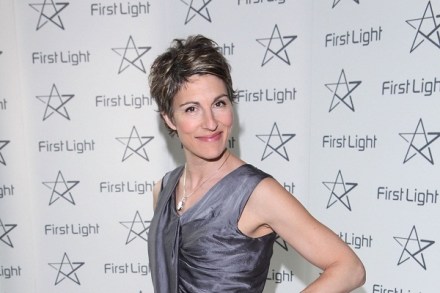
Tamsin Greig is so busy at the moment that Debbie Aldridge, the character she plays in The Archers, has to spend most of her time in Hungary. Star of TV shows like Black Books, Green Wing and Episodes, Tamsin Greig is also an accomplished stage actress and is about to reprise her role in Jumpy at The Duke of York in the West End. She tells us about her love for Seamus Heaney and Jackie Magazine. 1) What are you reading at the moment?      Under The Same Stars by Tim Lott and Collected Poems by Wendy Cope 2) As a child, what did you read under the covers? Jackie magazine 3) Has a book ever made you cry, and if so which one?  The Road by Cormac McCarthy 4) You are about to be put into solitary confinement for a year and allowed to take three books.

Shelf Life: Richard Bean

From our UK edition

This week's Shelf Lifer is Richard Bean. The British playwright recently won joint best new play at the Evening Standard Theatre Awards last year for both One Man, Two Guvnors at the National and The Heretic at The Royal Court. He tells us what he used to read to spite his father, which character in Brighton Rock he would sleep with and which play he would put on the GCSE syllabus. 1) What are you reading at the moment? Chavs by Owen Jones The King's War by Miss C. V. Wedgewood (Both social history books. Play research, I hardly ever have the time to read novels.) 2) As a child, what did you read under the covers? On the Road by Jack Kerouac; The Fan Man by William Kotzwinkle Junior - basically drug and hippy literature, surreptitiously  'cause my dad was a policeman.

Peter O’Toole’s new beginning

From our UK edition

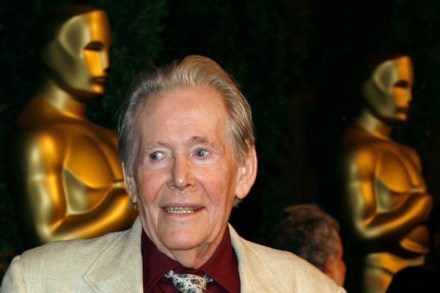
‘It is time for me to chuck in the sponge,’ said Peter O’Toole with characteristic singularity. The 79-year-old has announced his retirement from stage and screen, after a career that will span 56 years: with two films in post-production to be released next year. He goes, he said, ‘dry-eyed and profoundly grateful.’ He will devote his time to finishing a third volume of memoirs, which will record the ‘meat’ of his Hollywood career. The two previous volumes — Loitering with Intent: The Child and Loitering with Intent: The Apprentice — stand largely unread on my bookshelves. I dip into them from time-to-time; they’re that sort of book.

Gray’s anatomy

From our UK edition

Reading a new John Banville novel is like walking into a house you know but finding the dirty old armchair has moved. The shelf, still stacked with the same books, is now bathed in dusty light. The rug has shifted from right under your feet. Time and memory, ‘a fussy firm of interior decorators’, have rearranged the furniture. Whenever a Banville character peers into the recesses of their mind — and introspection is the norm — they experience a similar feeling of disorientation. We last met Alexander Cleave in Eclipse when the former thespian had retreated to wandering around his late mother's house in an attempt to gather his wits following a break down mid-performance.

Waiting for Growth

From our UK edition

With apologies to the Beckett Estate... Two tramps appear on stage. They are dressed in white tie and tails and wearing top hats. Their clothes are dirty and shabby; their hats gleam. The stage is bare, apart from a mound of earth and a tree. Which appears to be dead. ACT ONE: David: [gloomy] It's too much for one man. On the other hand what's the good of losing heart now, that's what I say. We should have thought of it a million years ago, in the nineties. George: What do you expect, you always wait till the last moment. David: [Ponders this] The last moment... Hope deferred maketh the something sick, who said that? George: It is an election, isn't it? David: [Despairingly] Why don't you help me? George: There's nothing to show. David: Suppose we repented?

Reasons to Like Nick Clegg

From our UK edition

As a person rather than as a politician, I mean. David has already mentioned Clegg's taste for Germanic* classical music and now there's another reason to approve of him. He's a Beckett fan. If he comes out for cricket and Wodehouse, his party can have my vote... Here he is on Sam: Every time I go back to Beckett he seems more subversive, not less; his works make me feel more uncomfortable than they did before. The unsettling idea, most explicit in Godot, that life is habit – that it is all just a series of motions devoid of meaning – never gets any easier.

Annals of Pointless security Theatre

From our UK edition

There's really no need to switch off your phones and iPods and iPads next time you are on a plane. Over to James Fallows: - 100% of the pilots making those landings and approaches have GPS receivers right there next to them in the cockpits, of the kind you would have to turn off if you had one in your lap in seat 38F; [...]- More and more pilots have iPads turned on through the entire flight, including United pilots who are being switched en masse from paper to iPad navigational charts. I now use an iPad extensively when flying, because the program I use, Foreflight, is so much more adaptable and informative than the paper charts it replaced. It would make things riskier, rather than safer, if I had to turn it off at arbitrary times.

Theatre to mark Western decline

From our UK edition

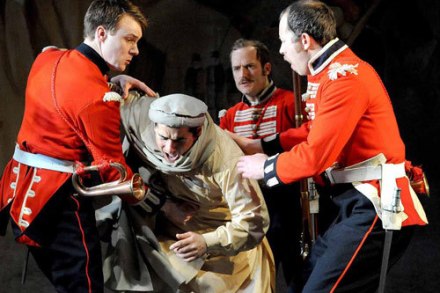
USO is not what it once was. The days of Bob Hope’s wisecracking have receded into the past, and ogled Playmates no longer sex their way across stages. The Pentagon has commissioned British theatrical talent to educate its troops about Afghanistan’s political culture and history. Performed by the Kilburn Tricycle Theatre, The Great Game is a 7 hour show about Afghanistan’s cycles of invasion, struggle and victory. Presumably if the grunts can withstand that, they can withstand anything. As Ben Macintyre notes in the Times (£), there is neither greatness nor beauty in the games that Western powers have played in Afghanistan.

A right song and dance

From our UK edition

The first Broadway musical that I saw, a quarter of a century ago, actually on Broadway, wasn’t, of course, actually on Broadway; it was on West 44th Street. The first Broadway musical that I saw, a quarter of a century ago, actually on Broadway, wasn’t, of course, actually on Broadway; it was on West 44th Street. It was 42nd Street. The geography is confusing, but so is the history, and indeed the nomenclature. For 42nd Street was not, of course, a Broadway musical, but a musical film made in 1933, based on a novel about life backstage at a Broadway theatre, with staged setpieces — notably the title song — in Hollywood’s version of the style of Broadway musical theatre.

Oh Caledonia!

From our UK edition

Paul Higgins as William Paterson in Alistair Beaton's Caledonia. To Edinburgh yesterday to see the flagship indigenous production at this year's Festival: Alistair Beaton's play about the Darien misadventure in the late 17th century. For a dramatist this should be much more fertile ground than were the mangrove swamps of Panama for the poor would-be colonists. It was a national adventure swallowing up, by some estimates, as much as half the national wealth which makes it all the more infuriating that Caledonia is both so glib and so very heavy-handed. Leaving the theatre my immediate sensation was one of a great opportunity badly, foolishly missed.

The Gospel at Colonus

From our UK edition

Taking Sophocles' least-known play and reinterpreting via the hymns and songs of gospel music is, damn it, just the sort of thing that you expect from Edinburgh* in August. Thankfully, Lee Breuer's plundering - adaptation is too limited a term - of Oedipus at Colonus is a monumental success. If you ever get the chance to see it in London, New York, DC, Chicago or wherever then for god's sake get yourself a ticket. Most of the reviews of the Gospel at Colonus have focused, understandably, on the music and, unavoidably, on the tensions between Christian and classical Greek theology and you can certainly argue that the production loses some of its force in Act Two as Oedipus prepares for and accepts his end.

Bush, Cheney, Blair, Brown: Four Characters in Search of a Tragedian?

From our UK edition

I enjoyed Ross Douthat's column this week in which he contemplates the inadequacies of Hollywood's response to the Iraq war. (Hey - at least Hollywood has responded: has the British film industry? There haven't been too many British stories told, as opposed to Britishers telling American stories. Which is a little different.) The narrative of the Iraq invasion, properly told, resembles a story out of Shakespeare. You had a nation reeling from a terrorist attack and hungry for a response that would be righteous, bold and comprehensive. You had an inexperienced president trying to tackle a problem that his predecessors (one of them his own father) had left to fester since the first gulf war.

Krapp’s Last Sale

From our UK edition

From John Banville's TNR review of The Letters of Samuel Beckett, 1929-40: In London, Beckett considered a number of possible day jobs, toying with the notion of becoming an airline pilot or--wait for it--an advertising copy writer. (There is food for a dinner-party game, devising the jingles that Beckett might have thought up for washing powder or diapers.) Quite so! Readers are therefore invited to suggest advertising copy that could have been written by Mr Beckett...

Death of a Gadfly Playwright

From our UK edition

Hugh Leonard has died. His Telegraph obituary reeks of boozy afternoons in Dublin's finest hostelries: Indeed, Leonard relished quarrels. "An Irish literary movement," he used to say, "is when two playwrights are on speaking terms"... Leonard resented what he saw as his exclusion from the Irish arts world, and poured vitriol on lesser performers. The trouble with Ireland, he said, was that it was "a country full of genius, but with absolutely no talent". His critics were equally forthright about the Leonard ego. He was, said one, not an original playwright, merely "an adapter always in search of a plug". Leonard retorted in kind. He eagerly debunked other famous names, including Brendan Behan, who, he said, owed all his success to Joan Littlewood's editing.

Lessons on Taking a Compliment

From our UK edition

Yeah, even by writers' standards, John O'Hara could be touchy. Here's Alan Jacobs: Anyway, when Pal Joey was a big hit on Broadway in 1940 a couple of friends ran into O’Hara at a restaurant and told him, “John, we just saw Pal Joey again and it was even better than the first time!” O’Hara replied, “What the hell was wrong with it the first time?” Splendid stuff, you'll agree.

Department of Calumny

From our UK edition

Patrick Appel, standing in for Andrew while the Boss Man takes a break, has the audacity to nominate Terry Teachout for one of Mr Sullivan's "Poseur Alert Nominee" awards. Yikes! What has the urbane Mr Teachout written to deserve such teasing? Why only this: "I know how it feels to see the design for the dust jacket of a book that I've written, but that's different: the cover is not the book. An opera, on the other hand, truly exists only in performance, and must be created anew each time it is produced: the score is not the show. As I saw how Hildegard had transformed my libretto into a three-dimensional object, a Biblical phrase popped into my mind: Thus the word was made as flesh.