The Kremlin

The chaotic truth about Russia’s internet blackouts

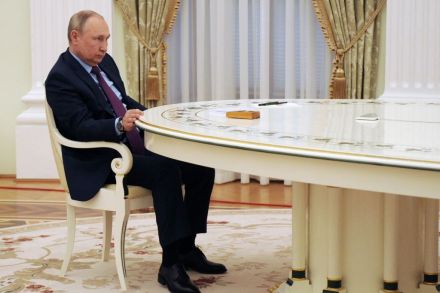
From the modern metropolises of Moscow and St. Petersburg to Arkhangelsk on the permafrosted northern coast and Khabarovsk on the Chinese border, for over a week now, Russian cities have been experiencing unprecedented interruptions to mobile internet coverage. Ostensibly for security reasons, the rumor mill has inevitably cranked out all kinds of alternative explanations, from fear of a coup to preparations for a comprehensive imposition of state control on the "runet," Russia's online world. Notions that Vladimir Putin fears some imminent coup can most quickly be laid to rest. There is dissatisfaction with the continuing war and its economic consequences, but nothing to suggest anything more serious.

russian

Putin’s éminence grise: The Wizard of the Kremlin, by Giuliano da Empoli, reviewed

From our UK edition

Occasionally a book is published, perhaps twice in a generation, which is so bad but internationally celebrated that one questions everything one has believed about literature. The Wizard of the Kremlin, written in French by the Italian political scientist Giuliano da Empoli, was awarded the French Academy’s Grand Prix de Roman in 2022. It narrowly missed the Prix Goncourt, France’s equivalent of the Booker, and has since been translated into 30 languages. If a novel this inept is so successful then we have truly entered Spenglerian end times. The book is not just poorly constructed, filled with two-dimensional characters, tin-eared dialogue and inauthentic settings. Its very premise is ridiculous.

Besieged Odesa is still caught in a conflict of identities

From our UK edition

How can you break the mental manacles of an empire that has occupied not only your physical world but also your education, publishing, media, high culture and popular entertainment? In his endearing memoir of Odesa, Undefeatable, Julian Evans quotes the Ukrainian author Viktoria Amelina, who describes growing up in post-Soviet Ukraine surrounded by all things Russian. She attended a Russian school, acted in children’s Russian theatre, listened to Russian rock and prayed in a Russian Orthodox church: ‘There was an entire system in place that aimed to make me believe that Moscow, not Kyiv, was the centre of my universe.’ When she was 15, Amelina felt flattered to be invited to Moscow for a Russian language contest. She was thrilled to be interviewed on state television.

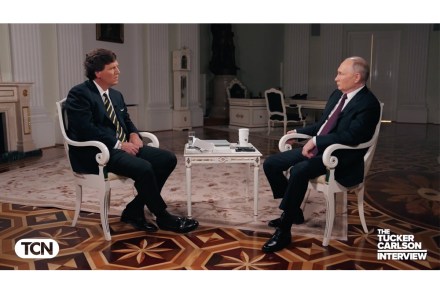
Vladimir Putin’s night at the Tucker Carlson circus

Tucker Carlson is a master contortionist. As conservative strategist David Reaboi reminded us this week, one of the most egregious examples of Carlson’s tendency for reality deformation came in the form of an interview with Kanye West, the troubled rapper who sat for an interview on Carlson’s erstwhile Fox News show a couple of years ago. It was the middle of West’s antisemitic meltdown, but because West was embracing Donald Trump, Carlson presented him as a sensible, even brilliant thinker. “Is West crazy?” Carlson asked at the top of the interview, before concluding at the end: “Not crazy. Worth listening to, even if you disagree with him.

tucker carlson

The valiant Vladimir Kara-Murza

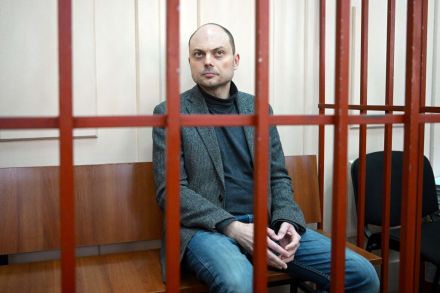
Vladimir Kara-Murza dies hard. He has withstood not one but two poisoning attempts by Vladimir Putin's government. He has withstood the targeting of Russia's officials. And he has borne the ramifications of the West's turn away from confrontation with a regime he understands for its villainy. Now, Kara-Murza is facing what could be a final challenge — a trial against him based on the 2022 laws against "misinformation" about the Russian military in the Ukraine war, by an authoritarian regime bent on silencing all its critics and sending them into the dark quiet of a cell where they will end their days. Kara-Murza is forty-one, the father of three, a former advisor to assassinated Putin critic Boris Nemtsov and a longtime advocate against the regime.

vladimir kara-murza

How will the battlefield stalemate end in Ukraine?

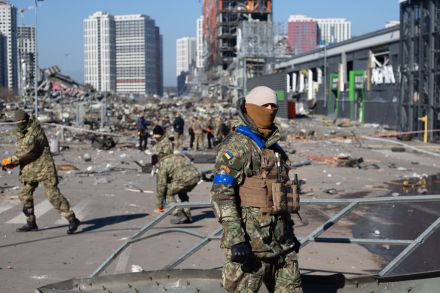
The simplest description of the war in Ukraine is this: stalemate, accompanied by constant, deadly bombardment. For the Ukrainians, that bombardment is aimed at the Russian military. For the Russians, it is aimed mostly at civilian targets, a deliberate strategy that is also a war crime. Russian artillery shells, cluster bombs and cruise missiles are killing tens of thousands of Ukrainian civilians and destroying their homes, schools and businesses. Meanwhile, Ukraine’s counterattack is imposing huge, irreplaceable losses on Russia’s army, killing soldiers, destroying their equipment and liquidating incompetent military leaders who come to the front to untangle the mess. Russia’s initial war plan failed, abysmally.

stalemate

Yes, Putin could use biochemical weapons in Ukraine

The Russian Defense Ministry held a briefing last week claiming that they have discovered US-led biological laboratories in Ukraine. Moscow stated that a rapid halt was brought to the facilities’ activities, adding that Kyiv and Washington had violated the Convention on the Prohibition of Biological and Toxin Weapons. The Kremlin did not feel the need to provide evidence of its claims, par for the course in Putin’s Russia.

biochemical weapons