Tesla

The stock market isn’t the success story Trump thinks it is

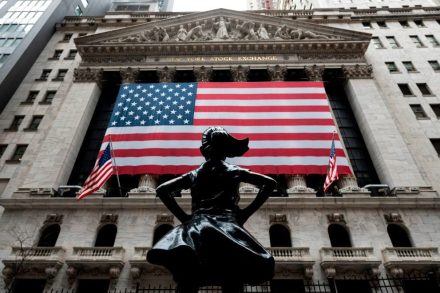
COVID-19 is still raging, with little sign of coming under control. The economy is already a tenth smaller than it was at the start of the year. Joblessness is soaring. And the budget deficit? Don’t even ask. But, hey, perhaps we shouldn’t worry about any of that. As the President of the United States keeps pointing out, the stock market is doing great, and, in his opinion, anyway, that means America, to borrow the kind of slogan that fits neatly onto a baseball cap, is great again as well. There is a problem, however, with Trump’s breezy 21-character analysis. It is not really true. The main equity indices reflect many different things, and the health of the economy is not always one of them. https://twitter.

stock market

Cars weren’t invented for transportation, but conversation

From our UK edition

When I first heard Abba’s magnificent 1982 swansong ‘The Day Before You Came’, I’d never come across the Americanised use of the verb ‘make’, meaning ‘reach’. So the line ‘I must have made my desk around a quarter after nine’ baffled me. Given the Swedish obsession with self-assembly furniture, I even wondered whether Björn was using the word conventionally, and Ms Fältskog was in fact kneeling on the floor aligning Tab A with Groove C, while looking for the elusive Allen key with which to attach the castors.

Is there anywhere visitors will be welcome this summer?

From our UK edition

Do stock markets foretell the future while politicians fudge and economists mumble? No: share prices collectively have a life of their own — driven by herd mentality, weight of money and the available range of investment choices — which indicates little more than the simple fact that what goes up must one day come down and vice versa. Both the FTSE100 and America’s S&P500 indices lost a third of their value between late February when the pandemic began to look serious and a month later when the rate of virus transmission was at its height. So far, so logical. But since then, both have sustained rallies that defy all public and corporate pessimism. Now, just as shops and factories are reopening, both markets look ‘overbought’ and wobbly again.

It’s mavericks like Elon Musk who’ll get us through this crisis

From our UK edition

This month’s most significant corporate deal attracted less attention than it might have done in normal times, crowded out by grim news elsewhere. It is the proposed £31 billion merger of O2 and Virgin Media to create a telecoms giant with 46 million customers. Following BT’s 2016 acquisition of the mobile operator EE, further ‘convergence’ in the sector had been expected, but the mid-lockdown timing was spun as a vote of confidence in the UK, described as ‘one of the most attractive markets on Earth’ by José María Alvarez--Pallete, chief executive of Telefónica of Spain, which owns O2. Investment of £10 billion in the new group’s mobile, broadband and television platforms is promised over the next five years.

Portrait of the week: Europe’s lockdowns ease, England stays alert and Broadway stays shut

From our UK edition

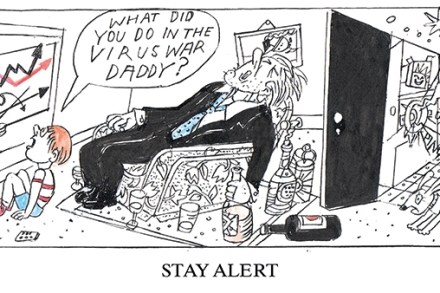
Home The government changed its slogan from ‘Stay home, protect the NHS, save lives’ to ‘Stay alert, control the virus, save lives’. Authorities in Scotland, Wales and Northern Ireland refused to adopt it. The day after a 13-minute televised speech to the nation by Boris Johnson, the Prime Minister, the government published a 50-page Recovery Strategy. A 14-day quarantine would bind anyone entering the country (with exceptions, such as people from France). Everyone should continue to work from home if possible, but workplaces ‘should be open’, apart from those required to be closed.

The dream of driverless cars is dying

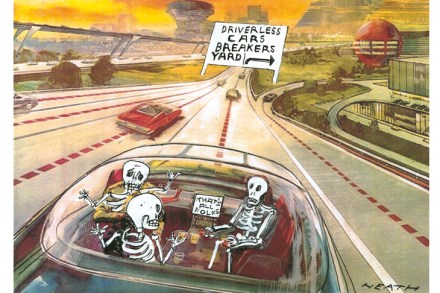
I was worried that going to the autonomous vehicle exhibition in Stuttgart would be tantamount to an atheist walking into St Peter’s while the Pope was conducting a mass. There is something religious about the fervour with which adherents to the driverless credo practise their faith and promise us a new kingdom. Their proselytising has indeed convinced many. Politicians are making outlandish statements, such as Jesse Norman’s two weeks ago, that ‘Our entire use of roads is to be revolutionised by autonomous vehicles’, and pouring large sums — a promised £180 million so far — into bizarre research projects such as the development of strange robot cars slower than a Reliant Robin and allowed only on pavements in Milton Keynes.