Technology

America needs talent

Before Donald Trump’s inauguration, Elon Musk caused a huge controversy within the MAGA movement by advocating increased high-skill immigration. As head of the Department of Government Efficiency he wanted, for example, to expand the H-1B visa program, which many Trump supporters are against. The angry debate over the visa issue still rages on social media and both sides tend to talk past each other. The MAGA movement is against any increase in immigration, whether high- or low-skill. Musk has acknowledged that the existing H-1B program was subject to abuse by employers and especially by IT firms that rely on outsourcing: the workers they import are often no better than the Americans they replace.

statue of liberty new york

An insightful account of America’s decline

I wouldn’t have thought a book about America’s decline would cause me to laugh out loud, but having enjoyed its author Matt Purple’s work for years now (full disclosure: he’s a personal friend and former Spectator colleague), I should not have been the least bit surprised that his debut book is as funny as it is insightful. Decline from the Top: Snapshots from America’s Crisis and Glimmers of Hope is a veritable joy to read. Though he declares himself to be a “cranky conservative,” Purple’s humor and wit offer a diagnostic examination of the American condition that exudes warmth and obvious heartfelt concern for our nation’s wellbeing.

Purple
whistleblower

Whither the whistleblower: leakers and leak-hunters get a boost from tech

When Americans think about the word “whistleblower,” their minds may go to the 1970s, when Bob Woodward and Carl Bernstein began communicating with the informant who came to be known as Deep Throat, after the pornographic film of the same name (their source, a disgruntled FBI official called Mark Felt, outed himself decades later). But the history of whistleblowing in the United States predates Watergate by centuries. “Whistleblowing in this country is not new,” says Jackie Garrick, executive director at the whistleblower-support group Whistleblowers of America.

Should you buy a folding phone?

Just five short years ago, Samsung released the first mainstream folding phone with their debut Galaxy Fold. It had some quirks — a small, slim, external display, thick bezels, an odd asymmetrical notch and an unprecedented $1,980 price tag — but what mattered most was the screen. Open the slim, TV-remote-shaped phone and you gazed upon a great, wide, 7.3-inch screen, bigger than any you could carry in your pocket before, with a folding crease in the middle. You could multitask, watch full-screen YouTube videos and browse the web as you would on a tablet. That is, you could do so temporarily. Early review units catastrophically broke at even the mention of a grain of sand, creating a run of viral tweets and videos.

folding phone

Inside the May issue: technology

Western governments seem ill-prepared to grapple with rapidly advancing technology. Watch any congressional hearing where a crusty congressman tries to keep pace with Silicon Valley’s top “autists” if you need further evidence — and read Spencer A. Klavan’s analysis of the high-skill but low-status rejects uniting into a formidable social class. The Silent Generation and boomers simply cannot keep up. The Space Race is back on — and tycoons are eager to cash in on the final frontier. Shane Cashman dives into the new wild west of explorers and entrepreneurs commercializing the great unknown. Lionel Shriver brings us back to earth with a look at the electrical grid and our government’s push for green energy and electric vehicles.

technology

Is the West ready to face the challenges of advancing technology?

The theme of this month’s edition is technology. The advancement of space exploration, defense technologies, artificial intelligence and the like should excite us. Yet the geopolitical issues they present are great and Western governments seem ill-prepared to grapple with them. Watch any congressional hearing where a crusty congressman tries to keep pace with Silicon Valley’s top autists if you need further evidence — and read Spencer A. Klavan’s analysis of the high-skill but low-status rejects uniting into a formidable social class on p.12. The Silent Generation and boomers simply cannot keep up. The Space Race is back on, as tycoons seek to cash in on the final frontier.

space technology

The digital habit

In an era that claims to value the authentic, the direct and the natural, the word "processed" has negative connotations, as in “processed” food. Nevertheless, it describes exactly how perhaps nine-tenths of the human race — including, I imagine, the lost Indian tribes of the Amazonian wilderness — experience reality these days, which is to say processed through electronic media, social media and the oxymoronic smartphone.

digital

The tech I’m looking forward to in 2024

The Consumer Electronics Show in Las Vegas, the first and biggest tech convention of the year, took place earlier this month, where the strangest, newest products were shown off. As usual, there was a lot of fluff — pointless gizmos that work on a show floor but never make it to stores — but there were also core signs of the technology trends we’re going to see this year, and products I’m excited to try. Screens are always a strong point at CES, and this year proved no different, from pure quantum dot prototypes, translucent televisions and yet another laptop with a glasses-free 3D display; but it’s the arrival of great OLED screens to mainstream laptops that truly excites me.

tech

Bowling Alone reads like a nostalgic look at the good ol’ days

In the Phetasy.com book club, we recently read the famous social science tome, Bowling Alone, by Robert Putnam. In it he examines the decline of social capital across various facets of American life. Based on his 1995 essay of the same title, the book was groundbreaking when it appeared in 2000. Putnam had noticed a trend: Americans were spending more and more time alone. His book analyzed the data and contemplated what it meant for our democracy and humanity. Although his observations were a harbinger of the oft-cited “epidemic of loneliness” we are currently living through, in our post-Trump, post-pandemic pre-maggedon reality, Bowling Alone reads like a nostalgic look at the good ol’ days. Days when people still interacted at all.

bowling alone
cancel

The other cancel culture

London, England We discuss and denounce the cancel culture of the woke all the time, but there’s another type of cancel culture that we never mention — the cancel culture of our friends. We cancel each other all the time. You arrange to meet someone and suddenly — you’re canceled! It happened again to me last week. I’d arranged to see a good friend when, a few hours before our meeting, up popped a text that read: “Sorry. Have to cancel x.” She offered no explanation. No signs of regret or guilt. Not even the suggestion that we reschedule our meeting. She wanted to cancel and so, I was canceled. In some ways this is nothing new.

The gap between technotopia and dystopia are never far apart

Broken Arrow isn’t just the title of a mediocre 1996 film, but the term for a serious accident involving a nuclear weapon. Over the last seventy years, the United States has officially experienced thirty-two Broken Arrows, where a nuclear weapon has been in a crash or fire, accidentally been dropped — or just disappeared. Incredibly, six have been lost and never recovered. Artificial intelligence (AI) pioneer Mustafa Suleyman tells one such story in his new book, The Coming Wave: Technology, Power and the 21st Century’s Greatest Dilemma. In 1961, a B-52 bomber carrying two live hydrogen bombs broke up in the skies above Goldsboro, North Carolina. One bomb disintegrated when it plunged into a muddy field.

Suleyman

My month using a tablet instead of a smartphone

Several years ago — long before Elon renamed it X, restricted most features behind a paywall and made it altogether less pleasant to use — I uninstalled Twitter from my phone. Then, on my laptop, I set the Minimal Twitter extension to hide all interaction counts. I still have no idea how many followers I have.  I wasn’t hopelessly addicted to the site, nor was it enraging me on a frequent basis. Put simply, though a Twitter-using liberal, I was not a “triggered lib.” But whenever I wasn’t doing something else, or waiting in line, or walking to make some coffee, I flicked through it. When I should have let the silence breath, I pulled out my phone and refreshed my feed.

tablet smartphone

The advent of AI-piloted planes

The US Air Force conducted the first flight test of the XQ-58A Valkyrie drone, from Kratos Defense and Security Solutions, piloted by artificial intelligence, on July 25. The test was part of a years-long effort headed up by the Air Force Research Lab designed to integrate advanced technology into the Air Force’s arsenal. The lessons learned and data gathered from the test will be applied to the Collaborative Combat Aircraft program, which seeks to procure an unmanned combat drone capable of working — collaborating — with manned systems, like a traditional fighter jet.  Bringing AI into the fold offers numerous benefits to the modern warfighter.

The Kratos XQ-58 Valkyrie ai drones

The new corporatism that’s killing capitalism

Over the years since the financial crisis, economic power and wealth has become ever more concentrated in fewer hands. This is something leaders have acknowledged, and policymakers have tried to do something about. And yet, despite brave talk of breaking up mega-giant companies, anti-trust efforts have been anemic, as most recently demonstrated by the failure to stop Microsoft from swallowing game maker Activision. The future looked a little brighter in the immediate aftermath of the pandemic. There were signs of a grassroots resurgence, with a strong uptick in new business formations in the United States. But since then, as interest rates have risen and regulatory pressures have increased, there has been a slackening off of new firms.

the new corporatism

Nothing makes technology transparent again

Consumer technology is, usually, profoundly dull. I love technology, but even I must concede the undeniable. A new pair of light gray, plastic cupped, noise-canceling headphones are functional, and often great, but they hardly get the blood rushing. Yet another gray Windows notebook has released! I struggle to stifle a yawn. And then — worst of all — are the phones. In the sixteen years since the first iPhone debuted, smartphones have become ubiquitous; the market is so large and flooded that innovation is no longer worth the risk. Phones are not cool new devices, but tools. You don’t care how a hammer looks; you care about the price and if it can hit a nail. The latest iPhone is a tool for accessing the internet and taking selfies. Most Android phones are the same but cheaper.

Photo courtesy of Nothing

What museums can learn from contemporary technology

"I grew up wanting to be an astronaut,” Robert Stein, the National Gallery of Art’s recently appointed chief information officer, tells me. “I studied electrical engineering, and I got a job doing high-performance computing. And then one day, I did a project with an art museum, and I thought, ‘Wait a second, this is an area of the world that needs more technology in order to connect more people together.’ And the rest was kind of downhill from there.” The National Gallery of Art in Washington, DC — the NGA — is now ranked the most popular art museum in America.

museums

Biden will never let Silicon Valley fail

After a bank run on Silicon Valley Bank left the institution in ruins, the Federal Reserve announced it would make whole the bank’s customers, including those with uninsured deposits in excess of $250,000, which should have made them ineligible for the Deposit Insurance Fund. President Biden promised the American people that this was not a bailout because no losses would be borne by taxpayers — a claim the Wall Street Journal assessed as a “whopper.” But the debate we should be having is not over the definition of the authorities' actions, but how to judge them morally — especially given how the Fed has been trying to tame inflation for the past two years.

The unfortunate ubiquity of smartphones

Arlington, Virginia Wandering through suburban Washington, DC's National Airport — I always liked the libertarianish ex-congressman from South Carolina Mark Sanford for voting against renaming it Ronald Reagan Airport on the grounds that the nomenclatorial decision belonged to locals, not Congress — I was refused service when trying to buy a bagel. It wasn’t because of my race, gender or vaccination status; rather, the eatery in question, which had no cash registers, accepted orders only from smartphones. As I have never owned a cell phone of any kind, let alone a smartphone, I was outta luck. I couldn’t plead food insecurity, to borrow the silly euphemism of our day, for soon enough I would be dining on the nine almonds that constitute an airline repast.

smartphones

M3GAN is a biting satire of screen-obsessed parenting

There’s a bit of moviegoing conventional wisdom that says January is the dumping ground for Z-list schlock films, all the genre fare not good enough for the holiday or summer seasons. And that’s why M3GAN — directed by Gerard Johnstone, and boasting story and production credits from legendary horror/thriller director James Wan — is such a pleasant surprise. It’s a nasty little cinematic bonbon packed with memorable images, and one that manages to say a few interesting things about modern life. After eight-year-old Cady (Violet McGraw) witnesses her parents’ deaths in a horrific auto accident, she’s sent off to live with her single aunt Gemma (Allison Williams).

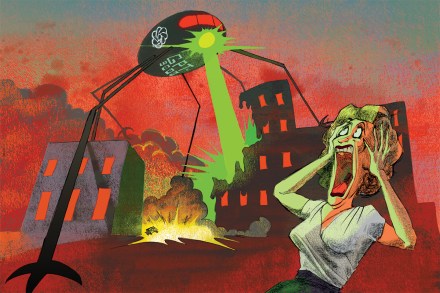
Why we should stop worrying and learn to love AI

Whether on British television news panels or late-night TV in America, it is hard to get away from talk about artificial intelligence (AI). Even the president of the United States has weighed in on AI, introducing an "AI Bill of Rights." The popular thing is to amplify the current media narrative — that AI will render millions jobless. It will eventually become more powerful than humans and destroy its creators. Just Google “AI doomsday” and then run and hide under the covers. I will be the first to admit that all technology has a dark side. Email came with spam and scammers; mobile phones came with robocalls and endless tracking by companies like Facebook. Artificial intelligence, too, will be used for nefarious purposes.