Racism

Diary – 19 April 2018

From our UK edition

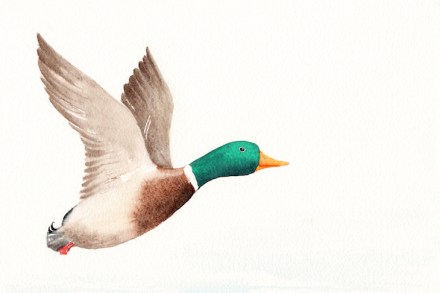
Our ducks are back. Two wild mallard have spent the last five springs on the brook which gurgles past us in Herefordshire. Each year they produce a paddling of chicks; each year most of the ducklings are killed by predators. Our friend Becky thinks she spotted an otter, more likely stoat or mink, in the brook. The fluffy ducklings have little chance of survival. We wish the mother duck would nest somewhere safer but there is no telling her or her green-headed drake. If I have felt kinship with the ducks lately it was because I was being pursued by sharp-fanged ferrets from the anti-meritocratic, politically unrepresentative, over-indulged arts establishment. In a Daily Mail theatre review I questioned diversity targets and colour-blind/gender-blind casting.

Quentin Letts isn’t racist – our theatrical culture, which hands out jobs on the basis of racial profiling, is

From our UK edition

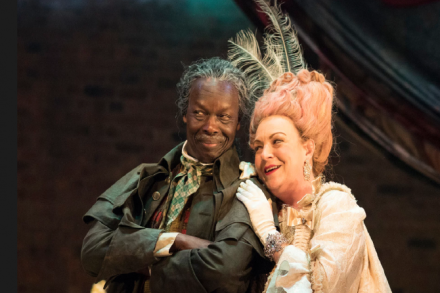
Oh my goodness. Quentin Letts is ‘a racist’ apparently . It says so on Twitter. In his review of the RSC’s The Fantastic Follies of Mrs Rich he referred to the quality of Leo Wringer’s performance and asked, ‘Was Mr Wringer cast because he is black?’ The RSC’s top brass assembled in full muster and denounced Letts for his ‘blatantly racist attitude to a member of the cast.’ I haven’t seen the production, only the reaction to Letts’s reaction to the production, but that’s enough. What’s striking is that the RSC’s accusation is false. Letts did not say the actor was bad because he was black. That would have been racist. Instead he asked if the actor was cast because he was black. Which is different.

Can you prove you’re not a racist?

After an essay in this month’s Prospect about literature and freedom of speech, it seems I was cited on Twitter as a ‘racist provocateur’. Now, I rather fancy being a ‘provocateur’. But as for the adjective. Someone can call you ‘stupid’, and that’s just one person’s opinion. It doesn’t seem true because a single childish naysayer has impugned your intellectual prowess. Yet hitherto, the tag ‘racist’ has tended to stick. And it’s self-verifying. Why ever would anyone call you a racist if you weren’t one? In our current climate of sensitivity about race (and everything else), finger-pointers wield enormous power.

Can you prove you’re not a racist?

After an essay in this month’s Prospect about literature and freedom of speech, it seems I was cited on Twitter as a ‘racist provocateur’. Now, I rather fancy being a ‘provocateur’. But as for the adjective… Someone can call you ‘stupid’, and that’s just one person’s opinion. It doesn’t seem true because a single childish naysayer has impugned your intellectual prowess. Yet hitherto, the tag ‘racist’ has tended to stick. And it’s self-verifying. Why ever would anyone call you a racist if you weren’t one? In our current climate of sensitivity about race (and everything else), finger-pointers wield enormous power.

Are racist chants now acceptable on the British left?

From our UK edition

On Friday the Guardian columnist and Corbyn-supporter Owen Jones sent out this Tweet to his followers: https://twitter.com/OwenJones84/status/939123128374046720 As a video of the resulting demonstration shows, the crowd outside the embassy loudly chanted (among other things) ‘Khaybar Khaybar, ya yahud, Jaish Muhammad, sa yahud’. This is a famous Islamic battle-cry which might be translated, ‘Jews, remember Khaybar, the army of Muhammad is returning.’ https://twitter.com/hurryupharry/status/939253702497628161 The battle of Khaybar relates to a 7th century attack on a Jewish community by the armies of Mohammed. Now two obvious questions arise. Why might this battle cry have been used on Friday night outside the American embassy in London?

Talking heads | 16 November 2017

From our UK edition

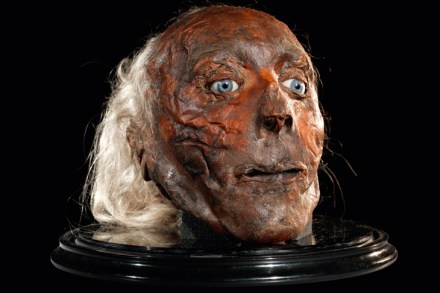
Under the central dome of UCL — an indoor crossroads where hordes of students come and go on their way to lectures and lunch — there’s an intriguing exhibition on at the moment about death. ‘Human remains are displayed in this exhibition’, it says in white lettering on the floor atall four entrances, to warn any passing snowflakes. The real head of Jeremy Bentham, who died in 1832, glass eyes staring out at you from behind a vitrine, is indeed a bit queasy-making. This is the central object of the exhibition. Bentham still has his long dark-grey hair at the back and sides of his bald pate, and his whole head is leather-brown from the tanning treatment after his death. He looks as if he’s grinning or grimacing.

To hell and back

From our UK edition

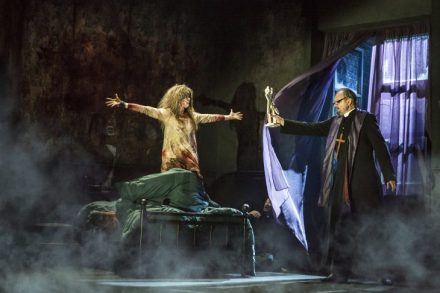
The Exorcist opened in 1973 accompanied by much hoo-ha in the press. Scenes of panic, nausea and fainting were recorded at every performance. Movie-goers showed up to witness mass hysteria rather than to enjoy a scary movie. This revival, produced by Bill Kenwright, targets the early 1970s demographic. At press night, the stalls were thronged with pensioners eager to relive a lurid evening from their adolescence. As one who dislikes shocks of any kind, I sat through this ordeal with my eyes bent towards the floor and my fingers wedged so firmly in my ears that their tips turned crimson. The show opened with a CRUMP loud enough to shake the theatre to its foundations. Everybody screamed. Then they all giggled. This pattern of shrieking followed by feathery tittering continued throughout.

High life | 2 November 2017

From our UK edition

I have a message for the London mayor, Sadiq Khan: you and your policies stink! While the fuzz are busy scanning the internet for racist or sexist material, crime in the capital is up by six per cent over the past 12 months and the police — handicapped by PC orders from above — have made 20 per cent fewer arrests. Statistics show youth violence and murder soaring in London, with the latter up by 84 per cent on last year. But here’s a story that’s not a statistic. Last week, my little girl Lolly was viciously attacked and robbed near the World’s End pub on the King’s Road after going to dinner with her cousin. She had spotted a hoodie (does Cameron still wish us to hug them?) on her way to dinner, a man of North African or Middle Eastern appearance.

Racism is a grey area

From our UK edition

This book is an exercise in crying wolf that utterly fails to prove its main thesis: that Europe is abandoning its core liberal values under threat from a resurgent populist right. It is a largely fact-free polemic that passes itself off as an open-minded work of interview reportage. Yet if you can ignore the author’s sly interventions on behalf of his left-liberal premises, he does introduce the reader to a fascinating cast of characters, mainly from the European populist right.

Perishable goods

From our UK edition

  Labour of Love is the new play by James Graham, the poet laureate of politics. We’re in a derelict colliery town in the East Midlands where the new MP is a malleable Blairite greaser, David Lyons. He arrives to find the office in crisis. The constituency agent, Jean, has handed in her notice but David is smitten by her acerbic tongue and her brisk management style so he asks her to stay. She agrees, reluctantly, and they settle into a bickering rivalry underpinned by affection. But is there more? Possibly, yes, but both are held back by their natural reticence and by fate. Secret declarations of love go astray. One letter is sent to the wrong person and another, written in code, makes sense only when read backwards. These contrivances aren’t entirely satisfying.

His dark materials | 12 October 2017

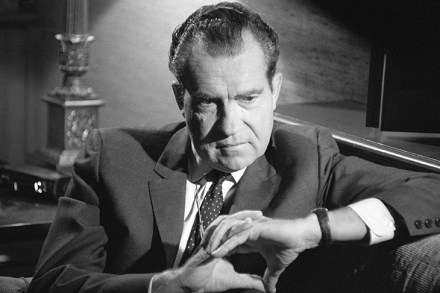
In this giant, prodigiously sourced and insightful biography, John A. Farrell shows how Richard Milhous Nixon was the nightmare of the age for many Americans, even as he won years of near-adulation from many others. One can only think of Donald Trump. Nixon appealed to lower- and  lower-middle-class whites from the heartland, whose hatred of the press and the east-coast elite, and feelings of having been short-changed and despised by snobs, held steady until their hero and champion unmistakably broke the law and had to resign his second-term presidency. Nixon won a smashing re-election in 1972, even as it was apparent that the White House was awash with skulduggery.

Woman of a thousand voices

From our UK edition

‘On air, I could be the most glamorous, gorgeous, tall, black-haired female… Whatever I wanted to be, I could be… That was the thrilling part to me,’ said Lurene Tuttle, talking about her career as a star of American radio in its heyday from the 1930s to the 1950s. She was known as ‘the Woman of a Thousand Voices’ because of her talent for voicing any part, from child to OAP, glamour puss to gangster moll, hard-nosed executive to soft-hearted minion. On Saturday we heard her in full flow on Radio 4 Extra in an episode of Suspense, brought out of the archive from June 1949 for the three-hour special celebrating The Golden Age of American Radio. It was terrifying.

The dwarves of death who control your TV

From our UK edition

My own fault, I suppose, for turning on the television. Not an action I undertake very regularly these days, because I am trying to be a nicer person. Some time ago, Charles Moore wrote in his Spectator diary about a hitherto ghastly, bitter old woman who had suddenly become much more pleasant to everybody. What had effected this change? ‘I have stopped reading the Daily Mail,’ she explained. So it is with me and the idiot box. I become so enraged at being clubbed over the head by the politically correct dwarves of death who inhabit that poxed machine in the corner that I stamp around and make everybody miserable with my ranting. Not just the news programmes, either, although they’re the worst.

Theresa May’s phoney war

From our UK edition

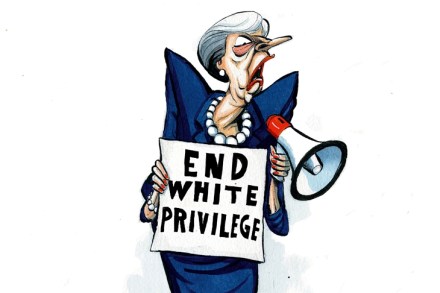
Next month, Theresa May is expected to launch her long-awaited audit into racial disparities in public services. We are being prepared for the worst. Unnamed Whitehall insiders say that they have been ‘shocked’ by the picture it reveals of racial discrimination in the UK. All this suggests the scene is being set for another bout of political self-flagellation regarding the subject of race in Britain, in which half-truths are peddled by lobbyists and swallowed wholesale by officialdom. Several studies have already shown   that some ethnic groups experience different outcomes in policing, health, employment and education. There are many causes behind these disparities but the evidence will be carefully selected to suit a predetermined agenda.

An orchestrated race storm

From our UK edition

A fascinating story has emerged from a north-western leftie quadrant of the United States: the sacking of British conductor Matthew Halls from his post of artistic director of the Oregon Bach Festival, in the college town of Eugene. Mr Halls insists he has not been told why he has been fired. Sponsors and supporters of the festival are also in the dark. Oregon University, which runs the bash, has said only that it intends to pursue a ‘different direction’ to the one pursued by Mr Halls, and hence he has to go. I would have thought there were a limited number of directions one could pursue with a Bach festival, most of them in the general direction of playing some Bach, but there we are. However, a very close friend of Mr Halls’s thinks he knows why he was fired.

Treason – not racism – is the only legitimate reason to pull down a statue

From our UK edition

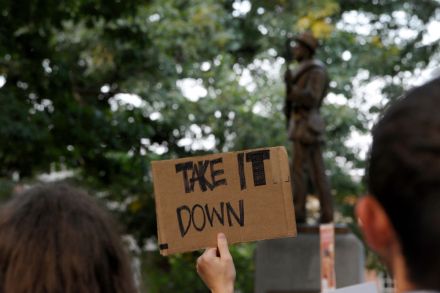
Donald Trump has a point when he asks, with respect to the tearing down of Confederate statues: 'Is it George Washington next? You have to ask yourself, where does it stop?'. The reason he has a point is the rationale being advanced by many advocates for removing such monuments: that the individuals depicted were racist or, in some cases, slaveholders. 'Robert E. Lee and Stonewall Jackson will be removed from the CUNY hall of great Americans because New York stands against racism,' New York Governor Andrew Cuomo tweeted. 'Confederate statues are all about racism,' declares Kevin Drum of Mother Jones. Karen L. Cox, professor of history at the University of North Carolina, insists that, 'The whole point of Confederate monuments is to celebrate white supremacy.

Low life | 31 August 2017

I arrived for lunch a bit late and was led to the dining table. Our hostess disappeared back into the house to bring out the food, leaving me to acquaint myself with the other guests, an Englishwoman and an American. The Englishwoman said that yesterday she had fallen off the wagon after eight weeks and today she was terribly hung over. She didn’t feel guilty, however, because she had enjoyed herself very much. The American man’s eyes were hidden behind sunglasses but he had a warm smile and great teeth and an easy, open manner. He introduced himself by saying that this was his first time in France, and that he was checking out Italy and France as possible places of refuge in the not-so-far-fetched event that he had to flee America. ‘Trump?’ I said.

Letters | 24 August 2017

From our UK edition

In defence of General Lee Sir: In your leader ‘America’s identity crisis’ (19 August) you state that ‘When General Lee emerged as a leader of that rebellion [the secession of the Southern states], we said that he had no cause that stood up to scrutiny.’ The irony is that Lee did not disagree with that view. Unlike Jefferson Davis and other Confederate leaders, he was opposed to secession and believed that the Union should be kept intact. Nor was he an enthusiast for slavery. A slave owner by proxy, he appears to have loathed the experience. In 1856 he wrote to his wife saying that ‘In this enlightened age, there are few I believe, but what will acknowledge, that slavery as an institution, is a moral & political evil in any Country.

Hit and miss | 24 August 2017

From our UK edition

Truman Capote should have been called Truman Persons. His father, Archulus, abbreviated his first name and introduced himself as Arch Persons. ‘And that,’ scoffed his son, ‘sounded like a flock of bishops.’ The young scribbler was thrilled when his divorced mother married a rich Cuban, Joseph Capote, whose zippy and eccentric name he gladly adopted. He got a job at the New Yorker and found the magazine’s celebrated wits, including Dorothy Parker and James Thurber, were embittered molluscs who hated each other. Capote’s literary life, as related by Bob Kingdom, is a parade of inspired bitchiness. He had the knack of getting to a character’s core problem. For Gore Vidal it was the knowledge that he had never written a masterpiece.

Making sense of an unjust world

From our UK edition

These three timely works of creative nonfiction explore the question of race: chronicling histories of colonialism and migration; examining the institutionalisation of prejudice; and charting movements of change and the resistance to change. Maxine Beneba Clarke’s memoir, The Hate Race, tempers a tale of schoolyard trauma with gentle humour; Reni Eddo-Lodge’s debut, Why I’m No Longer Talking to White People About Race, is a broadside, a roar of outrage; while Eula Biss’s elegantly structured essays in Notes from No Man’s Land are delivered with a deceptively quiet insistence that nevertheless leaves the reader shaken. They focus, respectively, on Australia, Britain and the United States.