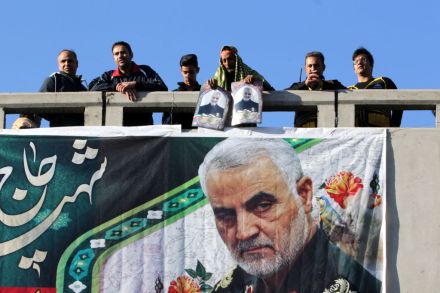
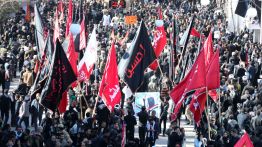
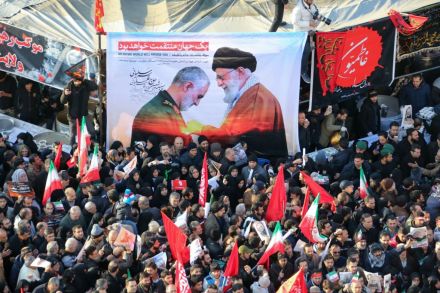
Qasem Soleimani

A superbly written and insightful account of the contemporary American military

Four-star Marine General Kenneth “Frank” McKenzie headed US Central Command — CENTCOM, covering the Middle East — from spring 2019 until spring 2022. It was an eventful, and stressful, three years: taking out long-time Islamic State head Abu Bakr al-Baghdadi in 2019, then notorious Iranian Quds Force commander Qasem Soleimani in early 2020 and overseeing the disastrous final withdrawal from Afghanistan in 2021. Prior to CENTCOM, McKenzie had spent four years in two top-level Joint Chiefs staff posts, and before that he served multiple tours of duty on the ground in Afghanistan. As a younger officer he had been in the Pentagon on September 11, 2001, when American Airlines Flight 77 hit; he was commissioned in the Marine Corps right out of the Citadel in 1979.
McKenzie

What Iran’s attack on Israel means for the Jewish state, America and the region 

Iran’s unprecedented attack on Israel Saturday night represents a dangerous escalation for three reasons. The first is its scale, some 300 drones and missiles. Second, it marks the first time the Islamic Regime has launched a lethal attack on Israeli territory from Iran itself, rather than through proxies. Most important of all is the combination of the first two: a major attack launched against Israel from Iranian territory. Although Israel, the US, the UK and, surprisingly, Jordan managed to shoot down nearly all the incoming drones and missiles, it was the thought that counts. And it was a very dangerous thought. Within hours, the Iranian attack changed the region’s strategic landscape.

israel iran

Iran, a dammed nation

The recent events in Afghanistan have made us think we know what regime collapse looks like. Militias roaming the streets, soldiers scrambling to helicopters, up against the clock to escape the anarchy below. But in some instances, the reality can be far more mundane. Across from Afghanistan’s own border, another Islamic theocracy — Iran — is struggling to manage a dangerous water shortage. As one hardline Muslim regime arose in Central Asia this year, another could yet be at the very beginning of its fall. In July, during the worst drought in half a century and scorching heat of over 120°F, protests erupted in the oil-rich province of Khuzestan as a water crisis that has been slowly bubbling for decades hit boiling point.

dammed water

Back to tit-for-tat in the Middle East

Plus ça change, plus c'est la même chose. President Biden may have promised that ‘America is back’, but the United States’ decades-long shadow war with Iran never left. Last month’s reciprocal strikes in Iraq and Syria, and a further 10 rockets launched at a US base in Anbar Province last week, were notable only for their normalcy. Far from being Biden’s ‘Hour One Crisis’, this kind of geopolitical hair-pulling via high explosives is all too normal in the post-Iraq War, post-Arab Spring hash of the Middle East. Two American contractors and at least one Iraqi Shia militiaman are now dead. More casualties are likely to come in the weeks ahead. This first Biden counter-strike was no more than violent messaging, perhaps primarily to a domestic audience.

iran tit-for-tat

Will coronavirus lead to a US war with Iran?

In a roundabout way, coronavirus may have been responsible for the deaths of two American service personnel and a British soldier in a rocket attack in Iraq on Wednesday. This triggered a prompt US military retaliation — American forces launched strikes at five sites in the early hours of this morning — and the prospect now is of an escalation while the rest of the world is consumed with a global health crisis. What's going on? It was Gen. Qasem Soleimani’s birthday on Wednesday and a Shiite militia — probably Kataib Hezbollah — chose to mark the occasion by firing Katusha rockets at Camp Taji, the US base just north of Baghdad.

war with iran coronavirus

How far will Trump go in Iran?

This article is in The Spectator’s February 2020 US edition. Subscribe here. ‘Get lost ayatollahs!’ ‘Death to Khamenei!’ The bravery of the anti-government demonstrators in Tehran is incredible, each one knowing that their actions could end with a bullet or a noose. I reached one through their favored encrypted app, Telegram, the interview arranged by a leading Iranian opposition group outside the country. ‘Elias’ — not his real name of course — is 25 and a postgraduate politics student in Tehran. The security forces were everywhere, he told me; everyone was very afraid. Still, he went on, ‘There is only one way this ends: toppling the regime.

iran

Shaken Saudis hedge their bets on détente with Iran

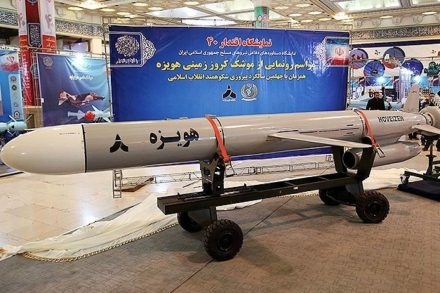
After the assassination of General Qasem Soleimani a month ago, Iran offered Saudi Arabia and its Sunni Gulf allies a stark choice. Stick with your newfound ally Israel and risk having your cities bombed to smithereens in the event of military escalation with the United States, or work on a peace deal with Tehran and stay out of the fray. The Iranians had already proven their ability to launch devastating missile strikes against Saudi Arabia's oil facilities, and the ineffectiveness of the US defensive anti-missile systems supposedly protecting them. Now it is clear that the shaken Saudis have decided to hedge their bets on détente with Iran.

saudis

Donald Trump, president of peace

This article is in The Spectator’s February 2020 US edition. Subscribe here. Groupthink is the last thing a country needs when debating questions of war and peace. But groupthink is what America’s pundits have succumbed to once again. In 2003, voices of opposition to the Iraq War struggled to be heard, with even the progressive cable news channel MSNBC silencing its most outspoken critic (Phil Donahue) and telling a right-wing dissenter from President Bush’s war (Pat Buchanan) that he was expected to represent Republican opinion — which is to say, pro-war opinion. So much for press freedom. Today, groupthink is on the side of peace, or rather on the side of caricaturing President Trump as a warmonger.

peace

You come at the Trump, you best not miss

The third presidential impeachment in US history has now reached the Senate. Like the first two, this one is almost certainly going to lead to presidential acquittal. An old saying given definitive expression by Ralph Waldo Emerson (and recently adapted by The Wire) warns that you should 'never strike a king unless you are sure that you shall kill him'. Congress may not be risking royal reprisal here, but it is teaching all Americans — including all future presidents — a fateful lesson in institutional impotence. After this, who is ever again going to take the threat of impeachment seriously? Congress has called its own bluff.

trump

The ‘Iran Spring’ delusion

What a difference a week makes when it comes to the western media narrative on the Middle East. When countless millions were mourning Gen. Qasem Soleimani in what was possibly the biggest funeral in history, we were told that Iran and its leadership had never been more united. Now, amid smaller protests inside the country against the mistaken downing of a Ukrainian airliner with mostly Iranian students on board, we are told that the Iranian people are rising up en masse to overthrow their hated leaders. Have the famously sophisticated Iranian people really become so absurdly fickle overnight? There is another explanation for the self-contradictory nonsense we are being told. Whatever happens in the Middle East, there is only one constant.

iranian

The Middle East mess has nothing to do with Donald Trump

Last week, like millions of others across the globe, I emerged blinking and stumbling from my fallout bunker to assess the destruction wrought by World War Three. There were a few surprises in store. Nukes had failed to rain from the sky. Critical infrastructure remained intact. Rationing was not yet in force. People still weren’t going to see Cats. World War Three, historians will note, consisted of: an assassination, a poorly organized funeral, the histrionic launching of a few sketchy rockets, an Everest of bad tweets and the downing of a passenger plane. But one thing remained as permanent as the second law of thermodynamics: all of this was Donald Trump’s fault.

middle east messs

Iran must pay the families of flight 752

After the Ukrainian crisis and the Iranian crisis, we now have the Ukrainian-Iranian crisis. For the second time in six months, Ukraine finds itself inexplicably — and inextricably — in the midst of a world-historical crisis that it had no part in crafting. As it was with Trump’s inquiries into Hunter Biden’s business activities, Kyiv is marooned politically and facing difficult and even unpalatable choices between warring opponents, neither of whom it wants to antagonize. The American airstrike that killed Qasem Soleimani had threatened to set off a conflagration which many observers — 99 percent of them never having heard of the most interesting man in the Middle East — histrionically predicted as ‘World War Three’. Blessedly, that did not happen.

flight 752

Eliminating Qasem Soleimani was Donald Trump’s Middle East farewell letter

In July 55 BC, in the midst of his campaigns to civilize Gaul, Julius Caesar was troubled by the Germans. They would cross the Rhine, wreak havoc, and then disappear back across the mighty river, whose depth and swift currents made the Germans regard it as an impregnable barrier. To teach them that it wasn’t, Caesar had his engineers construct a bridge across the Rhine. As Caesar recounts in Book IV of his commentaries on the Gallic War, they did this in an astonishing 10 days. Caesar and his troops crossed over, stayed for a few days in German territory, 'burned all their villages and other buildings, and cut down the grain in their fields'. They then crossed back over and destroyed the bridge.

qasem

Time for Tulsi

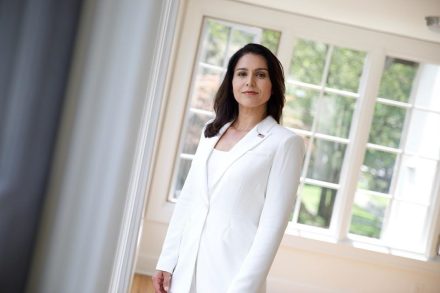
Tulsi Gabbard is looking pretty good right now. I mean, even better than usual. The veteran and Hawaii congresswoman has stood out from the crowded Democratic field with her peacenik foreign policy-focused campaign. And now President Trump, with his impulsive killing of Qasem Soleimani, has become the Big Bad Hawk Gabbard has described him as all along. When she entered the race in February of last year, Gabbard pledged to strike out against the military-industrial complex: 'We must stand up.

tulsi

So much for de-escalation

‘We are not looking to start a war with Iran,’ said defense secretary Mark Esper today. ‘We are looking to finish one.’ Iran just replied by firing off at least a dozen missiles at American targets in Iraq in an effort supposedly dubbed Operation Martyr Soleimani. It doesn’t mean all out war yet — but all the Trump administration’s talk about ‘de-escalating’ the situation sounds like hot air. As I write, the details of Iran’s retaliation are unclear — we don’t know if the strikes were aimed at American troops or infrastructure. Is it a face-saving measure? A decoy? Why did Iran attack Erbil and Al-Asad, rather than more obvious US bases? Have the fortified American defenses at these bases worked?

de-escalation al asad iran

Iran begins its ‘fierce revenge’

Details are still coming in as I write and the facts have not been confirmed, but it seems that ballistic missiles have been fired from inside Iran at US military targets in Iraq. A statement on Iran's official news media said: 'The fierce revenge by the Revolutionary Guards has begun.’ It went on to say that ‘tens’ of ground-to-ground missiles were fired in what the Iranian military is calling ‘Operation Martyr Soleimani’. That is of course a reference to the US assassination of Qasem Soleimani, head of Iran’s Quds Force and the country’s most popular general. ABC News quoted a US official as saying that the facilities hit included a base in Erbil in northern Iraq and Al Asad Air Base in western Iraq.

fierce revenge

Exclusive: the Iranian cultural sites Trump will bomb

Hours after Donald Trump tweeted a threat to target ‘52 Iranian sites’, some of them ‘at a very high level & important to Iran & the Iranian culture’, Cockburn met an Iranian exile source at the Moby Dick House of Kabob, Connecticut Avenue, Washington, DC. The source took Cockburn’s order and then slipped a tiny piece of paper no bigger than a grain of rice into Cockburn’s baghali polo. As baghali polo is a rice dish, Cockburn didn’t know this until he’d eaten it. It took 24 hours to recover the message. When Cockburn read it, he realized that he was holding the president’s target list.The first five targets are listed here.

iranian

The Democratic media hate Trump more than they love Iran — or America

If you need help talking with the children in your life about the aftermath of the ethical collapse of most of the American media, here’s a guide to explaining the topic.I refer, of course, to TIME’s offer of scripts for concerned parents: ‘If you need help talking with the children in your life’ — as opposed to the children you’ve casually seeded in other people’s lives — ‘about the aftermath of Iranian Gen. Qasem Soleimani’s killing.

media iran

Will the Iran-US confrontation spiral out of control? Even the experts don’t know

Politicians and policy experts tell us, with confidence, that America’s targeted killing of Qasem Soleimani makes the world safer — or more dangerous. Take your pick. Whatever answer they give, the talking heads sound very certain. They shouldn’t be. However deep their understanding of Iran, the Middle East, and US foreign policy, nobody really knows what will happen next.The problem is simply too complex. It depends on a sequence of difficult decisions, first by Iran’s Ayatollah Ali Khamenei and then by President Donald Trump, each responding to the other’s choices, each calculating the risks of going too far — or not far enough.The next decision is Tehran’s.

iran
pompeo

Mike Pompeo’s dishonest Iran defense

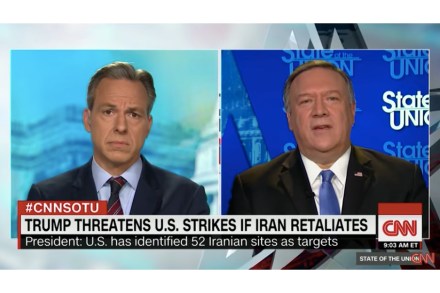
P.G. Wodehouse once described a character as so crooked that he sliced bread with a corkscrew. Secretary of state Mike Pompeo’s behavior on the Sunday morning television shows brings to mind Wodehouse’s description. No, Pompeo wasn’t toting a corkscrew or a loaf of bread, but he offered a study in deceit. Pompeo didn’t merely reiterate the wafer-thin claim that Iran was about to pose an 'imminent' threat to American interests in the Middle East, but also claimed that President Obama and his aides had essentially been in league with the mullahs of Tehran.In responding to Jake Tapper of CNN, Pompeo was unable to explain how blowing Qasem Soleimani to kingdom come would enhance the safety of America.