Police

The Camden solution

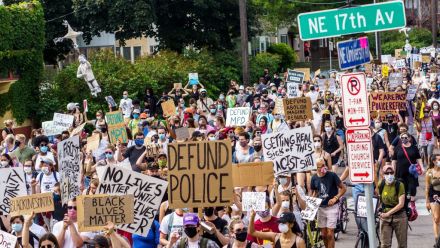
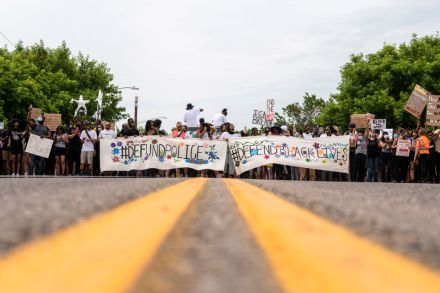
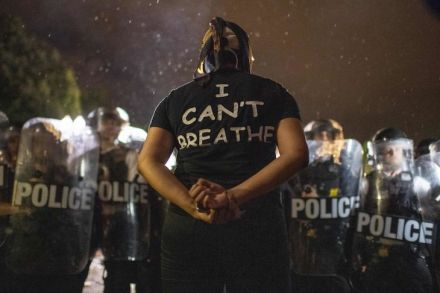
The left is demanding 'defund the police' in the wake of George Floyd’s killing. President Trump’s allies are hunkering down with calls for 'law and order.' Both miss the plot. When pressed, the left really wants a new Great Society. Black Lives Matter co-founder Alicia Garza told NBC's Meet the Press that 'defunding police' is really about 'increased funding for quality of life of communities who are over-policed and over-surveiled.' But the Great Society didn’t work, and a new one would also be ill-fated. For its part, the right fails to acknowledge real problems with our criminal justice system. President Trump addressed some of them in a much-praised federal sentencing reform bill last year.

camden

Abolish the police. Then what?

One of the best rules of thumb to emerge from systems theory is Stafford Beer’s famous statement: the purpose of a system is what it does. It doesn’t matter what the designer intended, or what the individual participants think they’re doing; the end result is all that matters. It’s a useful thing to bear in mind when we consider the objectives of the Black Lives Matter protesters, because right now the movement is beginning to look an awful lot like a machine for the abolition of police departments. It is frankly dizzying how rapidly the aims of the movement seem to have shifted from reform to destruction.

abolish police
imagine

Imagine no police force

Portland, OregonThe one resounding call from Black Lives Matter protesters in the wake of George Floyd’s death has been ‘defund the police’. This is a rallying cry I am 100 percent on board with. In an unprecedented move, Minneapolis City Council has chosen to see sense and formally announced plans to dismantle the Minneapolis Police Department and committed to establishing a new community-led system. This is exciting news, and sets a precedent for this model to be repeated around the world. However, many people (racists) are criticizing this bold strategy of tearing down the fascist state, because they simply cannot imagine their lives without the comforting restrictions living under an oppressive authoritarian regime brings them.

Would Joe Biden defund the police?

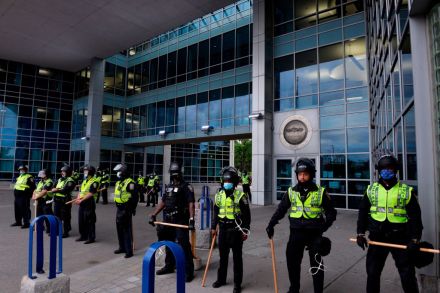
Thanks to the nature of digital media, the last 10 days can be seen in entirely different ways. On one feed rioters turn urban centers into scenes from a Purge movie, indiscriminately attacking people and property, advancing the cause of racial justice by burning down immigrant-run businesses and murdering a retired black police captain. On another feed, it is the cops who are running amok. Festooned with tactical gear and high-tech weaponry (or old-fashioned clubs), the police appear to attack people indiscriminately — from old men to young women out buying groceries to homeless guys in wheelchairs — apparently for the crime of being in their way.

defund police

The roots of riot

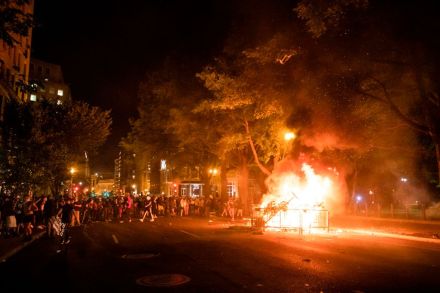
That LEGO set or Louis Vuitton bag you’ve always wanted can be yours free if you just wait for the next black suspect to die in police custody. That’s the lesson so far from the riots in Minneapolis, Portland, Atlanta and elsewhere following the death of George Floyd. Arson and luxury looting are not the most obvious ways of fighting racism or police brutality, but at this point riots are a ritual. ‘Antifa’ means bourgeois bolshevism — college-educated mock revolutionaries performing to a predictable script. This is the most sterile rebellion any country has ever seen. Far from terrifying the establishment, it reflects exactly what is taught in schools and preached over the airwaves and in respectable op-eds.

riot

America’s immune system is failing

From our UK edition

‘This American carnage stops right here and stops right now,’ said President Donald Trump in his inauguration speech on January 20, 2017. Three and a half years later, in the early summer of 2020, a bout of heavy riots has broken out, like a virus spreading, in cities across America. Minneapolis rioted for days on end. Other cities erupted: in Los Angeles, Las Vegas, Phoenix, Houston, Dallas, Atlanta, New York and Washington. A mob now menaces the White House. Maybe that American carnage is just beginning. This latest unrest, coming as it does in the middle of an ongoing global health crisis and a concomitant economic recession, feels more devastating We’ve seen plenty of riots in America in the last few decades.

The curious case of the coronavirus conviction

From our UK edition

Last Saturday, a 41-year-old woman was arrested for what police described as ‘loitering between platforms’ at Newcastle Central station. By Monday, she had been successfully prosecuted – finding herself with a criminal conviction for breaching the newly enacted Coronavirus Act 2020. Days later, the conviction was dropped after police accepted they had misunderstood the law.  Why does all this matter? Well, clearly it’s important when law enforcement misuses some of the most draconian legislation passed in living memory. But the case tells us something else about the state of our criminal justice system. British justice, like the other parts of our constitution, is designed precisely so that failures like this do not occur.

Police must be flexible when enforcing social distancing rules

From our UK edition

One recognises the need for firm rules about social distancing and other measures to control the coronavirus spread; but one should also recognise the need to keep things going. We rightly hail the NHS workers. We should also applaud the tremendously efficient businesses which continue to supply grocers’ shops and pharmacies. Given the difficulties and sudden demands, I am amazed by how well these markets are holding up. What on earth would Covid-19 have been like if it had arrived in pre-internet days? The authorities should themselves recognise difference of circumstances and adjust the rules accordingly as things change over the coming weeks.  Take the construction industry.

Letters: We need career detectives, not fast-tracked officers

From our UK edition

We need career detectives Sir: Your lead article (Trial and error, 29 February) rightly condemns Tom Watson for pressurising police into investigating the spurious allegations of Carl Beech. What should urgently be abandoned is the fast-tracking of police officers into senior positions, and the promotion of uniformed inspectors into detective ranks without them having the necessary experience and training to be effective investigators. It was well known in junior police circles that Operation Midland was a non-runner virtually from the start, but pressure from on high demanded that the investigation continued.

The ‘Westminster paedophile ring’ is a lesson in how not to carry out a police investigation

From our UK edition

A cornerstone of any -functioning democracy is the separation of police and the courts on one hand, and government and parliament on the other. Where the latter are charged with making the law, they should never, ever be allowed to interfere with the enforcement of that law. Politicians have no power to tell the police what to investigate. As Lord Denning once observed, no policeman is subject to orders of the Secretary of State: ‘No minister of the Crown can tell him that he must, or must not, keep observation on this place or that. Or that he must prosecute this man or that one… He is answerable to the law, and to the law alone.’ In Britain, for most of the time, that separation has been respected.

Letters: How to really revitalise the North

From our UK edition

Devolved or decentralised? Sir: Paul Collier (‘Northern lights’, 22 February) conflates what devolution has come to mean, in UK terms, with decentralisation of authority. Thus it is adrift to imply that Edinburgh has benefited from a conscious decentralising of powers from central government. It was simply that Scotland as a whole got devolution and Edinburgh is its capital city, whereby it administers the devolved responsibilities. Until such time as commentators and politicians distinguish properly between devolution and decentralisation, they will continue to prompt fears that England could be balkanised rather than treated as a national entity on a par with Scotland.

Cyclists have become an easy police target

From our UK edition

Most Britons assume at the outset that any misfortune involving a cyclist is the cyclist’s fault. After all, many a two-wheeled hellion has earned contempt. But put aside the understandable cynicism. This is not one of those stories. A week ago, I was cycling around Buckingham Palace while some low-key royal whatnot was pending but not under way. The vicinity was closed to traffic but not to bikes. As usual, I was heading for Hyde Park Corner via Constitution Hill, because the bike path on the right-hand side in Green Park is insensibly ‘shared use’ — meaning, teeming with pedestrians, and I see no point in our inconveniencing one another. As I passed, an officer shouted ‘Cyclist!’ and then barked something I couldn’t make out.

I’ve practically solved the crime myself but still the police won’t help

From our UK edition

‘Thank you for calling Surrey Police. We want to help you with your inquiry as quickly as possible. Did you know you can go online…’ That is probably the most depressing sentence in the English language. It is not only preposterous to suggest crime will be better dealt with by a website, it is insulting. I was ringing 101 to persevere with the police after trying to solve the burglaries in the barn myself, and after almost catching the thieves red-handed. After putting up game cameras, I captured images of them when they came back a second time. But I needed help with the grainy footage, and if the registration could be read, I needed the police to run it, obviously. I can’t search vehicle databases.

The cops are impotent in lawless New York

From our UK edition

New York   Things are heating up, in both London and Nueva York, as this place should correctly be called. Two flunkeys writing in the New York Times announced that Boris is committing gaffes and could, like Trump, be a dead man walking. This is wishful thinking and the premature celebration confirms that the media can no longer be trusted, certainly not here in the land of the depraved. (The flunkeys sought quotes from obscure British left-wing academics, and loftily present them as ‘the people’. Their detachment from the workaday world is hilarious.) In the meantime, here in the Bagel an alleged drug pusher looking at nearly 100 years behind bars is photographed walking free and saluting Governor Cuomo for his bail-reform law.

Priti Patel turns her back on Theresa May’s legacy at the Home Office

From our UK edition

This afternoon's law and order theme to Tory conference did take a bit of a knock when police were called to an altercation involving one of the party's MPs, resulting in the backbencher, Geoffrey Clifton-Brown, being sent home. Not long after this incident, which sent parts of the conference centre into lockdown, Priti Patel walked onto the stage and announced that 'today, here in Manchester, the Conservative party takes its rightful place as the Party of Law and Order in Britain once again'.

Letters: History has not done justice to Neville Chamberlain

From our UK edition

Helping the homeless Sir: The number of rough sleepers in one of the richest countries on the planet is surely a finger of accusation pointed at our generation (‘Wake-up call’, 31 August). Adam Holloway is correct when he says that giving cash directly to those living on the streets often compounds rather than alleviates the problem. Smarter ways should be found to direct compassion effectively, and a new charity, Nextmeal, is attempting to do just this. It uses GPS mapping technology to locate the nearest centre helping the homeless. The database currently details almost 400 such centres across the country, most of which are charities that can dovetail with state services. Thousands of cards have been printed with a link to the website, www.nextmeal.co.uk.

How verbal and physical abuse drove me out of the police

From our UK edition

The past decade has not been kind to those we entrust, in the words of Sir Robert Peel, ‘to give full-time attention to duties which are incumbent on every citizen’. Since 2010, police numbers have fallen by more than 20,000, with too many choosing to leave the force owing to physical and emotional assaults in a stressed and underfunded job. I can sympathise, because I had to step away from the front line and the job I loved three years ago. At the time, friends and family repeatedly asked me why I felt I had to leave. Set against the latest news of escalating assaults on police, I’m not so sure they’d ask now. There were approximately 31,000 assaults on officers last year, an increase of almost 5,000 on the year before.

Locking up bankers won’t solve Britain’s crime epidemic

From our UK edition

On Monday, a 16-year-old boy was stabbed to death in Munster Square in Camden. A Witness reported seeing three men 'screaming and laughing' as they chased him with a machete. The poor kid apparently sought refuge in a house, banging on the door and pleading for help, but his pursuers were close behind him. A couple of days before, across town in Leyton, a police officer had been attacked with a machete after trying to stop a van. PC Stuart Outten was slashed across his head and hand but courageously resisted the attack and survived. In Tottenham, a week before, an 89-year-old woman was reportedly raped and murdered in her home. Of course, unless you live in a small community you will always hear about evil and nauseating crimes.

Is it illegal to mock this drug dealer’s haircut?

From our UK edition

Is it a crime to mock a criminal’s unfortunate hairstyle? Police in South Wales seem to think so. Last week, Gwent Police posted on Facebook calling for any information on the whereabouts of 21-year-old Jermaine Taylor, a convicted drug dealer from Newport who had breached his license conditions. They put up the obligatory mugshot, in which Taylor sports his one-of-a-kind do – completely bald on top, two vertical, wispy columns of hair in the back. Facebook users proceeded to rinse him for all he was worth, with thousands of jokes, memes and puns. ‘Who done his hair? Moses?’, said one user, nodding to Taylor’s Red Sea-style parting. ‘Barber: “What you after bro?” Jermaine: “You know Joleon Lescott?

Letters | 1 August 2019

From our UK edition

Poppycock Sir: Last week’s lead article (‘Boris begins’, 27 July) suggested that if we leave without a deal, ‘the Johnson government will have another huge challenge on its hands — how to avert large-scale economic damage’. I have some experience of the conduct of economic policy, and I hope you will forgive me for saying that this is poppycock. Leaving the EU without a trade deal will cause some short-term disruption, but the essence of good government is to do what is best for the medium and long term, whatever the short-term difficulties. And although the main purpose of Brexit is political — i.e. self-government — the economic consequences will be hugely positive, not least through regaining our regulatory autonomy.