Persia

The Trumpian appeal of a Trojan horse

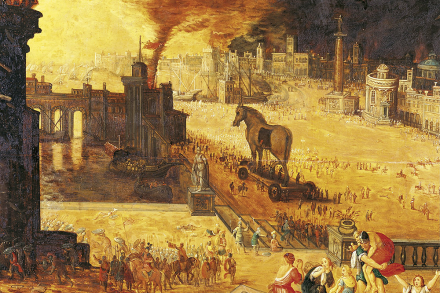
Given the tonnage of missiles launched at Iran, it seems remarkable how relatively few Iranians have been killed. But the Americans have no interest in wasting multimillion dollar ordnance on pain-in-the-ass innocent bystanders. However, Donald Trump is now considering a land invasion. That would have been unwise, as the ancients knew. Knowing all about the problems of land assaults against defended cities, the ancients often preferred to lay siege. That could be a wearisome business and did not necessarily guarantee success. Troy was besieged for ten years, but it took the trick of the wooden horse to take it. So when the Persian king Darius (c.
trojan horse

Greek tips on how to beat Iran

In 500 BC, Persia (modern Iran) was the most powerful state in the known world, ruling an area of more than two million square miles from the Balkans and Egypt to central Asia (nearly half of the world’s population). In 499 BC, Athens and a number of other Greek states rebelled against its empire and incredibly defeated it in the ensuing Persian Wars (390-379 BC). The Greek historian Herodotus (d. c. 425 BC) wrote up those wars after travelling extensively around the whole region. He was as fascinated by different cultures as he was by the war itself, contrasting the Persian way of life with the Greek. For example, he said that Persians did not put up statues or temples or altars, or treat their gods as human in nature, as the Greeks did.

A chat with the Princess of Iran

The Princess of Iran is casual over email. Noor Pahlavi, the 33-year-old eldest daughter of Iran’s Crown Prince in exile, Reza Pahlavi, is American-born, a potential heir to the Iranian throne and ready for regime change in the Middle East. “Hi it’s been a crazy couple of weeks,” she wrote me a few days after the US plopped some 400,000 pounds of bombs on the Islamic Republic’s nuclear sites. That same week, Reza began to appear across Western media, calling for rebellion within Iran and support from without: “This is our Berlin Wall moment.” Reza is the son of the last Shah of Iran. His family has become a symbol of a Persian, pre-Islamist Iran, and Reza casts himself as the transitory figure to lead the country into a more liberal post-regime future.

Conrad Black adheres firmly to the ‘great man’ view of history

From our UK edition

George Orwell has a story that when Sir Walter Raleigh published the first volume of his projected history of the world while in prison, he witnessed a brawl outside his rooms in the Bloody Tower which resulted in the death of a workman. Despite diligent enquiries, Raleigh was unable to discover the cause of the quarrel. Reasoning that if he could not even ascertain the facts behind what he had observed he could hardly accurately report what had happened in distant lands centuries earlier, he burned his notes for the second volume and abandoned the entire project. No such doubts assail the 79-year-old Conrad Black, sometime proprietor of The Spectator, who, like Raleigh, has written the first of a projected three-volume global history.

The empire that sprang from nowhere under the banner of Islam

From our UK edition

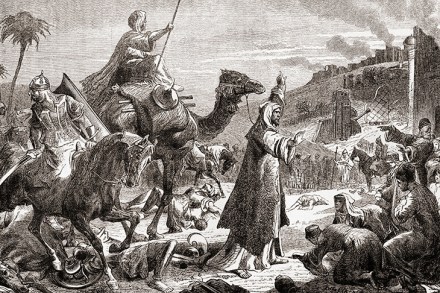
When the British formed the basis of their empire in the 1600s by acquiring territories in India and North America, they already had many centuries’ experience of foreign involvement. One of the most remarkable aspects of the force that reshaped Eurasia 1,000 years earlier is that there was no prelude: the Arab conquests, and the Islamic empire that they created, came out of nowhere. By the time of the death of the Prophet Mohammed in 632 most of the tribes of the Arabian peninsula had united under the banner of Islam, some out of faith, others from expediency. But few people outside Arabia knew who Muslims were or worried about the threat they might pose.