Friends again
From our UK edition
Hat-tip for video: ConservativeHome.
From our UK edition
Hat-tip for video: ConservativeHome.
From our UK edition
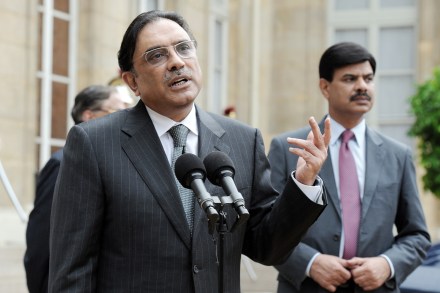
After his stark warning earlier, it's worth remembering that President Zardari can be quite cheerful in person.
From our UK edition
David Cameron isn't the only world leader who can lob rhetorical hand-grenades about the struggle in Afghanistan, you know. Speaking ahead of his visit to the UK, Pakistan's President Zardari has said that the "international community … is in the process of losing the war against the Taliban." Adding that, "And that is, above all, because we have lost the battle for hearts and minds." Given his pivotal, front-seat role in proceedings, it's got to go down as one of the most significant statements on the war so far. Is this intended as a riposte to Cameron's remark about Pakistan and terrorism? I'm not sure.
From our UK edition
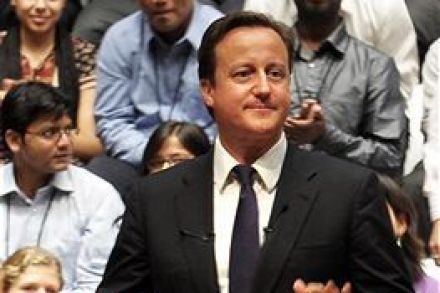
Domestically speaking, it has been an encouraging week from the coalition. Internationally speaking, less so. And today we see the first real rush of fallout from David Cameron’s appearance on the world stage, as the Pakistani intelligence agency cancels a visit to London, “in reaction to the comments made by the British Prime Minister against Pakistan.” It’s not the kind of development that we should exaggerate –after all, it still looks likely that President Zardari will visit Cameron next week, even if officials in Pakistan have been wavering on that front. But we shouldn’t underestimate it either. The main reason to worry is, largely, one of personality.
From our UK edition
So what is Pakistan up to? Cameron has a point: it is playing a dangerous double game which I once outlined in a piece. But in today's Spectator, it is all spelled out by a writer who is - in my view - the best authority on this mess and by some margin. Ahmed Rashid, whose book Descent into Chaos is the definitive work on the Afghan war, explains that Karzai has effectively switched sides - he's given up on Nato (as, it seems, has Cameron) and now wants Pakistan to preside over talks with the Taliban: " A few months ago Hamid Karzai would have been thrilled to have confirmation that American officers are speaking openly about how divisions of Pakistani intelligence are helping the Taleban.
From our UK edition
Oh for the days of inactive prime ministers. After yesterday’s hot-headedness about Gaza, comes an even more deliberately pointed statement. Cameron said: ‘[Pakistan] should not be allowed to promote the export of terror whether to India, whether to Afghanistan or to anywhere else in the world.’ I agree, providing of course it is established that the Pakistani state is fomenting terror and the Wikileaks revelations do not give that impression. That said, the Pakistan government is responsible for all of its agents, and they should curb S-Wing’s collusion with the Taliban and its affiliates in Waziristan. Cameron and Obama are right to press the Pakistani authorities. But a goodwill tour to India is plainly not the stage on which to do it.
From our UK edition
Courtesy of WikiLeaks, the Guardian and The New York Times have obtained classified documents pertaining to the killing of civilians in Afghanistan and the duplicity of Pakistani spies. The White House is furious, condemning the leaks for ‘endangering US and allied servicemen’ on active duty – a statement that seems reasonable until the White House added that the documents pre-dated President Obama’s assumption of office and that they ‘do not reflect current on-ground realities’. But that makes the allegations contained therein irrelevant or dated. Judging by the two newspapers' coverage, the leaks are vague and certainly not novel. It’s obvious that Pakistan is an unwilling ally, and one which has its own ambitions in the region.
From our UK edition
The implosion of General McChrsytal’s career has refocused attention on Afghanistan. Reading Peggy Noonan’s column on the subject I was struck by this paragraph reflecting on Jonathan Alter’s reporting of Obama’s decision making process when he ordered the surge: More crucially, the president asked policy makers, in Mr. Alter's words, "If the Taliban took Kabul and controlled Afghanistan, could it link up with Pakistan's Taliban and threaten command and control of Pakistan's nuclear weapons?" The answer: Quite possibly yes. Mr. Alter: "Early on, the President eliminated withdrawal (from Afghanistan) as an option, in part because of a new classified study on what would happen to Pakistan's nuclear arsenal if the Islamabad government fell to the Taliban.
From our UK edition
The proverbial shoe is dropping. Following General Stanley McChrystal’s forced retirement, a consensus is forming that President Obama's Afghan strategy is not working. The Economist says: ‘Since November, when Mr Obama promised 30,000 more of his country’s soldiers to the campaign, little has gone right. General McChrystal’s plan was for a “surge” that would seize the initiative from the Taliban and create the scope for Afghanistan’s government, backed by its army and police, to take charge. In practice that has not happened.’ In the Financial Times, Ahmed Rashid makes a similar point, arguing that the military strategy in Afghanistan is "failing".
From our UK edition
One of the biggest obstacles for NATO in Afghanistan has been the role of Pakistan and its intelligence apparatus in supporting the Taliban insurgency. Officially, the Pakistani government deny backing the Taliban insurgency, but even Admiral Mike Mullen, chairman of the U.S. Joint Chiefs of Staff, and General David Petraeus, head of U.S. Central Command, have said they suspect Pakistan's Inter-Services Intelligence service of being engaged in anti-NATO activities. Now, a new report by the Harvard-based analyst and former head of OXFAM in Kabul, Matt Waldman, takes the accusations to a new level.
From our UK edition
Richard Holbrooke, the U.S. diplomat in charge of Afghanistan and Pakistan affairs said Washington has now publicly made clear the US government is serious about negotiating with the Taliban. Speaking at a conference in Madrid, the US envoy said: ‘Let me be clear on one thing, everybody understands that this war will not end in a clear-cut military victory. It's not going to end on the deck of a battleship like World War Two, or Dayton, Ohio, like the Bosnian war It's going to have some different ending from that, some form of political settlements are necessary ... you can't have a settlement with al Qaeda, you can't talk to them, you can't negotiate with them, it's out of the question. But it is possible to talk to Taliban leaders.
From our UK edition
In opposition, the Conservatives pursued an AfPak policy that can best be described as loyal criticism - while they supported the mission they criticised the means and methods employed to achieve it. It was an effective line of attack. But now that they have the internal documents and can call for further intelligence assessments, they should instead undertake a zero-based review of the current strategy focusing on: 1) the viability of the current US approach; 2) the likely timing and manner of a US shift; and 3) the best role for the UK in the next six months, in the next 2 years and in the next five years. In this discussion nothing – absolutely nothing – must be off the table.
From our UK edition
The last time I saw Benazir Bhutto was at Oxford, over champagne outside the Examination Schools, when she inquired piercingly of a subfusc linguist, ‘Racine? What is Racine?’ Older and richer than most undergraduates, and as a Harvard graduate presumably better educated, she was already world famous, and was obviously not at Oxford to learn about classical tragedy. The last time I saw Benazir Bhutto was at Oxford, over champagne outside the Examination Schools, when she inquired piercingly of a subfusc linguist, ‘Racine? What is Racine?’ Older and richer than most undergraduates, and as a Harvard graduate presumably better educated, she was already world famous, and was obviously not at Oxford to learn about classical tragedy.
From our UK edition
Yesterday's attempted car-bombing in Times Square doesn't really tell us anything beyond that there are sociapaths willing to blow people up, and that sometimes luck – rather than judgement – foils their bloody plans. But, given the Pakistani Taliban's claim that they were responsible for the attempt, it does serve as a grim reminder of the poison seeping out of that region. The question now, and for the next few months, is whether the West will somehow become more engaged inside Pakistan. It's notable how British ministers have increasingly namechecked the country when justifying our presence in Afghanistan – but, still, it seems that the Taliban and other Islamist groups have strengthened their foothold there.
From our UK edition
"Going Dutch" will take on a whole new meaning now that the collapse of the Dutch government looks set to result in the country's departure from Afghanistan. Withdrawal had been on the cards for at least a year - especially as the coalition Labour party had campaigned to return Dutch troops at the last election. But now the process has gone into overdrive. Militarily, the competent Dutch forces will be sorely missed. They have done a really quite impressive job in Uruzgan province. But the Dutch pullback will be an even bigger problem politically. NATO likes to refer to the dictum it formulated during the Balkan operations - "in together, out together".
From our UK edition
Meanwhile, today's missive from the Party of Torture is written by Dana Perino and Bill Burck, Press Secretary and Special Counsel to George W Bush respectively. The Obama administration is working with Pakistani intelligence to interrogate Mullah Baradar, reportedly the Taliban’s number-two man. We’ve been a little underwhelmed by the Left’s reaction to this news. [...] The Left’s silence on Mullah Baradar is convenient. Gone are the hysterical cries of torture. Missing in action are the opponents of rendition. One searches in vain for impassioned denunciations of Obama’s outsourcing of interrogations to countries with long histories of torture.
From our UK edition
It’s not quite the “we got him” moment, as when US soldiers unearthed the fugitive Iraqi dictator. But the capture of Mullah Abdul Ghani Baradar, a top militant commander who is said to be second in command to elusive Afghan Taliban chief Mullah Mohhamad Omar, may be even more significant. By the time Saddam Hussein had been caught, the US was fighting a different enemy, though the Pentagon leadership had not realised yet. Baradar, who was in charge of the insurgency’s day-to-day operations on behalf of the so-called Quetta Shura, the Taliban’s leadership council, is very much today’s enemy - and his seizure should not be underestimated.
From our UK edition
On Wednesday, Baroness Kinnock told the Lords that a number of Foreign Office departments had been hit been hit by an estimated £110 million budget shortfall, and that an anti-drug program in Kabul has been cut. Coming after British dismay at President Karzai's desire to put Afghanistan's former (and widely-discredited) Interior Minister, Zarar Ahmad Moqbel, in charge of the country's anti-drug effort, the cuts are bound to cause concern. Afghanistan is the world's leading supplier of opiates, trafficked as opium, morphine and heroin. Over 90 percent of the heroin on the UK's streets originates from Afghanistan. Though cuts to counterterrorism programs are probably ill-advised, there is less reason to worry about the impact on any anti-drug efforts.
From our UK edition
Seriousness comes naturally to Gordon Brown and yesterday he gave a speech detailing how Britain is defending itself by striking at the heart of the ‘crucible of terror’. What Brown has in seriousness of delivery, he lacks in realism. Britain has not fought for such a sustained period since the high-water mark of empire; but the ambitions of two prime ministers, and to be fair the severity of the threat that Britain faces, have outstripped resources; Britain is now completely over-extended. Hours after Brown’s speech, Baroness Kinnock divulged that anti-terror measures run by the Foreign Office have been cut – anti-narcotics campaigns in Afghanistan and de-radicalisation programmes in Pakistan.
From our UK edition
An idea that has received little media attention in Britain, but is giving Foreign Office diplomats sleepless nights, is David Miliband’s push for a "regional stabilisation council" involving Pakistan, India and Afghanistan, to be unveiled at the international conference scheduled for January 28. The idea is seen as an innovate way to bring the three countries together, while at the same time allowing the Foreign Secretary, who will formally host the conference, to show leadership and initiative. The pretender to the post-election Labour throne needs something to get rid of his “Banana Boy” epithet. So far, however, the idea is not meeting with local support.