Oysters

Criminal gangs have developed a taste for snails and seafood

It was a dark night in November that the criminals stole softly upon the sleeping snails. They snipped away the fencing, pried open the door with a crowbar and knocked out the security lights. Then, they advanced upon their victims, who were lying, defenseless, in cold storage. No use for the snails to flee; heliciculturists breed them for flavor, not speed. The hapless gastropods could only pull in their horns, make themselves as small as possible inside their shells, and wait. The crooks worked with merciless efficiency. Some 450 kilos of snails soon found themselves shivering in the getaway vehicle as it sped off down a route départementale in northeastern France (where else?

snails

The decadence of seafood towers

Whether or not it is your intention to see and be seen, you cannot avoid the latter when you order a seafood tower. I can say this definitively, having experienced one side more than the other – the mere glimpse of a spire of glistening seafood floating through the brasserie will not only draw the attention of fellow diners, but stir up burning envy in their hearts. The seafood tower takes the experience of eating an oyster and scales it up tenfold into an exercise in excess, sometimes three or more tiers high.

seafood

The oyster is your world

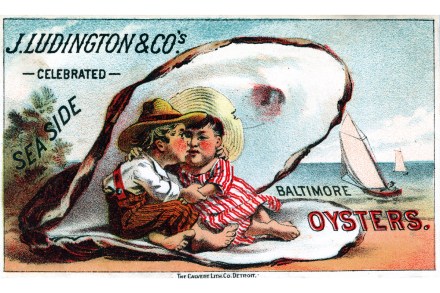
Oysters have recently achieved near-meme status as one of several “pick-me” foods alongside the dirty martini, pickles, tinned fish and other briny staples popularized online by Gen Z. These foods are noted for their slightly polarizing air – expressing a preference for them communicates an evolved palate, a niche preference, a willingness to see past an aesthetically questionable facade (the bumpy pickle, the barnacle-encrusted oyster). However, unlike its fellow “pick-me” travelers or its late, meme-ified millennial predecessor, avocado on toast, the oyster itself cannot be readily dismissed as a passing fad.

oyster

A culinary tour of southern France and northern Spain

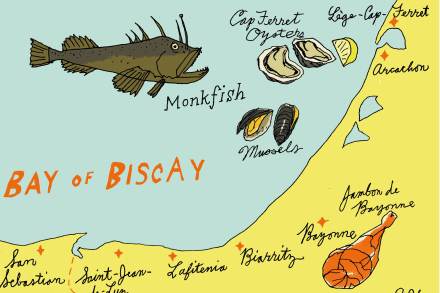
If I’d known what a whole monkfish looks like, I would never have ordered it. It was only weeks later that I saw a picture of the horrid creature: small, wicked eyes, prehistoric head, skin like rusty medieval armor and a gaping mouth overflowing with jagged teeth. Truly the stuff of nightmares. We’d popped over the border from France into San Sebastián, Spain, for a bite of dinner, selecting a spot a stone’s throw from the Baroque exuberance of Santa Maria del Coro. The daily special was monkfish, and for some reason — perhaps an excess of sun that day — the image that came to mind was, inaccurately, that of the innocent red mullet. The daily special in a fishing town is bound to be fresh, so it seemed fair to give it a try.

france